
Reviewed · SARDINIA TOURS
Cagliari Vintage Tour
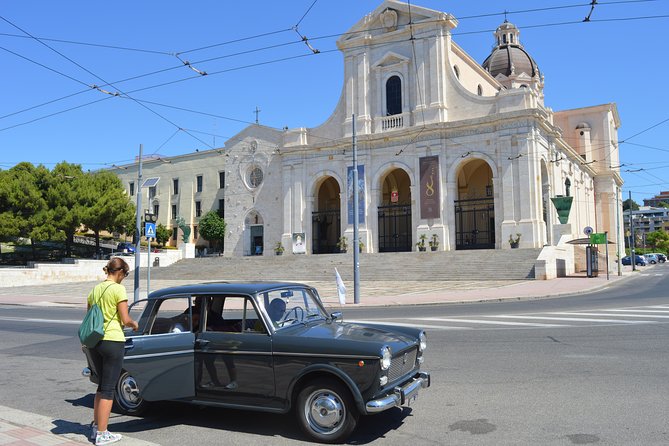
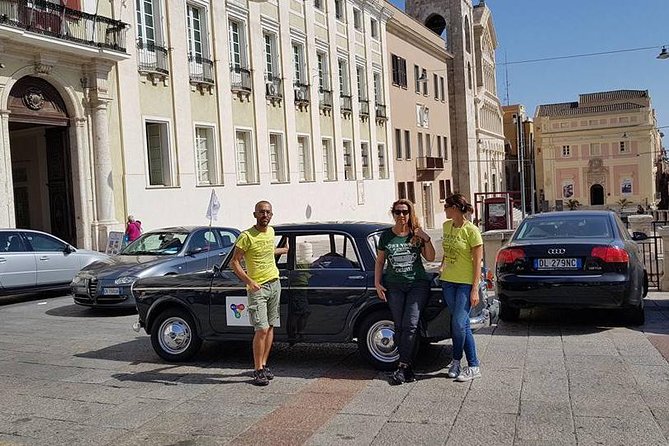
Cagliari reads best from the streets. This 2-hour vintage Fiat tour takes you up and down the city hills while a guide points out the old quarters that shaped Cagliari, from Stampace’s churches to Castello’s medieval gates and hilltop viewpoints.
I especially like the private, small-car format, because it feels far more personal than a bus ride and works perfectly for narrow lanes. I also love that the stops are practical, with plenty of brief photo moments at major landmarks without turning it into a rushed checklist.
One thing to weigh: a few of the sights have admission not included, so your final spend depends on what you choose to enter during the stops.
In This Review
- Key highlights before you go
- Why a vintage Fiat works so well in Cagliari
- Meeting at Carlo Felice and planning pickup
- Centro Storico: the hill-hopping introduction to Cagliari
- Palazzo Civico to Stampace: starting with power and then prayer
- Stampace landmarks you will actually remember
- The Roman Amphitheatre stop, and why it is worth the ticket check
- Castello in 40 minutes: gates, viewpoints, and the medieval core
- Santa Cecilia and Il Ghetto: Cagliari at street level
- Torre dell’Elefante and Bastione di San Remy viewpoints
- Villanova balconies and Bonaria’s sanctuary
- Other stops: San Saturnino and Cagliari’s portico street
- Tickets, entrances, and what might cost extra
- How the 2-hour pace really feels
- Price and value: what you get for $84.69
- Who this tour is best for
- Should you book the Cagliari Vintage Tour?
- FAQ
- How long is the Cagliari Vintage Tour?
- What does the tour cost?
- Is hotel pickup included?
- Where is the meeting point?
- Is this tour private?
- Is the tour offered in English?
- Which stops have free admission, and which might require a ticket?
- What is not included in the price?
- What happens if the weather is poor?
- Is there free cancellation?
Key highlights before you go
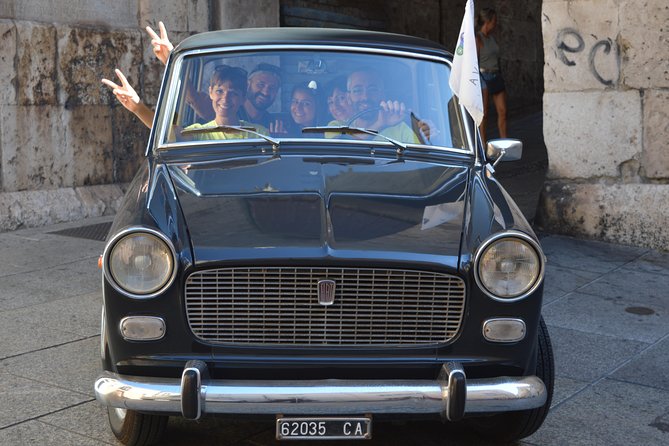
- A classic Fiat for tight streets that buses simply cannot handle the same way
- Old-quarter route through Stampace, Castello, Il Ghetto, and Villanova
- Multiple hilltop views built into the route, not tacked on at the end
- Most monuments are free, with only a handful marked as ticketed
- Guide-led photo opportunities so you do not just pass by scenery at speed
Why a vintage Fiat works so well in Cagliari
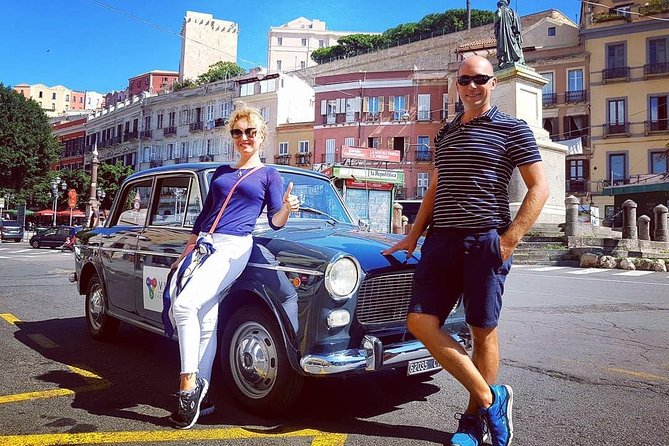
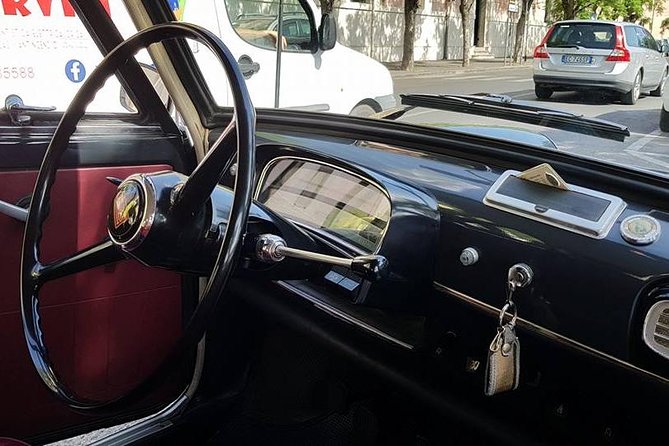
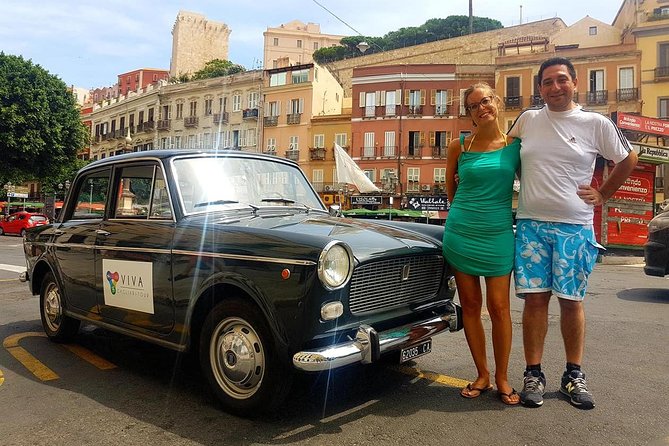
Cagliari is all hills and angles. With the vintage car, you get the sense of moving through neighborhoods rather than parking beside them and hiking blindly uphill. The “old car” factor is also real. People notice it, and that little bit of attention turns ordinary street corners into memorable moments.
You also get a smoother pacing than most city tours. The guide drives you between stops, then gives you short windows to look up close, take pictures, and get your bearings. Even if you are traveling solo or as a couple, the vibe is friendly and direct, not performative.
And since it is set up as a private tour (only your group), you are not stuck with someone slowing everything down or sprinting ahead. That matters in places like Castello where streets tighten and turns get frequent.
Introductions we still owe you around Cagliari

Meeting at Carlo Felice and planning pickup
The tour starts at Carlo Felice (Rinascente), 09124 Cagliari. If you are staying near the center, pickup is offered from hotels in central Cagliari, and you just need to send the hotel name so they can coordinate.
This matters for value. If you are not starting from a distant meeting point, you spend less time transferring and more time sightseeing. The tour is also listed as near public transportation, so even if pickup is not used, getting there is usually straightforward.
You also get a mobile ticket, which is a small but useful convenience when you are bouncing around town quickly.
Centro Storico: the hill-hopping introduction to Cagliari
The tour begins in Centro Storico, and the overall idea is simple: you are not just seeing a few landmarks, you are getting a sense of how Cagliari is layered. The route moves through key quarters and includes scenic viewpoints where the city drops away below you.
Centro Storico also sets the tone for the rest of the day. The guide helps you connect what you see with what it used to mean. For example, you will walk through areas tied to centuries of neighborhood identity, then jump to gates and towers that show how the city guarded access and controlled territory.
Practical tip: wear shoes you can trust on uneven old-stone streets. Most stops are short, but Cagliari can still feel like a mini workout because the terrain is steep.
Palazzo Civico to Stampace: starting with power and then prayer
One early stop is the Palazzo Civico, also known as Palazzo Baccaredda. It covers an entire block and was built in the early 1900s, with tall towers that face the sea. Even if you only get a brief look, it anchors the “modern city meets historic layers” feeling you get throughout Cagliari.
Then you head into Stampace, a neighborhood closely associated with the churches often grouped as the seven-churches area. Stampace is full of small shrines tucked into corners, so the best way to experience it is slowly, looking up and around while you walk a little at each stop.
Also on the Cagliari guest list:
- Cagliari: Walking Tour of the Old City
★ 4.8 · 560 reviews - Cagliari: Boat Tour, 4 Stops, Swim, Snorkeling, & 1 Spritz
★ 4.8 · 539 reviews - Cagliari: Zodiac Boat Tour, 3-4 SwimStops, Wine & Snorkeling
★ 4.9 · 500 reviews - Cagliari: Conti Vecchi Salt Flats Train and Tour
★ 4.5 · 484 reviews
Stampace landmarks you will actually remember

The tour highlights a few key Stampace landmarks that help you understand why this area mattered.
- Chiesa di San Michele is described as the city’s most important example of Baroque architecture, and it sits at the center of Stampace. This is one of those churches where the outside is already a clue, but the real effect is in how it frames the neighborhood around it.
- Torre dello Sperone is the only remaining tower from the fortifications that once encircled Stampace. Seeing a surviving edge of the old defensive system makes the neighborhood feel less like a postcard and more like a place built to protect people.
- A parish church appears next, dominated by a stairway. This kind of setting, church up above, gives you that instant vertical Cagliari feeling.
Time at each of these is brief, roughly 10 minutes each for several stops. That is long enough to take in the main features, but short enough that you are not stuck on a single viewpoint while the rest of the city passes by. If you want deeper time inside any building, you will likely need to plan that separately.
The Roman Amphitheatre stop, and why it is worth the ticket check
Next up is the Roman Amphitheatre of Cagliari, positioned on the edge of ancient Roman Karalis. Even without stepping inside for a longer visit, it helps your brain “place” Cagliari in a much older timeline than most visitors expect.
Admission is not included for this stop, so you should treat it as a decision point. If you are curious about Roman Cagliari, it can be a good place to pay for entry. If you prefer to save money and keep the pacing, a quick look from the outside still gives you the context you need.
Either way, this is a smart stop because it links the ancient world to the medieval and modern layers you are seeing elsewhere.
Castello in 40 minutes: gates, viewpoints, and the medieval core
One of the biggest chunks of time comes at Quartiere Castello, which is listed as 40 minutes. Castello is described as the historic district par excellence of the city, and in practice that means you get lots of major monuments close enough that the guide can connect them without long transfers.
Two highlights here are Porta Cristina and Tower of San Pancrazio.
- Porta Cristina is an ancient medieval gate later dedicated to Maria Cristina di Borbone, wife of Carlo Felice. It is still an evocative entrance to the medieval quarter, so it works like a dramatic door into a different era.
- Tower of San Pancrazio is the ancient north gate point of Castel di Castro and is tied to controlling territory. Admission is not included for this one, so again it is a “pay or pause” decision.
This is also where you start to feel the advantage of the small car. Castello’s streets can be narrow, and you do not want to be stuck negotiating them on foot for long stretches.
Santa Cecilia and Il Ghetto: Cagliari at street level
At Cattedrale di Santa Cecilia, you see a Romanesque cathedral placed in Piazza Palazzo, with Palazzo Viceregio, Palazzo Arcivescovile, and the ancient town hall nearby. The guide’s angle here is the cathedral’s curious history, which helps explain why this area feels like a civic hub rather than only a religious one.
Then the tour shifts to Il Ghetto at Bastione di Santa Croce. This stop focuses on the story of the Jews who lived among those streets and built their synagogue there. You get a sense of how neighborhoods carried culture and community, not just buildings.
If you care about seeing how cities treat history at the human scale, this pair of stops is a strong one. Churches and towers explain architecture, but these streets explain people.
Torre dell’Elefante and Bastione di San Remy viewpoints
Next you reach Torre dell’Elefante, described as the most picturesque entrance to the medieval fortress, symbolized by the baby elephant of Cagliari. Admission is not included, so you may choose to focus on the outside view and the symbolic details rather than paying to go in.
Then there is Bastion Saint Remy, built to connect historic districts, with a terrace view that is described as breathtaking. The timing here is short, about 10 minutes, but it is the kind of stop that changes how you see the city on the drive afterward. You stop, look, and suddenly the neighborhoods make sense as blocks on a hillside rather than separate “things to see.”
This is one of the places where the car tour format helps. You get the vista first, then you can connect it to what you just learned about the medieval layout.
Villanova balconies and Bonaria’s sanctuary
The tour moves to Villanova, known for its flower district reputation and the story of about 1,000 colorful balconies. It is also tied to Holy Week traditions, and the guide explains the origins behind the neighborhood’s colorful identity.
Villanova is listed for about 20 minutes, which is longer than several other stops. That extra time matters because balcony districts are hard to “get” in 10 minutes. You need at least a small window to look down the street, notice patterns, and take a few photos that do not all look identical.
After that comes Santuario e Basilica di Bonaria. This is described as a sanctuary and basilica in the same place, with a strong bond to a distant country and a city that takes its name from this place. It is a good emotional change from the tight medieval streets. The religious setting gives the tour a broader spiritual context, not only defensive history and civic landmarks.
Other stops: San Saturnino and Cagliari’s portico street
Another religious landmark is Basilica di San Saturnino, listed as one of the most ancient sanctuaries on the island, with a controversial and thousand-year history. Admission is not included for this stop. If you like long timelines and church history, you may want to pay to go in, but if not, the exterior stop still gives you the “this place goes back” feeling.
Finally, the tour ends with a look at one of Cagliari’s main streets, described as the living room of the city, with a portico and a series of Art Nouveau buildings. This final shift is smart because it pulls you out of only medieval and ancient imagery. Cagliari is also a modern city with style, and the Art Nouveau touches can be a nice contrast after the stone towers and churches.
Tickets, entrances, and what might cost extra
You should expect that most stops include free admission, but a few do not. Based on the tour details, the stops marked with admission not included include:
- Roman Amphitheatre of Cagliari
- Tower of San Pancrazio
- Torre dell’Elefante
- Basilica di San Saturnino
So your experience can stay close to the tour price if you stick to the free-access moments. If you choose to enter every ticketed site, budget a bit extra. The key is to treat those not-included stops as optional decisions made on the spot.
Also note that no food and drink are included. If you are doing this during a busy day, plan for a snack stop before or after the tour.
How the 2-hour pace really feels
A schedule like this can be either exhausting or energizing, depending on how it is run. Here, it is designed as many short stops, mostly around 10 minutes, with a couple of longer segments like the 40 minutes in Castello and 20 minutes in Villanova.
The vintage car helps because you are not walking between every highlight. You do get brief strolling and quick looking, but not long transfers on foot. Still, you will be on uneven surfaces and taking in a lot of details fast, so I recommend keeping your expectations realistic: this is an introduction with great photo angles, not a museum day.
Weather matters. This experience is listed as requiring good weather, which makes sense in a street-based car route with outdoor viewpoint moments.
Price and value: what you get for $84.69
At $84.69 per person for about 2 hours, the value comes from three things working together: private transportation, pickup (if available), and a professional guide, plus early booking.
The big practical win is that you are getting coverage of multiple neighborhoods in a short time. Many first-timers to Cagliari spend a day bouncing between places on their own. Paying for a guided route compresses that work, and you spend your energy looking instead of navigating.
Also, many stops are listed as free admission. That makes the cost feel less like “paying for access everywhere” and more like paying for the storytelling and route design that connects it all.
Group discounts are mentioned too, which can make it even better if you have a small group traveling together and want the private-car experience without paying solo rates.
Who this tour is best for
This is a great fit if you want:
- A first-time orientation to Cagliari’s main historic districts
- A more human-sized experience than big buses
- Photo opportunities without the stress of planning every stop
- A guide who can explain what you are seeing in plain language while you move through the city
It is also well-suited for couples and solo travelers. The private nature helps everyone feel comfortable, and the vintage car is the kind of detail that makes the whole day feel special without needing a big budget for a fancy dinner plan.
If you are traveling with mobility limits, the tour is likely still doable because you are not walking the city end to end. But the city streets are steep and old, so you should consider whether short uphill walks to viewpoints will work for you.
Should you book the Cagliari Vintage Tour?
Yes, if you want a smart, fast intro to Cagliari that balances major landmarks with neighborhoods that feel lived-in. The route hits the essentials: Stampace’s church focus, Castello’s medieval core, Il Ghetto’s street-level story, plus Villanova balconies and the Bonaria sanctuary. Add in the vintage Fiat experience, and you get something you will actually remember when you think back on Sardinia.
I would only hesitate if you dislike ticketed stops and want everything included, or if you prefer long indoor visits instead of short, well-chosen moments. If that sounds like you, do this tour first for context, then return later on your own to the places you want to spend more time.
Book this one when you want the city to make sense quickly, with a guide and a classic car doing the heavy lifting.
FAQ
How long is the Cagliari Vintage Tour?
It lasts about 2 hours.
What does the tour cost?
The price is $84.69 per person.
Is hotel pickup included?
Yes, pickup is offered from hotels in the center of Cagliari. If you want pickup, you send the name of your hotel.
Where is the meeting point?
The tour meets at Carlo Felice (Rinascente), 09124 Cagliari.
Is this tour private?
Yes. It is private, meaning only your group participates.
Is the tour offered in English?
Yes, the tour is offered in English.
Which stops have free admission, and which might require a ticket?
Many stops are listed as free admission, but some are marked as admission not included, including the Roman Amphitheatre of Cagliari, Tower of San Pancrazio, Torre dell’Elefante, and Basilica di San Saturnino.
What is not included in the price?
Gratuities and food and drink are not included.
What happens if the weather is poor?
The experience requires good weather. If it is canceled due to poor weather, you will be offered a different date or a full refund.
Is there free cancellation?
Yes, there is free cancellation up to 24 hours in advance for a full refund.
Just introduced: the newest Cagliari write-ups
- Cagliari: Quad Adventure Experience from Chia★ 4.9 · 187 reviews
- Cagliari: Old Town Guided E-Bike Tour★ 4.9 · 189 reviews
- Cagliari: Coastline Cruise with Drinks and Snorkeling★ 4.7 · 201 reviews
- Cagliari: Boat Tour with Snorkeling, GoPro & Sardinian Beer★ 4.7 · 207 reviews
- Catamaran tour stops bathing and snorkeling toast with prosecco★ 5.0 · 214 reviews
- Small-Group Food and Wine Tour from Cagliari★ 5.0 · 237 reviews
- Cagliari: 2-Hour Guided E-Bike Tour with Coffee★ 4.7 · 240 reviews
Sardinia Tours, compared.


Golfo Aranci: Eco-Friendly Dolphin Watching Boat Trip
Read our review →
La Maddalena Archipelago Full-Day Trip by Boat
Read our review →
From Palau: La Maddalena Islands Full-Day Trip by Boat
Read our review →
From Palau: La Maddalena Archipelago Day Tour by Boat
Read our review →
From Cala Gonone: Gulf of Orosei Cruise to Cala Goloritzè
Read our review →
Golfo Aranci: Kayak Tour with Dolphins and Aperitif
Read our review →Browse the lists this tour appears in