Reviewed · ROME TOURS
Rome: The Original Fiat 500 Self-Drive Tour
Want Rome with a side of nostalgia? This Fiat 500 self-drive tour turns classic Cinquecento handling into a fast, fun way to see Rome, with built-in chances for photo stops. You’ll roll through quieter roads, pop up at major sights, and also catch smaller, more local-feeling places you’d skip on foot. One key consideration: the cars are manual, so you should feel comfortable with stick shift before you go.
You start in central Rome at Palazzo Manfredi (Via Labicana, 125), then follow your guide’s car in a small group. I especially like the mix of “big names” and off-the-main-street moments, plus the included coffee break (one espresso or cappuccino) and free phone photo shooting. If you’re hoping for effortless, automatic driving in modern traffic, this is not that kind of tour.
In This Review
- Key points before you drive the 500
- Meeting Palazzo Manfredi and starting your Cinquecento day
- Why this drive tour is a smart way to see Rome fast
- Passing the headline sights, without the bus congestion
- Terme di Caracalla, Rome’s mega-baths stop (and why it’s worth it)
- Buco della Serratura and the keyhole view mission
- Circus Maximus: chariot-race echoes in a modern setting
- Janiculum terrace at Piazzale Giuseppe Garibaldi, big-city views included
- Porta San Paolo and the weirdly specific Egyptian pyramid clue
- Via Galvani and the hill of broken vases
- Trastevere from behind the wheel, narrow-street magic
- Porta San Sebastiano and the quiet feel of Rome’s edges
- What’s included, what costs extra, and why the price can make sense
- Driving in Rome in a manual Fiat 500: what to plan for
- Who this tour is best for (and who should skip it)
- Should you book the Rome 500 Self-Drive Tour?
Key points before you drive the 500
- Small-group feel (up to 10 people) with cars split as needed, so you can actually keep track of what’s happening.
- Manual Fiat 500, not automatic, so stick-shift skill matters, and the driver must have the right license/permit.
- Stops built for photos and short walks, including keyhole-view spots and classic Roman ruins.
- Guide-led rhythm, with the caravan format helping you navigate narrow streets and traffic flow.
- Coffee and/or tea included (one espresso or cappuccino), plus a free photo shoot using your own phone/camera.
- Comfort limits for the tiny car, with height and weight limits that you should check ahead of time.
Meeting Palazzo Manfredi and starting your Cinquecento day
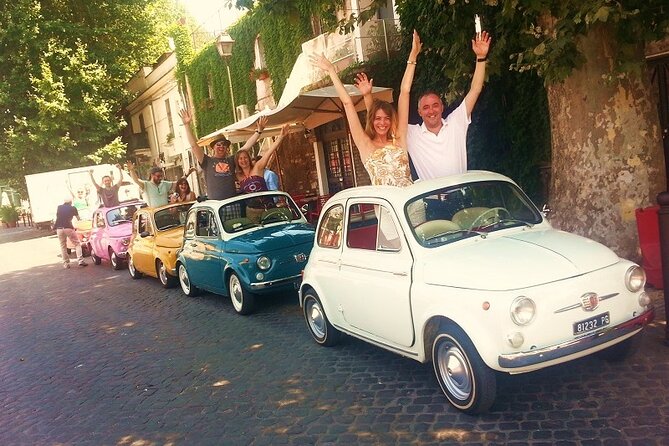
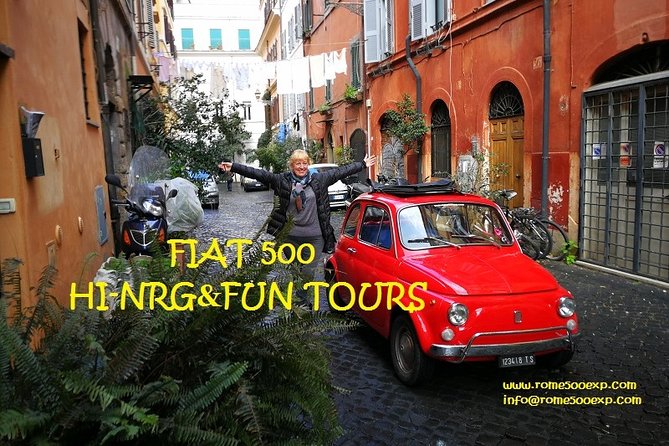
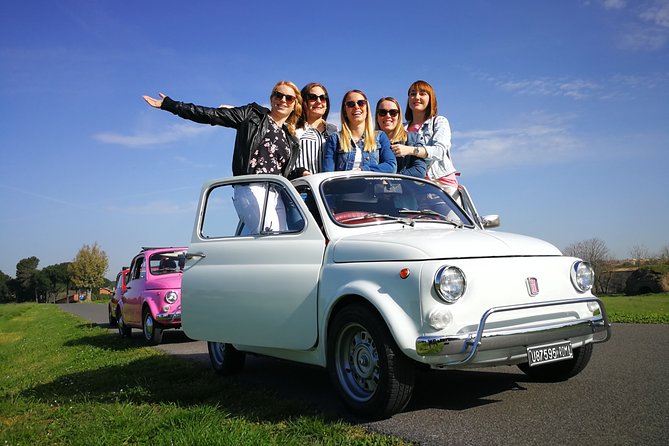
The tour starts back at Palazzo Manfredi, Via Labicana 125, 00184 Rome, in central Rome. You’ll meet your guide there and get paired with a vintage candy-colored Fiat 500, often called a Cinquecento. Then comes a quick safety briefing and a rundown of the manual controls.
This is one of those tours where the setup matters. If you’ve driven a manual car before, you’ll feel more confident right away. If you haven’t, you’ll want to treat the first few minutes as practice time, not a race.
The drive itself is in a small convoy. The guide leads, and you follow along quieter roads when possible, which is a smart way to keep you from getting lost in Rome’s traffic maze. If your group is larger, you’ll be split into separate Fiats.
Introductions we still owe you around Rome

Why this drive tour is a smart way to see Rome fast
A 3-hour car tour can feel like a blur, but this one is designed to slow down at the right moments. You get repeated short stops where you can get out, look around briefly, and grab pictures without turning the day into a long walking tour.
I like how the route mixes headline sights with “wait, how do I find this?” stops. On one side you have major Roman icons that most first-timers want. On the other side you get places where a bigger bus or taxi might not be practical, which is exactly where the Fiat 500 feels like the perfect tool.
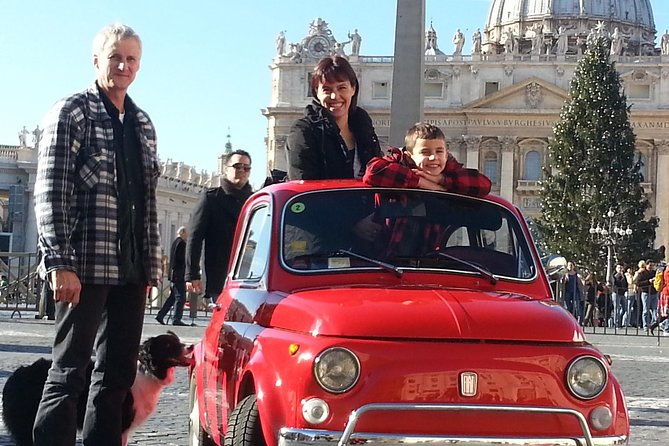
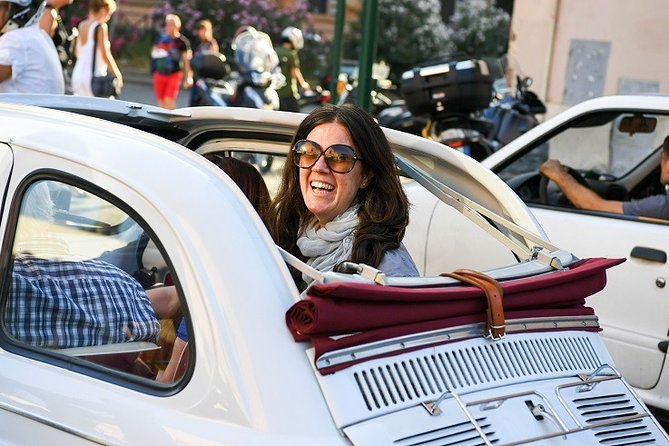
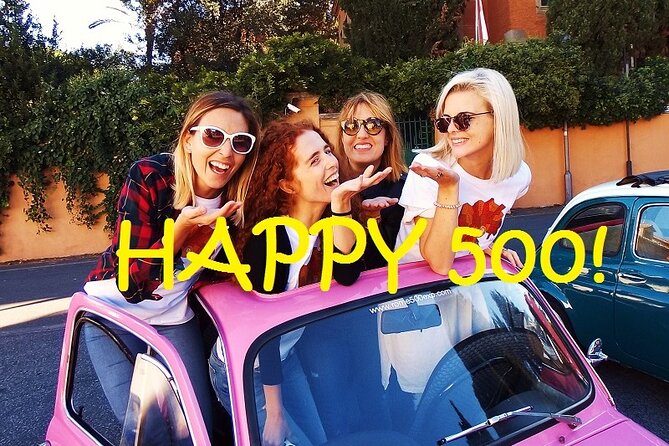
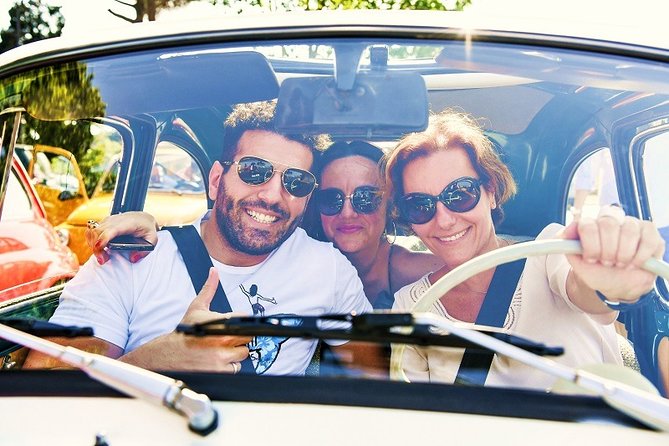
And yes, you’ll look like you stepped into an Italian movie. People often pause for photos as you pass by, which is part of the fun and part of why this tour is memorable for many couples and car lovers.
Passing the headline sights, without the bus congestion
Even early on, the tour aims to get you a difference perspective on Rome from a classic car. You’re set up to see major landmarks along the way, including the Colosseum, Circus Maximus, the Arch of Constantine, and even the Mouth of Truth as part of the big-picture highlights.
The value here is timing. Instead of picking just one or two sights and spending the rest of the day negotiating transport, you get a concentrated route that gives you multiple “I know this place” moments in one morning or afternoon.
There’s also something psychologically calming about the caravan system. The guide keeps you together, and the group format reduces the mental load of figuring out where to go next. You can focus on the sights, not on constant map-checking.
Terme di Caracalla, Rome’s mega-baths stop (and why it’s worth it)
One of the first substantial stops is Terme di Caracalla. This is ancient Rome’s bath complex, described as huge, big enough to compare to roughly 15 football pitches, and functioning as one of the largest health and social centers of its time.
What makes this stop special is scale. When you stand among the ruins, you get the sense of Rome as a full-on everyday city, not just a collection of monuments. And because it’s a classic ruin site, the photo opportunities feel natural, not forced.
You’ll have about 10 minutes, and that’s enough for a focused look, quick photos, and a couple of guide facts before you’re back in the cars. If you’re the kind of traveler who enjoys a “short but meaningful” stop, this works well.
Also on the Rome guest list:
- Vatican Museums, Sistine Chapel & St Peter’s Basilica Guided Tour
★ 4.5 · 39,149 reviews - Rome: Colosseum, Palatine Hill and Roman Forum Guided Tour
★ 4.8 · 32,814 reviews - Rome: Guided Tour of Colosseum, Roman Forum & Palatine Hill
★ 4.7 · 27,897 reviews - Rome: Colosseum & Forum with Audio Guide App -Optional Arena
★ 4.2 · 24,770 reviews
Buco della Serratura and the keyhole view mission
Next you hit Buco della Serratura, the famous “keyhole” sight often tied to dramatic views framed in architecture. You’ll peer through the opening and see three countries lined up through the keyhole, which is a surprisingly distinctive Roman gimmick that still feels clever, not cheesy.
Then the tour also includes Parco Savello, another keyhole-related stop with a similar view concept and 20 minutes to take it in. Together, these stops are a good example of how the tour earns its time. You get a very specific, photo-friendly moment that’s unlikely to happen by accident during a normal sightseeing walk.
The tradeoff is that keyhole-style views can be crowded depending on the day. Your time window is limited, so go straight for the viewing spot, and keep your camera ready. This is one of those moments where being efficient makes the experience better.
Circus Maximus: chariot-race echoes in a modern setting
Circo Massimo is a standout for anyone who likes imagining what Rome felt like at peak energy. The tour stop here focuses on the scale and excitement of the arena, described as big enough for roughly 250,000 spectators in the days of chariot racing.
Today, parts of the area can be used for concerts, so the space has layers. That contrast is the point. You’re not only looking at ancient ruins, you’re looking at a venue that still holds cultural weight.
You’ll spend about 20 minutes here, which is perfect for a guided context plus a few minutes of wandering and framing your photos. If you like history but don’t want to spend all day in museums, this kind of stop hits the sweet spot.
Janiculum terrace at Piazzale Giuseppe Garibaldi, big-city views included
Then you roll to Piazzale Giuseppe Garibaldi, also called the Janiculum terrace. This is the “look back across Rome” moment. The perspective is the whole reward, with views described that include the Colosseum, Pantheon, Altare della Patria, and lots of dome tops.
This is a great stop for orientation. If Rome feels confusing on day one, a high viewpoint can reset your mental map fast. You start seeing how the city’s landmarks line up, and it makes the next day’s walking easier.
The time here is about 20 minutes, so you’ll want to pick your angle early, then let the view work for you. If you enjoy photography, this is one of the most satisfying photo windows on the route.
Porta San Paolo and the weirdly specific Egyptian pyramid clue
The tour moves to Porta San Paolo, and the hook here is genuinely unusual: a nearby ancient Egyptian pyramid associated with Rome. You’re told it’s the 4th biggest Egyptian pyramid in Rome, built around 18 BCE, connected to the tomb of Gaius Cestius.
This kind of stop is why a drive tour can beat a standard checklist. It’s not just another place with columns. It’s an oddball detail that makes Rome feel surprising even when you’re seeing the expected big sights.
You’ll have about 20 minutes, enough for a look, a few guide notes, and some photos without rushing. If you like quirky context, this one pays off.
Via Galvani and the hill of broken vases
Next up is Via Galvani, tied to the story of a hill made from broken pottery. The tour description explains that Romans created an artificial hill using pieces of vessels used to transport olive oil, fish sauce, and wine. Over time, what sounded like industrial waste became a large hill, estimated around 40 meters high with a circumference of 700 meters, connected to terracottas from about 50 million vases.
That number is what makes it memorable. You’ll hear it, see the area, and suddenly the city feels like a living record of real daily life, even when it’s ancient.
With 20 minutes, this works best if you stay curious and ask yourself, what did that place do in its time? The guide framing helps, and you’ll end up with a more vivid mental image than a standard photo stop.
Trastevere from behind the wheel, narrow-street magic
Then comes Trastevere, often the neighborhood that people keep talking about because it feels different from central Rome. Here, you get that “whizzing through tiny streets” feeling in your Fiat 500, something that bigger cars and tours often can’t pull off.
The best part is the perspective. From inside a small classic car, you feel the street scale. You also get those quick street-level moments where locals and passersby look, wave, or pause to film or photograph the convoy rolling by.
You’ll spend about 20 minutes in Trastevere, long enough for a short loop and a few photos. It’s also a nice emotional break, shifting from ruins and terraces to the day-to-day Rome vibe.
Porta San Sebastiano and the quiet feel of Rome’s edges
Finally, you head to Porta San Sebastiano. The tour gives it a 20-minute stop, and the value is more atmospheric than instructional in the description. You’re looking at a different side of Rome, one that feels more like city edges and historic routes than postcard centerlines.
Even without long explanations, this is a useful closing stop. After you’ve spent time on terraces and grand ruins, it’s satisfying to end near a Roman gate and feel how the city boundaries used to work.
What’s included, what costs extra, and why the price can make sense
The price is $211.72 per person for about 3 hours. That sounds like a lot until you break down what you’re actually paying for: a professional guide, use of a vintage Fiat 500, and a free photo shoot using your own phone or camera, plus an included espresso or cappuccino (one per participant).
You’re also paying for convenience. Hotel pickup and drop-off are not included, so you’ll meet at Palazzo Manfredi. But once you’re there, the driving, the stops, and the guide guidance are handled.
Food and drinks are not included beyond the one coffee or tea. The tour description says you might stop for gelato or coffee, but that part is own expense. Think of it like: you’re buying the ride and the guided moments, not a full meal plan.
One more practical consideration from the experience write-ups: insurance expectations. One traveler notes being asked for an additional €25 for full cover right before starting. I can’t promise that will happen on your day, but it’s smart to ask what coverage is included when you arrive, and whether any upgrade may be offered.
Driving in Rome in a manual Fiat 500: what to plan for
This is not a tour for passengers who want to sit back with no responsibilities. The tour uses manual stick/clutch, so the driver must have experience and the company can refuse a rental if you don’t.
You also must have the right credentials: the driver needs a valid European Union driving license or an International Driving Permit. The driver has a minimum age of 18. Children have a minimum age of 5, as stated.
Car size matters too. Because the Fiat is tiny, booking allows a maximum of three adults per car or two adults and two children. There are also limits for height and weight: not suitable if you weigh over 220 pounds (100 kg) or are taller than 6.2 feet (1.9 meters). If you’re near either limit, check carefully before you book, because comfort in this car is the difference between fun and frustration.
Finally, wear closed-toe shoes only. That sounds minor, but you’ll be climbing in and out of the little car repeatedly, and Rome cobblestones do not forgive flip-flops.
Who this tour is best for (and who should skip it)
You’ll love this if you fit at least one of these boxes:
- You want to see several major sights in a short window without spending the day on buses.
- You enjoy classic cars and want the experience of driving a vintage Fiat 500, not just riding.
- You like photo-friendly stops and short viewpoint moments, not long museum marathons.
- You’re confident with manual driving, or you have a driver in your group who is.
You might want to skip it if:
- You cannot drive a manual and you don’t have anyone in your group who can.
- You’re over the weight or height limits.
- You want fully automatic, low-effort sightseeing.
And if you are traveling with mixed comfort levels, the group-splitting into separate Fiats can be a good solution. Just confirm your car assignments and who will be driving.
Should you book the Rome 500 Self-Drive Tour?
Book it if you want a memorable, motion-based way to see Rome, and you’re comfortable with the reality of manual driving in narrow streets. The best part is the combination: you get big landmarks, keyhole viewpoints, classic ruins, and neighborhoods like Trastevere, all in one short, guided loop.
Skip it if manual driving or comfort in a tiny car sounds like stress. Also, ask about insurance coverage when you show up, since one account mentioned an extra charge for fuller coverage.
If your goal is to leave Rome with a bunch of photos, a strong mental map, and a fun story about driving a Cinquecento through the city streets, this is a solid pick.
Just introduced: the newest Rome write-ups
- Excavation Tour to the Tomb of St. Peter’s & St. Peter’s Basilica★ 4.0 · 183 reviews
- Imperial Rome and External Colosseum Tour★ 5.0 · 183 reviews
- Rome: Rooftop Cooking Class with Wine Tasting near Vatican★ 5.0 · 184 reviews
- Rome to Civitavecchia Cruise Port Transfer★ 5.0 · 184 reviews
- Ancient Rome and Colosseum Private Tour with Underground Chambers and Arena★ 4.5 · 184 reviews
- Rome: Vatican Museums & Sistine Chapel Skip-the-Line Ticket★ 4.1 · 185 reviews
- Borghese Gallery Max 6 People Tour: Baroque & Renaissance in Rome★ 5.0 · 185 reviews
Rome Tours, compared.
Vatican: Museums & Sistine Chapel Entrance Ticket
Read our review →
Vatican Museums & Sistine Chapel Tour with Optional Basilica
Read our review →
Colosseum, Roman Forum & Palatine Guided Tour
Read our review →
Vatican Museums, Sistine Chapel & St Peter’s Basilica Guided Tour
Read our review →
Colosseum, Palatine Hill and Roman Forum Guided Tour
Read our review →
Guided Tour of Colosseum, Roman Forum & Palatine Hill
Read our review →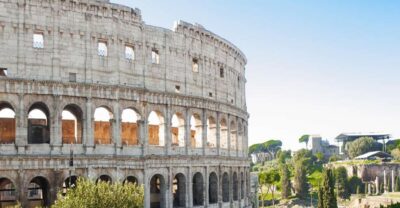
Colosseum & Forum with Audio Guide App -Optional Arena
Read our review →