Reviewed · ROME TOURS
Taste of Testaccio: Special 15 Year Anniversary Edition
Testaccio tastes like Rome, not like a postcard. This 3.5-hour food walk sends you through the neighborhood locals actually use, mixing tastings with side sights like the city’s Egyptian-style pyramid, plus a quick stop for old-school sweets and drinks. I like that it feels hands-on at the market, not just a lineup of bites.
One more thing I love is the way the tour teaches you how to order and recognize classics, from real gelato to Roman pasta logic. A possible drawback to know up front: it is not suitable for severe or life-threatening food allergies, and you’ll be doing quite a bit of walking in Rome weather.
In This Review
- Key highlights worth waking up for
- Why Testaccio is the Rome I keep recommending
- The practical plan: what happens from meet to finish
- Salumeria Volpetti: cured meats, 150 cheeses, and the Prosecco toast
- Piramide Cestia: Rome’s 2,000-year-old Egyptian-style pyramid
- Testaccio Market: your bruschetta-making moment
- The old slaughterhouse and the idea behind quinto quarto
- The amphora hill: a giant mound made from ancient olive jar fragments
- Roman street specialties: suppli and Trapizzino
- Flavio al Velavevodetto: carbonara, amatriciana, cacio e pepe, plus wine
- Giolitti: old-school gelato and how to spot the real thing
- The included menu: what you get for your money
- Price and value: is $131.81 worth it?
- Who this tour suits best, and who might want to pass
- A quick strategy to get the most out of your day
- Should you book Taste of Testaccio for your Rome trip?
- FAQ
- What is the duration of the Taste of Testaccio tour?
- Where does the tour start and end?
- What food is included?
- Is this tour suitable for dietary restrictions?
- What language is the guide?
- Can I cancel for a refund?
Key highlights worth waking up for
- Testaccio Market bruschetta practice with fresh tomatoes from vendors
- Supplì and Trapizzino street-food style comfort, Roman version of a snack meal
- A real 2,000-year-old pyramid (Piramide Cestia) inside the city
- Five senses cheese stop at Salumeria Volpetti, including an olive oil and balsamic tasting
- Old-school gelato education so you can spot the real stuff vs. the fake
- Small group cap (12 people), which makes questions easy
Why Testaccio is the Rome I keep recommending
Most first-time visitors see Rome from a narrow track. This tour flips that by putting you in Testaccio, a historic working neighborhood where food culture is more normal than staged. Instead of racing between landmarks, you get a slow, tasty education on how Romans eat day to day.
The pacing matters. With a duration of about 3 hours 30 minutes and a maximum group size of 12, you can actually hear the guide, ask questions, and pause at shops without feeling herded. The route also ends close to where you start, so you are not stranded across town after your last gelato.
And yes, there are famous sights in Rome, but this one throws in a fun oddball: the Piramide Cestia, an Egyptian-style pyramid in the middle of the city. If you like Rome for its surprises, you’ll enjoy how the food route braids in history that most visitors never see.
Introductions we still owe you around Rome



The practical plan: what happens from meet to finish
You meet at Piazza Testaccio, 39 and finish at Via Amerigo Vespucci, 35, just a couple blocks from the start. Expect a walking tour format, so wear shoes you trust. Bring a bit of water or at least be ready to stop for it, especially on hot days.
This tour is built around “eat, then understand.” Each stop gives you something to taste, then your guide connects it to Roman food habits, ingredients, and a bit of lesser-known neighborhood history. The guide is English-speaking, and you can also request dietary accommodations (like vegetarian or gluten-free) when booking, though severe allergies are a no-go.
Stops and timing are part of the value here. Salumeria Volpetti is the longer early stop (about 40 minutes), then you get the pyramid (about 15 minutes), and the market is the hands-on center (about 45 minutes). After that, you move through Roman pasta and gelato, with the tour ending while you still feel pleasantly full, not painfully stuffed.
Salumeria Volpetti: cured meats, 150 cheeses, and the Prosecco toast
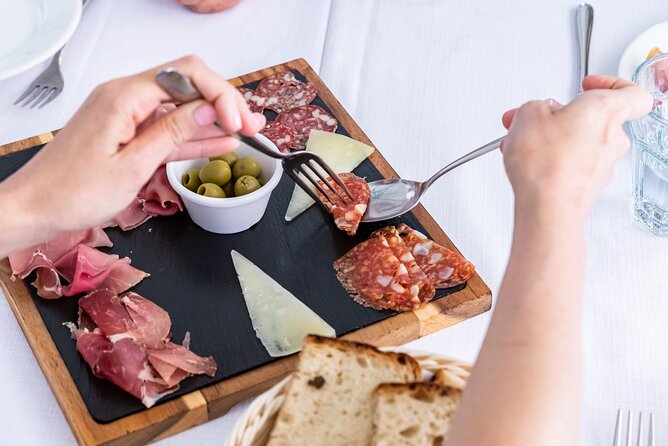
Your tour often starts with Salumeria Volpetti, a cheese and cured-meat institution. You’ll get welcomed with a selection of fine charcuterie and artisanal cheeses, plus a small tasting lesson using olive oil and balsamic vinegar. That pairing is more than flavor, it teaches you why Roman cured meats work so well with simple, sharp components.
Volpetti is also where the tour quietly sets expectations for quality. You’re not chasing mass-market snacks. You’re tasting things that look like they belong behind a glass counter for a reason.
A celebratory toast with a glass of crisp Prosecco shows up here too, which is a nice rhythm shift early in the walk. It turns the first stop into more of a welcome meal than a rushed sample station.
Piramide Cestia: Rome’s 2,000-year-old Egyptian-style pyramid
Then you get the oddball moment that makes this tour memorable. The Piramide Cestia is an ancient Egyptian-style pyramid structure, roughly 2,000 years old, and it sits in the heart of Rome in a way that feels almost impossible at first glance.
This stop is short (around 15 minutes), but it’s the kind of thing that improves how you see the neighborhood as you walk. It is not only a visual twist. It reminds you that Rome has always been good at borrowing and remixing, then planting those stories into everyday streets.
If you like small, specific sights over big crowds, this is the kind of inclusion you’ll appreciate. Most food tours stick to eating and maybe one quick photo moment. Here, they give you a real “wait, what is that?” landmark.
Also on the Rome guest list:
- Vatican Museums, Sistine Chapel & St Peter’s Basilica Guided Tour
★ 4.5 · 39,149 reviews - Rome: Colosseum, Palatine Hill and Roman Forum Guided Tour
★ 4.8 · 32,814 reviews - Rome: Guided Tour of Colosseum, Roman Forum & Palatine Hill
★ 4.7 · 27,897 reviews - Rome: Colosseum & Forum with Audio Guide App -Optional Arena
★ 4.2 · 24,770 reviews
Testaccio Market: your bruschetta-making moment
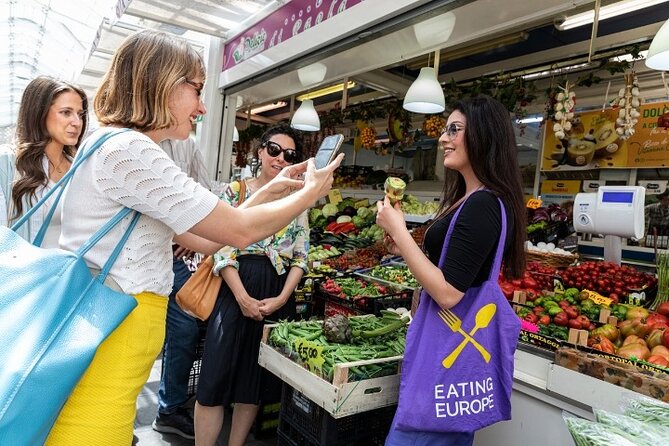
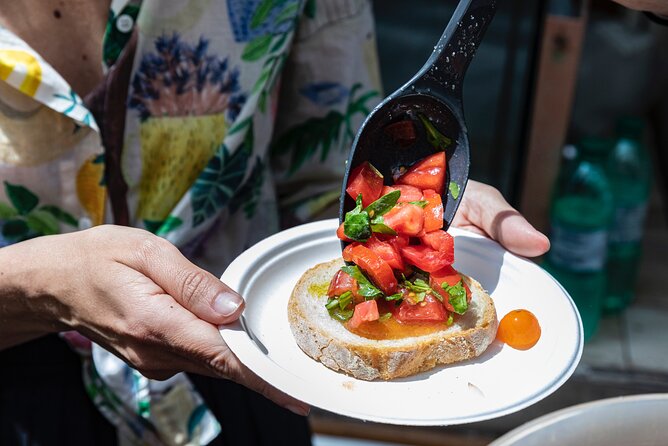
The center of the tour is Testaccio Market, where you get hands-on. You’ll help make your own bruschetta using fresh tomatoes sourced from market vendors. This is one of the most practical parts of the experience, because it trains your eye for what good tomatoes look like and how simple ingredients become something you want to eat slowly.
After the bruschetta, the market section continues with classic Roman street food. Expect samples like buffalo mozzarella (a highlight), plus items like fried specialties and a caprese salad built around that mozzarella. If you’ve ever eaten caprese and wondered why some versions taste like “wow” and others taste like “salad,” this is where the difference is explained through actual ingredients.
The best part for value is that you are not just paying for food. You’re paying for a guided food context. You learn what to ask for, how to recognize quality, and how Roman market shopping works as a social event, not a chore.
The old slaughterhouse and the idea behind quinto quarto
Testaccio also has a story that runs through Roman cooking: using what is available and turning it into something worth eating. The tour includes a stop at the complex that served as Rome’s former city slaughterhouse, the historic culinary heart of Testaccio.
Here you’ll learn about quinto quarto cuisine. Even if you don’t memorize the full definition, you’ll get the concept: Roman cooking historically leaned into parts of the animal that others overlooked. That mindset matters because it explains why Roman menus are so satisfying and why trattorias value technique over fancy ingredient marketing.
This part of the walk also helps you connect food to place. When you know the neighborhood was built around meat production and trade, dishes start to make more sense. You’re not just eating pastas. You’re tasting the logic of a district.
The amphora hill: a giant mound made from ancient olive jar fragments
Another “only-in-Rome” stop comes next: a man-made hill built from fragments of millions of ancient Roman olive oil jars, or amphorae. This is one of those archaeological moments that feels like the city left you a clue.
You only get a brief look, but the payoff is understanding the scale of the Roman economy. Olive oil mattered, and the empire’s appetite left physical evidence under the streets. Even with limited time, that context can make the neighborhood walk feel bigger than it looks.
If you want history that does not drag, this kind of inclusion works well. It stays short enough to keep the tour moving, but it gives you something concrete to remember beyond the food counters.
Roman street specialties: suppli and Trapizzino
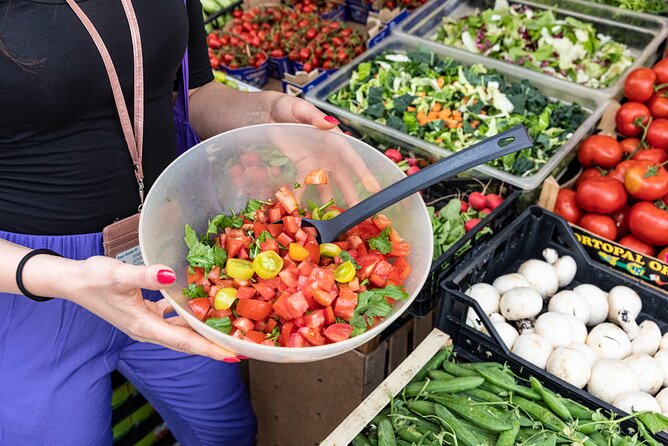
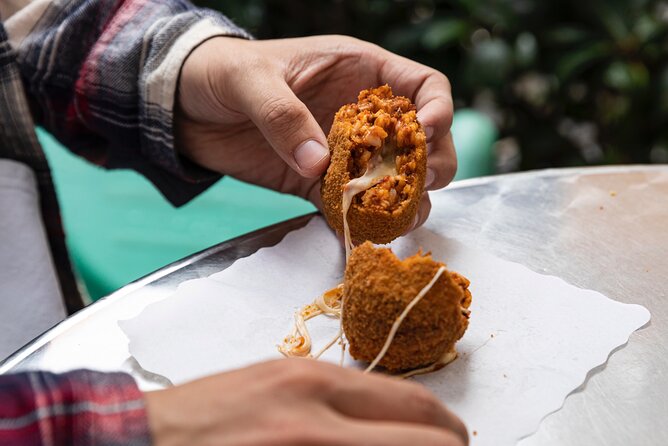
After the sights, the tour turns back to eating with supplì and Trapizzino. Supplì is a local fried rice ball, and this is one of those foods you eat slowly because it’s hot, crunchy, and messy in a satisfying way. It also explains how Roman street food can be both simple and very specific.
Then comes Trapizzino, a take on a sandwich that is built like a street snack but filled with comfort-food flavors. You’ll get the hunter style chicken version, which fits the Roman habit of making hearty food portable.
These stops are valuable because they give you Roman street food you often won’t find the same way outside the city. You’ll get the feel of local eating rhythms, where food is not only for sit-down dinners.
Flavio al Velavevodetto: carbonara, amatriciana, cacio e pepe, plus wine
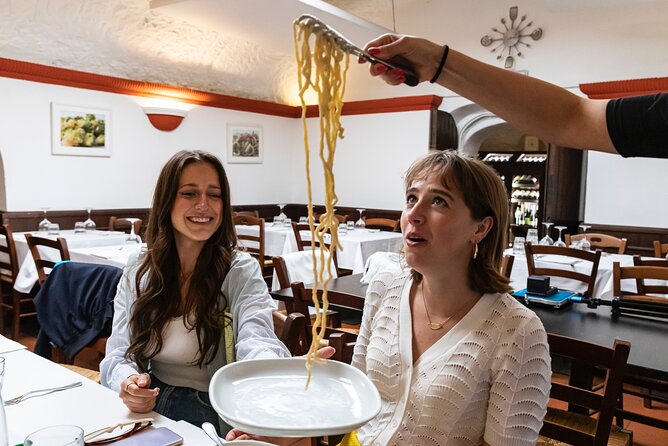
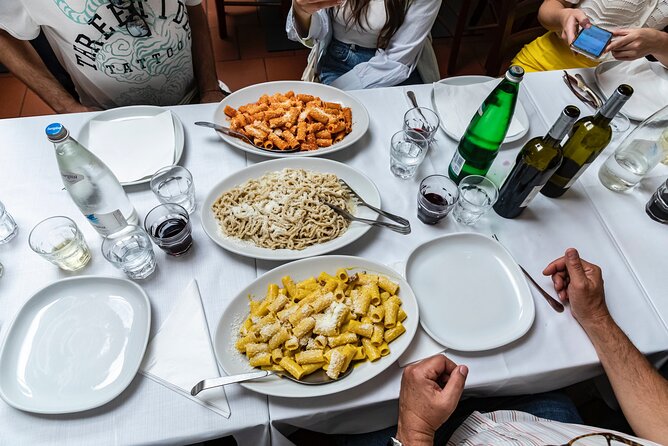
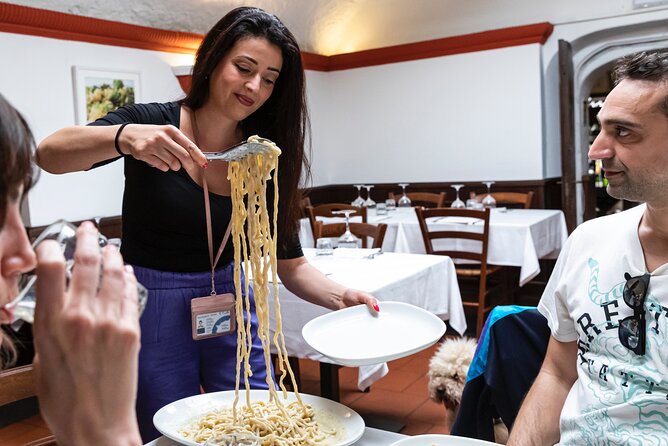
This is where the tour turns into a proper Roman pasta lesson. At Flavio al Velavevodetto, you’ll taste three iconic pastas: carbonara, amaticiana, and cacio e pepe. Each is distinct, so you can compare texture and seasoning instead of just eating “more pasta.”
Carbonara is creamy and egg-forward, amatriciana is built around tomato and salty depth, and cacio e pepe is all about cheese and pepper discipline. Your guide ties these together with why Romans treat sauces like the real main event, not background flavor.
You also get local wine paired with the pastas. That pairing matters for value because it helps you understand how Romans balance richness with something acidic or refreshing. It is not only a drink add-on. It becomes part of how you learn the flavor system.
Giolitti: old-school gelato and how to spot the real thing
To finish, the tour heads to Giolitti, a gelateria that has been making artisan gelato for more than 100 years. This is a classic way to end a food walk, because gelato is lighter than a final pastry course, but it still feels celebratory.
What makes this stop more than a sweet stop is the education. You’ll learn how to spot authentic gelato, which is useful back home and even useful while you stay in Rome. The guide will point out what to look for, so you can make better choices later at other shops.
Because the tour is about tasting and learning, you end with something that lets you practice recognition, not just consumption. Save room. People consistently say that the last stop is the best kind of finish, meaning you should plan to go hungry enough to enjoy it.
The included menu: what you get for your money
The tour is priced at $131.81 per person, and the value is in how many different categories you cover in one go. You are not only eating carbs. You sample cheese and cured meats, market food and bruschetta, fried street bites like supplì, hearty pasta with wine, and artisan gelato.
What you can expect to be included along the way:
- Charcuterie and DOCG wines at the start
- Bruschetta and caprese salad with buffalo mozzarella at the market
- Supplì with local beer
- Trapizzino, hunter style chicken
- Three pastas: carbonara, amatriciana, cacio e pepe, plus local wine
- Espresso and a typical Italian pastry
- A gelato tasting that includes how to identify real gelato
Even the drink bits add value because they’re tied to the food stops, not random add-ons. Prosecco at the cheese start, wine with pasta, and local beer with fried bites keeps the day feeling like a real meal arc.
Price and value: is $131.81 worth it?
For Rome, $131.81 for a 3.5-hour food walk can be a fair deal, mainly because the tour is doing three things at once: feeding you multiple full-flavor tastings, guiding you through a real neighborhood, and adding special sights you would not naturally include.
You also get a small group size with a maximum of 12 travelers, and you get an English-speaking guide. That matters because quality guides help you understand what you’re eating, which is where the money really turns into a better trip.
Booked around 62 days in advance on average, this is the kind of tour people plan ahead for. If you can lock your date, you’ll avoid the common problem of last-minute “we only have loud, packed tours left” decisions.
Who this tour suits best, and who might want to pass
This is a great match if you want real Roman food culture in a neighborhood setting. If you love markets, pasta variety, and street snacks, you will probably have fun. I also think it’s ideal if you enjoy off-the-beaten-path stops like the pyramid and the amphora hill, because you get that mix without a long bus ride.
It may be less ideal if:
- You have severe or life-threatening food allergies, since the tour cannot safely accommodate those risks
- You hate walking tours or you need a very sedentary itinerary
- You don’t eat much street food, because the tour includes fried and handheld bites
For families, the tour is mostly open to most travelers. Children under 4 join without a ticket, but food is not included for children 3 and under. Paid tickets with food included are available for ages 4 and up.
A quick strategy to get the most out of your day
Go in hungry, but don’t try to win a food contest. The tour includes multiple substantial tastings, and the final gelato is best when you’re not stuffed.
Keep your questions simple:
- Ask what to order next in that same place
- Ask what ingredient makes the difference between similar dishes
- Ask how to spot authentic gelato, then try it again later in Rome
Also, dress for comfort. You’ll be moving between shops and outdoors sights, including the pyramid area. Good shoes make the whole day feel easier.
Should you book Taste of Testaccio for your Rome trip?
I’d book it if your Rome trip needs one thing: a food-forward neighborhood experience that also teaches you how Romans think about ingredients. The mix of market learning, Roman pasta sampling, and specific local landmarks like Piramide Cestia is a strong combo for the time you spend.
I’d skip it if you cannot manage the walking pace or if food allergies are a serious issue. In that case, you’d be better off finding a tour designed for your needs.
If you want a practical shortcut to understanding Testaccio, this “15 Year Anniversary Edition” style tour makes sense. It’s structured enough to feel easy, but it still gives you plenty of local-style eating and real sights you can’t easily copy on your own.
FAQ
What is the duration of the Taste of Testaccio tour?
The tour lasts about 3 hours 30 minutes.
Where does the tour start and end?
It starts at Piazza Testaccio, 39, 00153 Roma RM, Italy and ends at Via Amerigo Vespucci, 35, 00153 Roma RM, Italy, just a couple of blocks from the starting point.
What food is included?
The tour includes tastings such as cured meats and cheeses, DOCG wines, bruschetta, caprese salad with buffalo mozzarella, supplì with local beer, Trapizzino, three Roman pastas (carbonara, amatriciana, cacio e pepe) with local wine, and espresso plus a typical Italian pastry. Gelato is also included.
Is this tour suitable for dietary restrictions?
You can email or add a note at booking for accommodations like vegetarian or gluten-free. However, the tour is not suitable for those with severe or life-threatening food allergies.
What language is the guide?
The tour is offered in English with a local English-speaking guide.
Can I cancel for a refund?
Yes. You can cancel up to 24 hours in advance for a full refund.
Just introduced: the newest Rome write-ups
- Rome Fiumicino Airport Transfer in Luxury Private Transportation★ 4.5 · 339 reviews
- Vatican: Pope Francis Tomb and Papal Basilicas Tour★ 4.7 · 340 reviews
- From Rome: Sorrento, Positano & Amalfi Coast Day Trip★ 4.5 · 340 reviews
- Rome: Guided Colosseum Underground Tour★ 4.8 · 342 reviews
- Colosseum Arena Floor, Roman Forum & Palatine Hill Guided Group Tour★ 5.0 · 343 reviews
- Rome: Small Group Rome’s Dark Side – Ghosts & Legends Tour★ 4.9 · 343 reviews
- Rome: City Highlights Electric Bike Tour★ 4.9 · 343 reviews
Rome Tours, compared.
Vatican: Museums & Sistine Chapel Entrance Ticket
Read our review →
Vatican Museums & Sistine Chapel Tour with Optional Basilica
Read our review →
Colosseum, Roman Forum & Palatine Guided Tour
Read our review →
Vatican Museums, Sistine Chapel & St Peter’s Basilica Guided Tour
Read our review →
Colosseum, Palatine Hill and Roman Forum Guided Tour
Read our review →
Guided Tour of Colosseum, Roman Forum & Palatine Hill
Read our review →
Colosseum & Forum with Audio Guide App -Optional Arena
Read our review →