Reviewed · ROME TOURS
The Treasures of Rome
Rome gets fast when someone plans it. In three hours, you get a guided sweep of central Rome, stopping for real time at the Pantheon and the Piazza Navona before you finish near St. Peter’s Square.
My main takeaway is simple: this tour can feel like a walking morning, with cobblestones and plenty of moving around, and the church dress code is strictly enforced.
In This Review
- Fast hits before you go
- Why this 3-hour Rome morning tour works
- Starting point in Rome, and the Piazza Barberini warm-up
- Trevi Fountain: how to enjoy it in only 20 minutes
- Pantheon: the stop many people talk about later
- Piazza Navona: baroque squares in a short walk
- Riding toward Vatican City, then ending at St. Peter’s Square
- Walking comfort, uneven streets, and the dress code you must plan for
- Value check: what you get for $49.26 in about 3 hours
- Guide quality can make or break your morning
- Who should book this Rome morning tour
- Should you book The Treasures of Rome?
- FAQ
- How long is The Treasures of Rome tour?
- What time does the tour start?
- What sights are included during the tour?
- Is lunch included?
- Is St. Peter’s Basilica interior included?
- What is the dress code for churches?
- Is the tour only in English?
- How many people are in the group?
- Can I cancel for a full refund?
Fast hits before you go
- Small-group size (max 20) keeps the pace friendly and questions easier to answer.
- Air-conditioned vehicle for transfers helps when Rome heat hits.
- Pantheon time is real, not just a photo stop, and it connects to famous tombs inside.
- Piazza Navona gets you Bernini fountain design and baroque square energy in one tidy block.
- Ends at St. Peter’s Square, so you can stay longer at your own pace after the tour.
Why this 3-hour Rome morning tour works
If you’re trying to hit the big classics without turning your day into a giant routing puzzle, this format makes sense. You start in central Rome, cover the Centro Storico on foot and by short rides, then finish on the Vatican side at St. Peter’s Square.
The best part of a morning tour like this is the energy. Early on, the lanes still feel like a neighborhood. You get to see the landmarks with enough time to actually look around, then you’re released with a clear path for what to do next. End your tour at St. Peter’s Square, and you can choose your own pace for the rest of Vatican area sightseeing.
One more practical perk: the group size tops out at 20. In Rome, that matters. Big groups can turn every stop into a waiting game. Smaller groups usually mean you spend more time at the sight and less time herding.
Introductions we still owe you around Rome

Starting point in Rome, and the Piazza Barberini warm-up
The tour begins at Via Giovanni Amendola 32 (00185 Roma) and starts at 9:00 am. You’ll meet your local guide in central Rome, near public transportation, which helps if you’re coming from a hotel not within easy walking range.
Before the headline sights, you get a short introduction around Piazza Barberini. This is not just a “pretty square.” You’ll see Bernini’s Triton Fountain, made of travertine and commissioned by Pope Urban VIII Barberini. It’s a great warm-up because it shows how baroque Rome thinks, not just what it looks like. Pay attention to the details in the fountain, including the Barberini coats of arms between the dolphins.
There’s also the Fountain of the Bees near Via Veneto, another Barberini symbol. This kind of quick context is what makes the later stops click, because you start recognizing recurring families, patrons, and symbols across the city.
Trevi Fountain: how to enjoy it in only 20 minutes
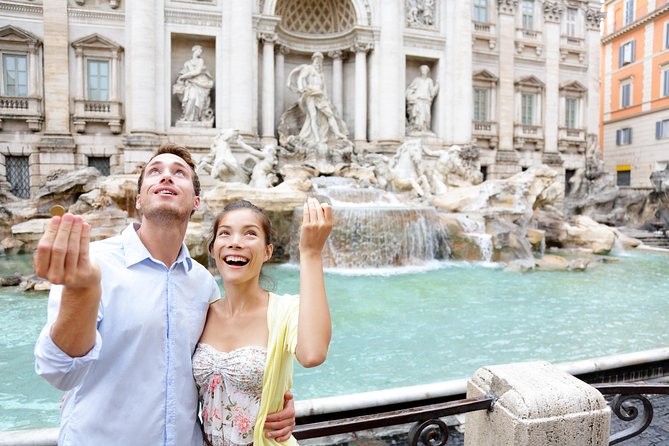
Trevi Fountain is the stop everyone knows, and it can still be worth your time if you treat it right. Here, you’ll have about 20 minutes and you won’t pay an admission fee to view it.
The trick is to not spend your whole time staring straight on. After a minute to take in the whole composition, walk a bit to see the fountain from an angle. That’s where you start noticing how the stone and water work together, and how the plaza layout shapes the crowd.
Also, if you want to do the coin moment, do it quickly and then shift your attention back to the fountain itself. Rome rewards movement. Even small repositioning helps you find a better view without turning your whole visit into a queue problem.
Pantheon: the stop many people talk about later
If there’s one location that tends to make this tour feel worth it, it’s the Pantheon. You’ll get roughly 30 minutes here, and it’s one of those places where time goes fast because every direction has something to notice.
What makes the Pantheon special is that it has the kind of preservation you rarely get in Rome. It began as a Roman temple complex, commissioned during Augustus’s era and completed under Hadrian. Over time, it shifted into Christian worship, dedicated to St. Mary and the Martyrs.
For visitors, the real wow factor is the mix of scale and focus. Even if you only stay at ground level, you can feel how the interior pulls your eye upward. And this tour connects you to the human side of the monument by highlighting tombs inside, including those of Renaissance artist Raphael and King Umberto I.
Practical note: in a place like this, the line to get a good look can be part of the experience. Your guide helps you use the time you have well, not just stand around waiting to see a view.
Also on the Rome guest list:
- Vatican Museums, Sistine Chapel & St Peter’s Basilica Guided Tour
★ 4.5 · 39,149 reviews - Rome: Colosseum, Palatine Hill and Roman Forum Guided Tour
★ 4.8 · 32,814 reviews - Rome: Guided Tour of Colosseum, Roman Forum & Palatine Hill
★ 4.7 · 27,897 reviews - Rome: Colosseum & Forum with Audio Guide App -Optional Arena
★ 4.2 · 24,770 reviews
Piazza Navona: baroque squares in a short walk
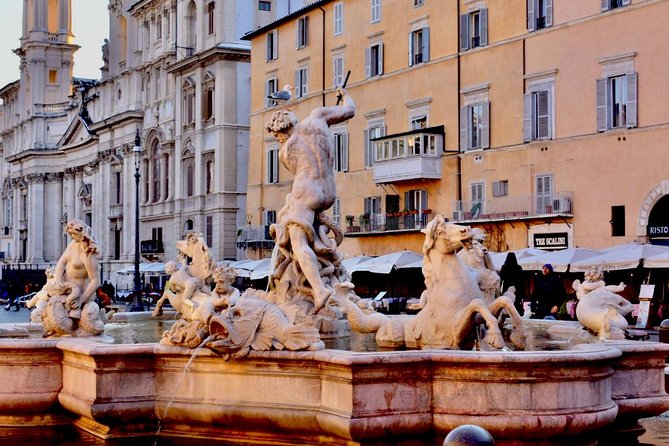
After the Pantheon, you’ll move toward Piazza Navona, one of the city’s most dramatic open spaces. You’ll have about 20 minutes here.
Navona is built on the footprint of an ancient Roman stadium, tied to Domitian and the games Romans called agones. That matters because the square isn’t random. The shape and layout connect the ancient “competition arena” idea to the baroque street-life square you see today.
What you’ll enjoy most is the baroque fountain design linked to Bernini. Piazza Navona does not hide its theater. It’s meant to be looked at, and it’s meant to be lived in. While you’re there, resist the urge to rush from fountain to fountain like it’s a checklist. Pause long enough to understand how the fountains anchor the square, and how the surrounding facades frame the view.
If you only have a few hours in Rome, Piazza Navona is one of the quickest ways to feel how the city turns art into public space.
Riding toward Vatican City, then ending at St. Peter’s Square
Between central Rome and the Vatican area, you’ll take an air-conditioned vehicle. This is a lifesaver in summer, and also useful if you’re tired of cobblestones by the time you reach the final stretch.
The tour ends at St. Peter’s Square (Piazza San Pietro) with about 30 minutes allocated. Even if you don’t go into every indoor space, the square alone gives you major landmarks quickly.
You’ll see the ancient Egyptian obelisk in the center, erected in 1586. And you’ll learn why Bernini’s design is so memorable: the Doric colonnades that frame the square were developed in the mid 1600s, and they create that signature embracing space effect.
This is where the tour earns its “then explore on your own” ending. You’re positioned right where you want to be. If you want to keep going around the basilica exterior, linger at the views, or simply enjoy the scale without rushing, you can.
Just be aware: the tour includes an inside visit of St. Peter’s Basilica, but access may not be possible on Sundays, religious festivals, or ceremonies. On those days, the schedule can change.
Walking comfort, uneven streets, and the dress code you must plan for
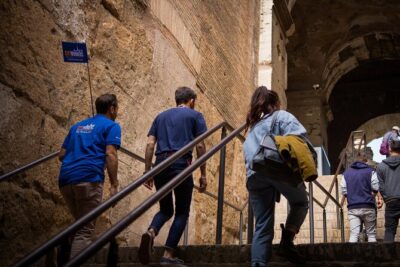
Here’s the biggest real-world consideration for this tour: Rome walking is real walking. Cobblestones are uneven, and there can be a decent amount of it depending on where the bus can stop and what your group flow looks like that day. One review sentiment that lines up with your planning reality is that the tour can feel more like a walking route than some people expect, even with an air-conditioned bus segment.
You can stay on the coach for some stretches, but if you do, you’ll miss many of the sights. I’d treat this as a “wear your Rome shoes” experience, not a sit-and-watch city ride.
Also, the church rules are strict. For entrances tied to places of worship and selected museums, you need knees and shoulders covered. That means no shorts and no sleeveless tops for both men and women. This dress code is enforced, and if you don’t follow it, entry can be refused. If you’re traveling in warm weather, plan ahead with a light layer that still covers shoulders and knees.
Finally, Rome sometimes changes access. During the Jubilee period, some monuments may be under restoration, so it’s smart to read any updates you receive before you go.
Value check: what you get for $49.26 in about 3 hours
At around $49.26 per person for a roughly 3-hour morning tour, this is priced like a classic “high-demand sights plus guide” product. The value comes from three things you cannot replicate easily by winging it:
- A guide who keeps the visit coherent. You’re not just seeing monuments, you’re getting context that makes each stop connect to the next.
- Time with key landmarks. You get dedicated time windows at major sites like the Trevi Fountain, Pantheon, Piazza Navona, and St. Peter’s Square, instead of racing through them.
- Efficient routing. The air-conditioned vehicle helps connect neighborhoods without you spending energy fighting transit and station decisions in the morning rush.
Lunch is included only if you pick the lunch option. If you’re not doing lunch, you may want to bring water or snacks before you start. Drinks are not included, so factor that into your budget.
One more value note: you also get a mobile ticket, which simplifies the “where do I find this” problem on a day full of moving parts.
Guide quality can make or break your morning
This tour lives and dies by your guide. The best experiences highlight guides who are friendly, sharp on details, and quick to answer questions. One guide name that shows up strongly is Georgio, praised for being nice and very knowledgeable.
At the same time, you should expect that English skill and energy can vary from day to day. Rome tours are staffed by humans. If your morning includes a guide who’s more quiet or less comfortable with English, you might feel like you’re mostly observing rather than understanding.
My advice is to treat this as a guided orientation into Rome. If you’re using it as your foundation, a strong guide will make the rest of your trip easier, because you’ll know where to focus next.
Who should book this Rome morning tour
This is a good fit if you want:
- A first-day orientation to central Rome and the Vatican approach
- A tight schedule that still includes meaningful time at the Pantheon and Piazza Navona
- Small-group attention and a guided story that helps you connect the dots
It’s less ideal if:
- You hate walking on uneven cobblestones and stairs
- You need slow, frequent breaks and low physical effort
- You show up underprepared for the church dress code
If you have mobility challenges, you’ll want to think carefully before booking, since the route involves walking and the bus cannot cover every sight.
Should you book The Treasures of Rome?
I think this is worth booking if your goal is classic Rome highlights in one smart morning, with a guide adding clarity to the “what am I looking at?” moments.
Book it if you can handle walking, you’re dressing for strict church rules, and you want a clean end point at St. Peter’s Square so you can choose your own next steps.
Skip or reconsider if you want a mostly seated sightseeing experience, or if you’ll struggle with the cobblestone reality. In that case, you’ll likely feel the schedule more than the sights.
If you do book it, pack light layers for the church dress code, wear comfortable shoes, and plan to treat those 20 to 30 minutes at each major stop as the main event. That’s how you get the best return on your morning in Rome.
FAQ
How long is The Treasures of Rome tour?
It runs for about 3 hours.
What time does the tour start?
The start time is 9:00 am.
What sights are included during the tour?
You’ll visit Piazza Barberini (including Bernini fountains details), Trevi Fountain, the Pantheon, Piazza Navona, and end at St. Peter’s Square.
Is lunch included?
Lunch is included only if you select the lunch option.
Is St. Peter’s Basilica interior included?
The inside visit is included, but it will not be possible on Sundays, religious festivals, and religious ceremonies, and the itinerary may change.
What is the dress code for churches?
You must cover knees and shoulders. No shorts or sleeveless tops are allowed for both men and women, and enforcement is strict.
Is the tour only in English?
The tour is offered in English, and it is described as a multilingual tour.
How many people are in the group?
The tour has a maximum of 20 travelers.
Can I cancel for a full refund?
Yes, you can cancel up to 24 hours in advance for a full refund.
Just introduced: the newest Rome write-ups
- Excavation Tour to the Tomb of St. Peter’s & St. Peter’s Basilica★ 4.0 · 183 reviews
- Imperial Rome and External Colosseum Tour★ 5.0 · 183 reviews
- Rome: Rooftop Cooking Class with Wine Tasting near Vatican★ 5.0 · 184 reviews
- Rome to Civitavecchia Cruise Port Transfer★ 5.0 · 184 reviews
- Ancient Rome and Colosseum Private Tour with Underground Chambers and Arena★ 4.5 · 184 reviews
- Rome: Vatican Museums & Sistine Chapel Skip-the-Line Ticket★ 4.1 · 185 reviews
- Borghese Gallery Max 6 People Tour: Baroque & Renaissance in Rome★ 5.0 · 185 reviews
Rome Tours, compared.
Vatican: Museums & Sistine Chapel Entrance Ticket
Read our review →
Vatican Museums & Sistine Chapel Tour with Optional Basilica
Read our review →
Colosseum, Roman Forum & Palatine Guided Tour
Read our review →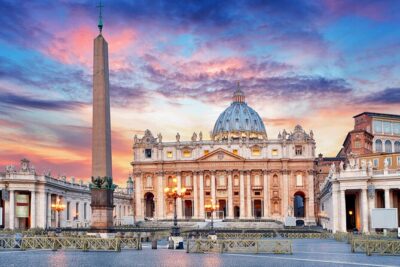
Vatican Museums, Sistine Chapel & St Peter’s Basilica Guided Tour
Read our review →
Colosseum, Palatine Hill and Roman Forum Guided Tour
Read our review →
Guided Tour of Colosseum, Roman Forum & Palatine Hill
Read our review →
Colosseum & Forum with Audio Guide App -Optional Arena
Read our review →