
Reviewed · TRAIN EXPERIENCES
From Rome: Ostia Antica Guided Half-Day Trip by Train
Ostia Antica feels like Rome’s port city has been paused in time. You’ll walk along Decumanus Maximus and into spaces that match how regular Romans ate, worked, bathed, and queued up in public. Two things I love here are the focus on everyday life and the way the guide turns scattered ruins into a real place you can picture.
One thing to consider: this is a half-day walking tour, and the site is large. You’ll need comfortable shoes, and it is not suitable for wheelchair users, with no strollers allowed.
In This Review
- Key things to know before you go
- Rome to Ostia Antica by train: the smooth start at Piramide
- Ostia Antica in four hours: why this half day works
- The streets of Roman daily life, Decumanus Maximus and the port-city rhythm
- Baths of Neptune: mosaics, sea gods, and why you’ll stop mid-walk
- Amphitheater and Forica: where the city feels human
- How the guide shapes your day: Rob, Cat, Alberto, and Laura type effects
- After the tour: Ostia town, the museum options, and a simple beach add-on
- Price and value: is $58 worth it?
- Who should book this Ostia Antica half-day?
- Should you book this Rome to Ostia Antica guided train trip?
- FAQ
- How long is the tour?
- Where do I meet, and how do I find the group?
- What’s included in the price?
- Do I need to plan my own train back to Rome?
- Can I stay in Ostia Antica or go to the beach after the tour?
- Is there a toilet break?
- Is the tour wheelchair accessible, and are strollers allowed?
Key things to know before you go
- Train day, not a bus day: round-trip train tickets are included, and you go from central Rome to the ruins area fast.
- Small group (up to 12): you get more attention, plus easier questions while you’re walking.
- Hands-on Roman details: you’ll see the mosaic at the Baths of Neptune and the public washrooms at the Forica.
- A rare “less crowded” feeling: Ostia Antica is often quieter than the headline sites, so it’s easier to take your time.
- Time after the tour: you can stay in Ostia Antica or head to the beach, then use the provided train ticket back on your own.
Rome to Ostia Antica by train: the smooth start at Piramide
This tour is built around a simple idea: go by train, walk with a guide, then decide what to do after. You meet at Piazzale Ostiense, 9, at Cafe Piramide by the tracks, near the exit from the trains. City Wonders guides carry a sign, so you can spot them without a long scavenger hunt.
The trip itself is short, about 15 minutes by train, which matters more than you’d think. When you spend most of the day at the ruins, the day feels full, not rushed. Plus, once you arrive, you’re not juggling tickets, transfers, and directions while trying to stay focused on history.
The tour group stays small, limited to 12 participants, which helps in a park this size. In particular, guides like Rob, Cat, Alberto, and Laura are known for keeping people moving and stopping at the places that actually tell a story. If you like asking questions, the pace makes it easier than in a large group.
Introductions we still owe you around Rome

Ostia Antica in four hours: why this half day works
Ostia Antica was founded in the 4th century BC and once housed over 100,000 people, so it’s not a tiny “quick stop” ruin. It was Rome’s commercial and military harbor in the Republic era, meaning real work happened here, not just sightseeing.
In just about 3 hours on site, you’ll get a clear “what mattered and why” tour. You see trade and daily life, not only dramatic monuments. And the scale helps, because the preserved walls and multi-story remains give you a better sense of the height and bustle than you’d get from flat ruins alone.
Another reason this works is that the tour is structured around key spaces, not random wandering. You’ll walk the main thoroughfare, hit the baths and entertainment areas, then pause for the kind of human detail that makes Romans feel less distant.
It also helps that many visitors find Ostia calmer than the usual Rome-satellite stars. That quiet can make your photos cleaner, your listening easier, and your sense of the place stronger.
The streets of Roman daily life, Decumanus Maximus and the port-city rhythm
The heart of the experience is walking the main route through Ostia Antica, the Decumanus Maximus. As you go, the guide points out how the city’s layout supported commerce. You start to connect the dots between the warehouses, taverns, public buildings, and the flow of people moving through a working port.
What I like about this approach is that it changes how you read ruins. Instead of seeing “some walls and columns,” you start seeing jobs, services, and routines. You’ll notice surviving details tied to everyday use, like structures connected to food and trade, plus spaces you can imagine bustling during the peak Roman years.
Roman statues lining the walkways add a second layer. They aren’t just decorations. They help you picture the civic culture, the public messages, and the sense that the city wanted to look official and important.
One practical note: this is real walking through an archaeological park. You’ll want to save your energy for the big stops, and plan for sun and uneven ground. Guides who know the site well often manage the rhythm by including brief breaks so you can catch your breath and orient yourself.
Baths of Neptune: mosaics, sea gods, and why you’ll stop mid-walk
The Baths of Neptune are one of the tour’s easiest wins. They’re a classic example of how Roman leisure was built into daily life, even in a working port city. You’ll come face-to-face with a mosaic that is famously well preserved, featuring the sea god being drawn in a four-horse chariot.
This is where a good guide earns their pay. The baths aren’t just a pretty floor. They tell you about Roman taste, art patronage, and how entertainment mixed with hygiene and socializing. When you see a mosaic this intact, you stop thinking about “ancient fragments” and start thinking about the full interior experience Romans expected.
If you’re the kind of person who reads plaques slowly, plan to slow down here too. Even in a guided flow, this stop gives you a chance to actually register the craftsmanship and imagine the room’s atmosphere.
And yes, it also helps that the baths are visually “sticky.” People remember them, even if they forget a random street you passed an hour earlier.
Also on the Rome guest list:
- Vatican: Museums & Sistine Chapel Entrance Ticket
★ 4.5 · 144,003 reviews - Vatican Museums & Sistine Chapel Tour with Optional Basilica
★ 4.3 · 67,413 reviews - Colosseum, Roman Forum & Palatine Guided Tour
★ 4.7 · 63,148 reviews - Vatican Museums, Sistine Chapel & St Peter’s Basilica Guided Tour
★ 4.5 · 39,149 reviews
Amphitheater and Forica: where the city feels human
Ostia Antica isn’t only grand buildings. Two stops make it feel personal: the amphitheater and the Forica, the public washrooms.
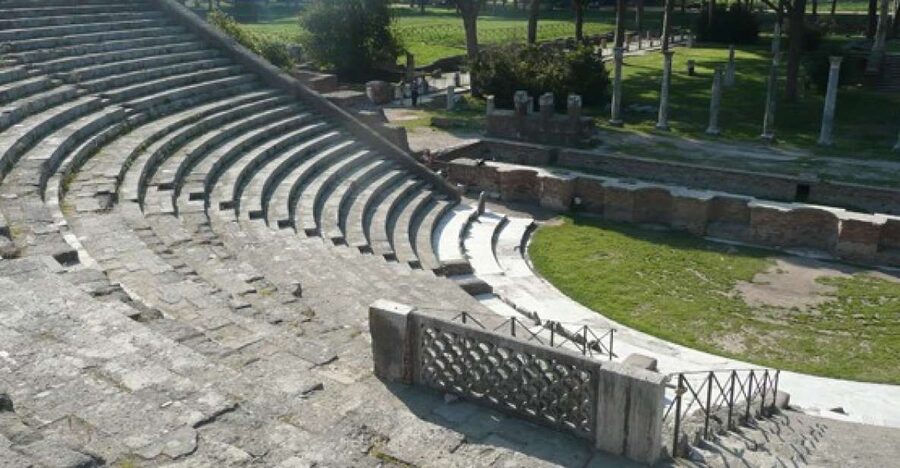
At the amphitheater, you’ll learn that it was built in 12 BC for around 3,500 spectators. The numbers matter, because they help you picture the crowd size for the kinds of events that made Roman entertainment a social glue. As you stand where you’d imagine the actors and fighters, you can almost hear the roar, even if you’re in quiet modern air.
Then the Forica hits you in a different way. It’s communal, open, and intensely practical. You’ll see a marble bench lined with 20 well-spaced holes along four walls. It’s not glamorous, but it’s the most Roman kind of detail, because it shows how public life included bodily needs and routines.
I love that this stop is part of the standard route. It keeps the tour grounded. You’re not only looking at power and wealth. You’re seeing what day-to-day life required.
How the guide shapes your day: Rob, Cat, Alberto, and Laura type effects
This tour’s biggest variable is the guide. Since you’re walking a large site, the guide’s job is to select what to notice and explain why it mattered. In the real world, that makes the difference between seeing ruins and understanding a city.
You’ll hear different guide styles, but the best ones share a few traits. Rob and Cat, for example, are often praised for strong pacing and clear, easy-to-follow storytelling. Alberto and Laura come through with energetic delivery, plus details that help you picture how Romans lived, worked, and used public spaces.
It’s also common for guides to use light reenactment or role-style storytelling to help the space “turn on.” If you like history that talks like real life, that style will land well. If you prefer facts and structure, you’ll still get plenty of context, because the tour’s route forces key topics to appear in sequence.
And during hot weather, you’ll appreciate guides who keep the group moving at smart intervals. One theme that shows up is the ability to find shade and keep things comfortable without turning the day into stop-and-start.
After the tour: Ostia town, the museum options, and a simple beach add-on
At the end, the guided portion ends back in Rome around 1:00 PM, at the Piramide Metro Station area. The tour service gives you the return train ticket, but the return journey is unescorted, so you’re planning your own way from Piramide onward.
The fun part is what you can do before you go back. You can stay at Ostia Antica and explore the modern town at leisure. Some people also add a beach visit, since it’s an easy extra from this part of the coast.
This is also where timing matters. There is an on-site museum inside the archaeological area, but hours can vary depending on the season. In winter, one account notes it can close early, around 1:30 PM, so if you care about it, check your timing once you finish the main tour.
If you want the most value, treat this as two experiences in one day. Do the guided walk for structure, then stay on your own to wander with better context in your head. You’ll recognize what you see and understand what you might otherwise miss.
Price and value: is $58 worth it?
At $58 per person for about 4 hours, the price feels fair because you’re paying for three practical pieces, not just a guide. You get return train tickets, entry to Ostia Antica, and the guide. Those are the big “friction costs” that eat time when you try to DIY.
The hidden value is that the tour helps you interpret the site quickly. Ostia Antica is large, and without context you may walk past areas that are actually key to Roman daily life. With a guide, your time inside the archaeological park becomes more efficient.
Small group size also pushes the value upward. With a limit of 12 participants, you’re less likely to get stuck in a long line with zero chance to ask questions.
One more thing: if you’re comparing this to Pompeii, the big perk is often less crowd pressure. You still get major ruins and famous set pieces, but you can move at a more human pace. That can make the half-day feel more satisfying than spending hours in higher-demand sites.
Who should book this Ostia Antica half-day?
Book it if you want a Rome side trip that teaches daily life, not just monuments. It’s great for history lovers, first-timers who want the essentials, and anyone who likes a guided route through a big site.
It’s also a good fit if you’re balancing the rest of your Rome schedule. The train time is short, the guided portion is concentrated, and you get flexibility at the end to stay in Ostia or head to the beach.
Don’t book it if you need wheelchair accessibility. The tour is not suitable for wheelchair users. Also, no baby strollers are allowed, which can affect families who rely on them.
If you enjoy quiet ruins with room to think, Ostia Antica is a strong match. The guide plus the calmer setting make it easier to feel connected to what you’re seeing.
Should you book this Rome to Ostia Antica guided train trip?
Yes, if your goal is to leave with a real sense of how Rome worked beyond the big skyline. For $58, you’re getting a guided half-day in a major port-city ruin site, plus transport and entry handled for you.
I’d book it especially if you care about everyday Roman life, like baths, entertainment spaces, and the public routines shown in the Forica. And if you like having time afterward, this is one of those tours that gives you a clean structure first, then breathing room to wander.
If you prefer your history in a self-guided way only, you might skip the tour. But if you want the ruins to make sense fast, this is one of the easier wins from Rome.
FAQ
How long is the tour?
The experience runs for about 4 hours total, with around 3 hours spent on the Ostia Antica guided visit.
Where do I meet, and how do I find the group?
You meet at Cafe Piramide near Piazzale Ostiense, 9. The meeting point is easy to spot by the white umbrellas outside the café, and guides carry a City Wonders sign.
What’s included in the price?
You get a return train ticket from Rome to Ostia Antica, the Ostia Antica entry ticket, and a live English-speaking guide.
Do I need to plan my own train back to Rome?
The tour provides the train ticket for the return, but the return journey is unescorted. The tour ends in Rome near Piramide Metro Station at about 1:00 PM.
Can I stay in Ostia Antica or go to the beach after the tour?
Yes. After the tour, you can remain in Ostia Antica and the modern town, or head to a nearby beach.
Is there a toilet break?
Yes. There will be a toilet break with time for a snack and/or drink at the snack bar.
Is the tour wheelchair accessible, and are strollers allowed?
No for wheelchair users. Baby strollers are also not allowed.
Just introduced: the newest Rome write-ups
- Rome Fiumicino Airport Transfer in Luxury Private Transportation★ 4.5 · 339 reviews
- Vatican: Pope Francis Tomb and Papal Basilicas Tour★ 4.7 · 340 reviews
- From Rome: Sorrento, Positano & Amalfi Coast Day Trip★ 4.5 · 340 reviews
- Rome: Guided Colosseum Underground Tour★ 4.8 · 342 reviews
- Colosseum Arena Floor, Roman Forum & Palatine Hill Guided Group Tour★ 5.0 · 343 reviews
- Rome: Small Group Rome’s Dark Side – Ghosts & Legends Tour★ 4.9 · 343 reviews
- Rome: City Highlights Electric Bike Tour★ 4.9 · 343 reviews
Train Experiences, compared.
Bernina Red Train, Swiss Alps & St Moritz From Milan
Read our review →
Swiss Alps Bernina Red Train and St.Moritz Tour from Milan
Read our review →
Rome to Pompeii Guided Tour with Wine & Lunch by High Speed Train
Read our review →
Small-Group Lake Como & Lugano by Swiss Train + Boat Cruise
Read our review →
Guided tour of Pompeii skip-the-line and round-trip train
Read our review →
Pompeii Express Guided Tour by Train from Sorrento
Read our review →Browse the lists this tour appears in