
Reviewed · GOLF CART CITY TOURS
Rome on a Golf Cart Semi-Private Tour Max 6 with Private Option
Rome’s highlights, delivered by golf cart. In just about 3 hours, this tour strings together major ancient and baroque sights plus a few side streets that most people never bother to seek out. I especially love the small group size (max 6), because you get real back-and-forth with your guide instead of feeling like a passenger on rails, and you cover a lot of ground without turning Rome into a walking punishment. One thing to consider: you are moving constantly, so it is not the right choice if you want long, slow time inside museums or at one stop for hours.
You meet in the city center at Piazza della Repubblica, and you finish back in the center. The tour is led by a local expert guide, offered in English, and you can upgrade to a private tour when you want a more tailored route and pace. If you get motion sick easily or strongly dislike riding in traffic-adjacent areas, it is smart to think about your comfort level first.
In This Review
- Key things that make this golf cart tour worth it
- Why a golf cart is the smart way to see Rome fast
- Piazza della Repubblica start, then the route builds like a history map
- The Michelangelo stop and the first wave of ancient Rome
- Circus Maximus to Capitoline Hill: big arenas and the center of control
- Mouth of Truth and Largo di Torre Argentina: legend meets politics
- Piazza Venezia, Vittorio Emanuele II, and the Pantheon portico
- Trevi Fountain, Piazza Navona, and Janiculum Hill panoramas
- Spanish Steps: the easiest way to connect the city levels
- What the small-group guide style really changes
- Price and value: is $168.09 per person a good deal?
- Who should book this golf cart tour, and who should think twice
- Should you book this LivTours Rome golf cart tour?
- FAQ
- How long is the Rome golf cart tour?
- What group size is used on this tour?
- Where does the tour start and end?
- Is the tour offered in English?
- Is there a private tour option?
- What are some of the sights you will see?
- Are gratuities included in the price?
- Is free cancellation available?
Key things that make this golf cart tour worth it
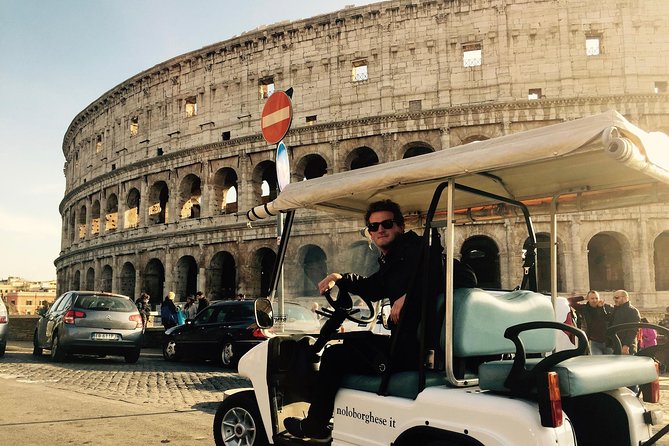
- Max 6 group size keeps the vibe intimate and questions actually get answered
- A quick hit of big Roman names like Constantine, Palatine Hill, Circus Maximus, and the Pantheon portico
- Less walking, more sighting makes it a strong option for mobility challenges
- Side-street stops get included including a church designed by Michelangelo
- Works as a first-day orientation so you know where to go back later
- Private option available if you want custom routing
Why a golf cart is the smart way to see Rome fast
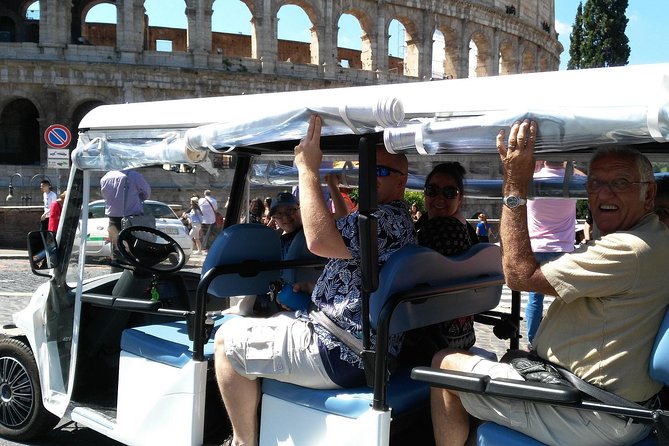
Rome rewards slow roaming, but not every trip gives you the time. This is built for people who want the essentials, then freedom to explore after they understand the layout. In a 3-hour window, you still get big-picture context, not just random photo stops.
The golf cart also changes the experience emotionally. You feel less pressed by crowds, less drained by pavement, and more like you are gliding between eras. When it is hot or you are dealing with limited mobility, that matters. One theme that shows up again and again in guide feedback is calm pacing, with drivers handling Rome traffic carefully so you can focus on what is in front of you.
The other practical win is that you spend your energy on looking, not negotiating routes. You get to see places like the Arch of Constantine area, Capitoline Hill, and the Pantheon portico without doing the long back-and-forth that can happen when you try to DIY everything.
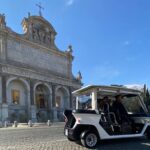
More old streets covered by golf cart:

Piazza della Repubblica start, then the route builds like a history map
The tour kicks off in the city center at Piazza della Repubblica. That is a useful starting point because it helps you avoid the common problem of “we started too far away and now the day is gone.” It is also close to public transportation, so you are not trapped if your timing slips.
From there, the route moves through Rome in a way that feels chronological and geographic at the same time. You begin with recognizable landmarks tied to Roman power and empire, then shift toward the heart of ancient political life and major public squares. By the time you reach fountains and hilltop views, you understand how Rome layers neighborhoods and viewpoints on top of each other.
Because your group is capped at 6, you also tend to get more flexible moments for photos and questions. Guides described as calm on busy streets usually translate that into fewer bottlenecks for the cart group, so you do not feel like you are constantly sprinting to catch up.
The Michelangelo stop and the first wave of ancient Rome
Early on, you get a side-street stop that includes a church designed by Michelangelo. You are not just hearing history in the abstract. You actually see how Renaissance influence bleeds into everyday Rome, tucked into quieter streets where most people walk past without noticing. If you like your Rome with surprises, this kind of early detour is a real morale boost.
Then the tour leans hard into imperial Rome with the Arch of Constantine. This triumphal monument was built in 312 AD to celebrate Constantine’s victory, and it is one of the best-preserved symbols of imperial power. Standing near it, you get a clear reminder that Rome was built to project authority, not just to last.
From there, you head toward Palatine Hill, which is tied to Rome’s legendary birthplace and also served as a prestigious home for emperors and aristocrats. Even if you do not go inside anything, the hill location alone teaches you something: Rome’s leaders chose views and status. Palatine Hill is basically a living argument for why power likes elevation.
Circus Maximus to Capitoline Hill: big arenas and the center of control
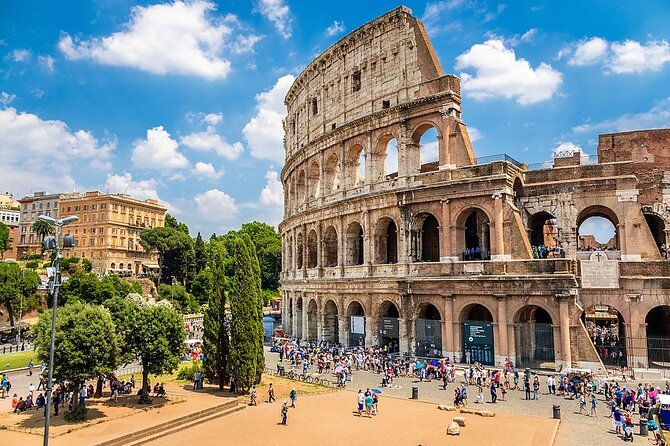
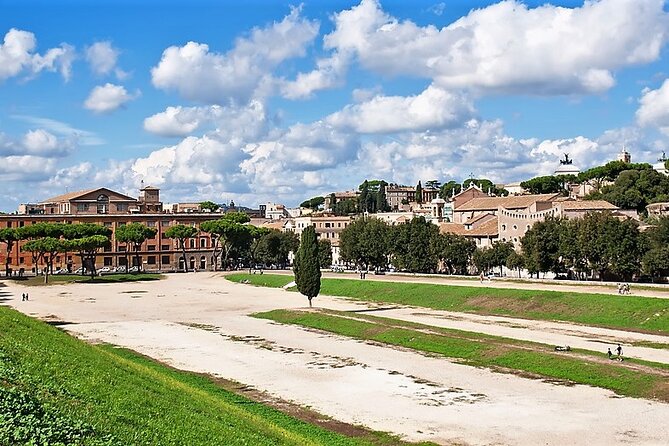
Next up is Circus Maximus, ancient Rome’s largest stadium, where chariots raced for crowds rumored to exceed 150,000. This is one of those places where understanding scale helps everything click. When you look at the sweep of the area, you can almost picture how mass entertainment shaped daily life.
The tour then shifts toward Capitoline Hill, often treated as the political and religious heart of ancient Rome. It is also famously redesigned by Michelangelo, which adds another layer to the stop. This is a strong point on the tour if you like architecture and civic planning. You are not just seeing “ruins,” you are seeing how Rome kept reinventing itself on top of the old foundations.
At Capitoline, you are also in the zone where piazzas and museums belong. You get a taste of the area’s bigger story, and that makes it easier to decide later if you want to return for more time.
Introductions we still owe you around Rome
- Vatican: Museums & Sistine Chapel Entrance Ticket
★ 4.5 · 144,003 reviews - Vatican Museums & Sistine Chapel Tour with Optional Basilica
★ 4.3 · 67,413 reviews - Colosseum, Roman Forum & Palatine Guided Tour
★ 4.7 · 63,148 reviews - Vatican Museums, Sistine Chapel & St Peter’s Basilica Guided Tour
★ 4.5 · 39,149 reviews
Mouth of Truth and Largo di Torre Argentina: legend meets politics
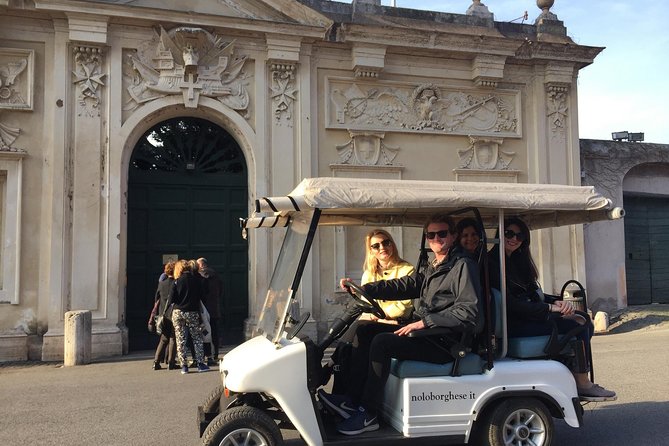
One stop many people remember immediately is the Mouth of Truth, an ancient marble mask linked to the story that it bites the hand of anyone who tells a lie. Whether you take the legend literally or as a theatrical bit of Roman folklore, the point is the same: Rome loves turning moral lessons into public spectacle. Seeing it in person makes the myth feel less like a movie prop and more like part of city life.
Then comes Largo di Torre Argentina, where ancient temples protect the site associated with Julius Caesar’s assassination. This is a moment that can hit hard. You go from iconic myths and games to the reality of political danger and public drama. It is also a good reminder that the “beautiful Rome” you see today was built on extremely messy human history.
If you are the type who likes to connect scenes, this part of the tour does that. It is not just random stops. It helps you link public power, public ritual, and the consequences of ambition.
Piazza Venezia, Vittorio Emanuele II, and the Pantheon portico
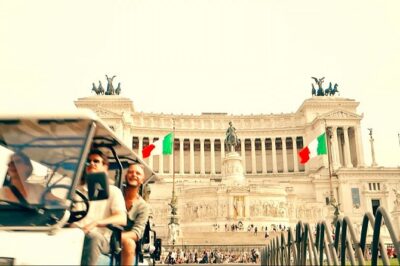
When you reach Piazza Venezia, Rome feels like it is doing what it always does: gathering people around authority and ceremony. This square is dominated by the Vittorio Emanuele II Monument, a huge presence that frames the area’s ongoing role as a central meeting point.
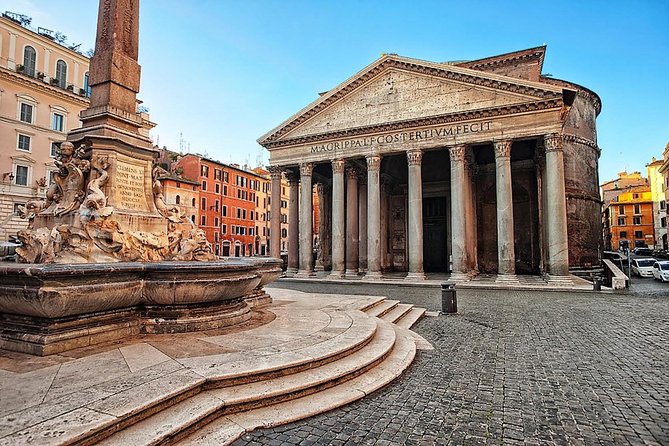
After that, you get the iconic Pantheon portico. The portico is one of the most recognizable “Rome from a distance” views in the world. Seeing it as part of this ride matters because the tour places it at the right time, after you have already absorbed some ancient political locations and public spaces. Your brain starts grouping Rome into systems, not isolated landmarks.
Practical note: this is a sight-from-the-street moment, not a long museum day. If you want to go inside and linger, you will still want separate time later. But as an orientation and photo anchor, it works.
Trevi Fountain, Piazza Navona, and Janiculum Hill panoramas
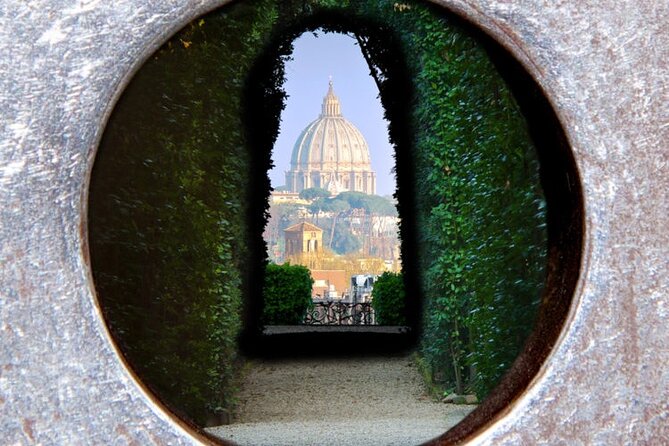
Few stops do the heavy lifting that Trevi Fountain does. You get the dramatic cascade, where myth and marble mix into the city’s most famous wish-making ritual. The biggest value here is not just the photo. It is the energy. Trevi is where Rome turns into a story you can feel, even if you have never studied Roman mythology.
Then you move to Piazza Navona, a Baroque masterpiece with fountains and an open-air sense of theater. It is one of the best places on the tour for lingering just a little, because the square layout encourages you to look around. You can spot how Rome’s public life flows from buildings, into open space, and back again.
Finally, you climb toward Janiculum Hill for panoramic views. This is a smart ending stretch because it reframes everything you have seen. When you look out over the city, you understand why Rome is so hard to “finish.” It is layered and spread out, and that is exactly what makes planning follow-up visits easier after the tour.
If you are sensitive to walking after a tour, Janiculum still involves an ascent. The benefit is the payoff in views, and the golf cart helps you avoid turning the day into an all-out endurance test.
Spanish Steps: the easiest way to connect the city levels
You wrap with the Spanish Steps, where elegance meets history. The staircase connects Rome’s vibrant center to the area of Trinità dei Monti, giving you a clean sense of how the city climbs and dips. Even if you do not spend long sitting on the steps, you get an important visual lesson: Rome’s beauty often lives in elevation changes.
This stop is also a natural “pause button” after hill panoramas. You are still looking at Rome, but in a more human-scale, people-watching environment. It is an easy place to take one last set of photos and mentally mark where you might want to walk next.
What the small-group guide style really changes
The biggest repeated advantage is the guide. Names mentioned in real tours include Andy, Luca, Emanuele, Massimo, Alice, Riccardo, Xander, Matt, Carlo, Brando, Valentina, Chiara, Francesca, and Francesco. The common thread is a tour style that mixes major landmarks with practical storytelling, plus room for questions.
Guides also appear to handle traffic with steady focus, which is not a small thing in Rome. If you have spent time dodging scooters and buses, you know why this matters. A calm driver plus a guide who times stops properly means you can actually enjoy the landmarks instead of worrying about navigation.
Another highlighted factor is flexibility. Some guides reportedly can tailor the route to your interests and even adjust the pace based on family needs or personal preferences. That makes a difference because Rome is not one-size-fits-all. If your group cares more about ancient sites than piazzas, you feel that adjustment.
And yes, some guides add small extras, like a gelato stop, or in at least one case a more social touch like champagne split and an apéritif stop. Those are not guaranteed, but they show a key point: the experience is guided, not robotic.
Price and value: is $168.09 per person a good deal?
At $168.09 per person, you are paying for three things that are hard to assemble on your own in one tidy package: a pro guide, a safe transport method through traffic-heavy areas, and time efficiency that protects your energy.
Here is how I think about the value. If you try to do this as a DIY sprint, you lose time figuring out routes and you burn legs climbing between sites. If you hire a private driver and a guide, costs usually rise quickly, and you may still end up with more waiting. This tour sits in the middle by keeping the group small and the route packed, while still letting you ask questions.
It also tends to be a strong match for the “first day in Rome” crowd. You get a fast orientation: where the Pantheon portico sits relative to major piazzas, how the ancient sites connect by area, and where viewpoints like Janiculum fit into the city plan. That can reduce wasted time later, because you know what to revisit and what you can skip.
Who should book this golf cart tour, and who should think twice
This is a great fit if you:
- want to see a lot in a short window
- have mobility challenges or fatigue from walking
- are traveling with teens or mixed ages and want everyone engaged
- want an easy way to get your bearings fast
It may not be your best choice if you:
- want long, slow museum time at one site
- strongly dislike being in motion for most of the tour
- expect an in-depth deep-dive at each stop without sacrificing other places
Timing is also worth a thought. If heat is a concern, morning often feels better than midday, especially because your comfort depends on the outdoors time between stops.
Should you book this LivTours Rome golf cart tour?
If you want maximum Rome per hour and you like learning what you are looking at, I think you should book it. The combination of a max 6 group, a professional local expert guide, and a route that hits big Roman landmarks plus a Michelangelo-designed church makes it a practical win.
If you are on the fence, here is my simple decision rule: book it on day one if you want a layout and story. Book the private option if your group has specific needs and you want a more tailored pace. Either way, you will come away with a clearer mental map of Rome, plus a bunch of iconic sights you can build on afterward.
FAQ
How long is the Rome golf cart tour?
The tour runs about 3 hours.
What group size is used on this tour?
It is offered as a semi-private experience with a maximum of 6 travelers.
Where does the tour start and end?
It starts at Piazza della Repubblica in Rome and finishes in the city centre.
Is the tour offered in English?
Yes, the tour is offered in English.
Is there a private tour option?
Yes, there is a private tour option available.
What are some of the sights you will see?
You will see stops including the Arch of Constantine, Palatine Hill, Circus Maximus, Mouth of Truth, Capitoline Hill, Largo di Torre Argentina, Piazza Venezia and the Vittorio Emanuele II Monument, the Pantheon portico, Trevi Fountain, Piazza Navona, Janiculum Hill, and the Spanish Steps.
Are gratuities included in the price?
No. Gratuities are optional.
Is free cancellation available?
Yes. You can cancel for a full refund up to 24 hours in advance of the experience start time. If you cancel less than 24 hours before, the amount you paid is not refunded.
Just introduced: the newest Rome write-ups
- Rome Fiumicino Airport Transfer in Luxury Private Transportation★ 4.5 · 339 reviews
- Vatican: Pope Francis Tomb and Papal Basilicas Tour★ 4.7 · 340 reviews
- From Rome: Sorrento, Positano & Amalfi Coast Day Trip★ 4.5 · 340 reviews
- Rome: Guided Colosseum Underground Tour★ 4.8 · 342 reviews
- Colosseum Arena Floor, Roman Forum & Palatine Hill Guided Group Tour★ 5.0 · 343 reviews
- Rome: Small Group Rome’s Dark Side – Ghosts & Legends Tour★ 4.9 · 343 reviews
- Rome: City Highlights Electric Bike Tour★ 4.9 · 343 reviews
Golf Cart City Tours, compared.
Rome by Golf Cart Private Tour: Beyond the Landmarks
Read our review →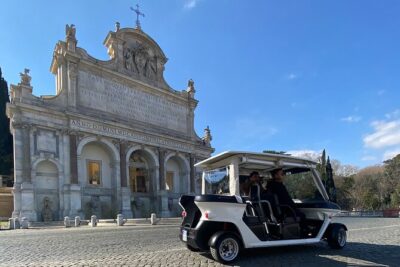
Rome Highlights by Golf Cart Private Tour
Read our review →
Golf Cart Tour to Fiesole Roman Theatre and Museum
Read our review →
Eco-Friendly Golf Cart City Tour with Audio Guide
Read our review →
Rome Highlights City Tour by Golf Cart with Gelato
Read our review →
Golf Cart Small-Group Guided Tour: Rome City Highlights
Read our review →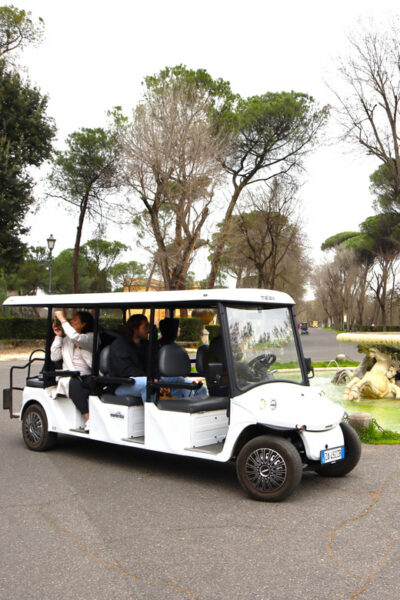
Browse the lists this tour appears in