
Reviewed · CITY TOURS
Golf Cart Small-Group Guided Tour: Rome City Highlights
Rome looks best when you keep moving.
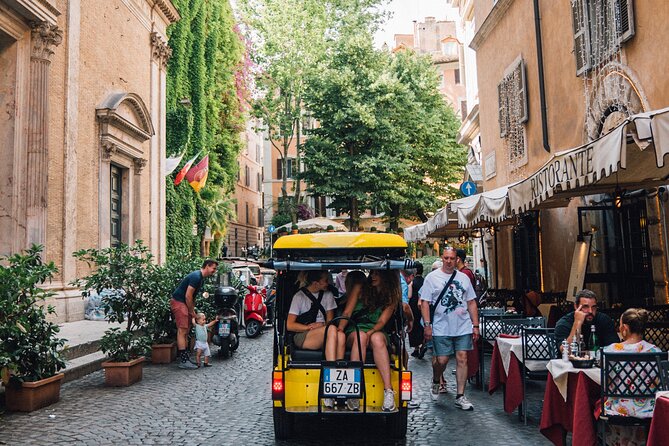
This small-group electric golf cart tour strings together the city’s big-name sights with guided context you can actually hear, thanks to headsets. You get a fast, organized route through Rome’s historic center, so you spend less time figuring out what’s where and more time seeing why these places matter.
I especially like two parts: the headsets, which make the narration clear even on busy streets, and the relaxed pacing of a max 14-person group in up to two carts. That setup keeps the experience social, but still lets your guide pay attention. One thing to consider, though, is that most stops are brief, so if you want long hangs at a single monument, you may feel slightly rushed.
In This Review
- Key things to know before you ride
- Why a Rome golf cart highlights tour makes sense
- Price and value: what $104 really buys you
- Meeting point, end point, and how not to waste time in Rome
- Small-group logistics: carts, headsets, and what to expect
- Stop 1: Monterone office to the Pantheon area (the warm-up ride)
- Stop 2: Pantheon quick glimpse, and the key admission detail
- Drive through the historic center: Colonna and the story of triumph
- Stop 3: Trevi Fountain, coins, and the gelato timing
- Stop 4: Spanish Steps and Piazza di Spagna (quick, but meaningful)
- Stop 5: Piazza del Popolo and the northern gateway idea
- Drive past the Mausoleum of Augustus: Roman power, seen from the road
- Stop 6: Piazza Navona, stadium-shaped square, and the Roman clues
- Stop 7: Area Sacra di Largo Argentina, where archaeology matters
- Stop 8: Piazza del Campidoglio and the Campidoglio staircase moment
- Stop 9: Piazza Venezia and the Altar of the Fatherland
- Monti neighborhood and Via Giulia drive: the in-between Rome you usually miss
- Finishing outside the Colosseum: what to do next
- Who this tour is best for, and who may want something else
- Should you book this Rome city highlights golf cart tour?
- FAQ
- What is the duration of the Rome City Highlights golf cart tour?
- How much does the tour cost?
- Is the tour offered in English?
- Does the tour include entry tickets?
- What is included in the price?
- How large is the group?
- Where do I meet, and where does the tour end?
- Is hotel pickup included?
- Can I cancel for a full refund?
Key things to know before you ride
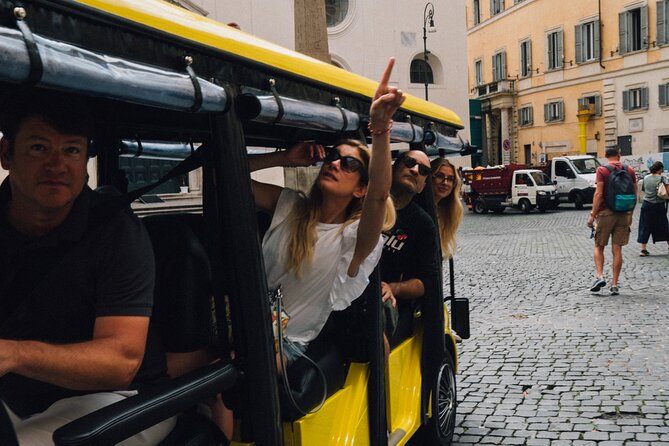
- Small-group setup (up to 14) with two carts traveling together, like connected carriages.
- Headsets are included, so you can follow along on cobblestone streets and at crowded plazas.
- Most admissions are not required, but the Pantheon stop does not include admission.
- Gelato is built in: one gelato per person plus bottled water.
- Stop times are short (often 5 to 10 minutes), which is great for an overview, not a slow tour.
Why a Rome golf cart highlights tour makes sense
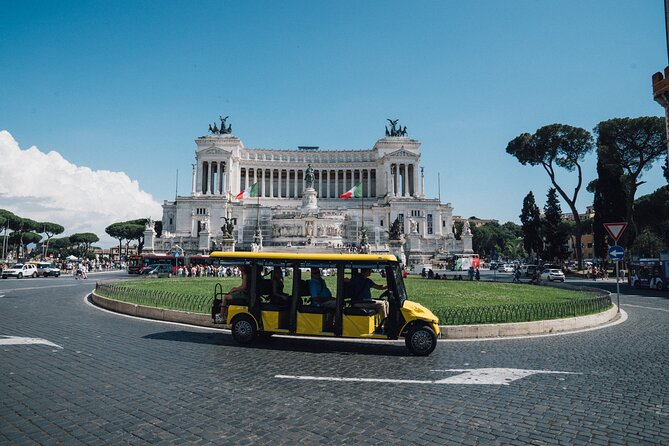
Rome can feel like a never-ending maze. Streets twist, crowds bunch up, and it is easy to waste time just getting from one famous spot to the next. This golf cart format solves a practical problem: you still get close to the sights, but you do not have to walk the whole route.
The other reason this works is how it blends movement and meaning. You are not just dropped at landmarks for photos. Your guide gives context while you ride through the historic center, then you have quick windows to take it in, snap a picture, and move on.
If you are visiting for the first time, this is a strong way to get your bearings fast and decide what deserves a second visit later.
More old streets covered by golf cart:

Price and value: what $104 really buys you
At $104 per person for about 2 hours 30 minutes, you are paying for convenience plus guidance, not for a museum ticket bundle. The value shows up in the included extras:
- Electric golf cart with seating for up to 7 per cart
- English-speaking local guide and driver
- Headsets so the guide stays audible
- Bottled water
- Snacks plus one gelato per person
Also, the structure matters. Tours are limited to a maximum of 14 travelers, and the carts travel together with shared narration through the same headsets. That is the kind of organization that makes a short tour feel smooth instead of chaotic.
The main cost-related note is about admissions. Most stops are free to see from the outside or in the public areas, but the Pantheon is not included. So you should expect you may need to pay for Pantheon access if you want to go inside.
Meeting point, end point, and how not to waste time in Rome
You start at V. Monterone, 19, 00186 Roma RM. The tour ends outside the Colosseum, at Piazza del Colosseo, 1.
That end detail is worth planning around. If you were hoping to exit the tour and immediately enter the Colosseum, you will likely still need to walk or arrange onward transport to match your exact ticket and timing.
One practical tip: arrive early enough to find the office. Rome is very easy to get turned around in, and the tour cannot be delayed for late arrivals. You do not want your “first-day Rome plan” to get derailed by a wrong turn and a missed start time.
Small-group logistics: carts, headsets, and what to expect
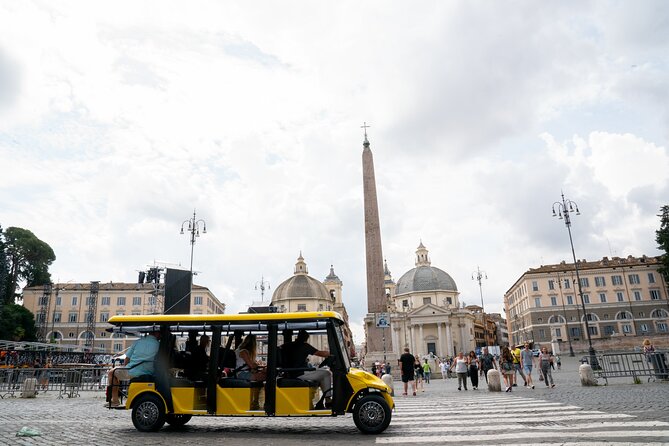
This is a small-group tour, run with up to a maximum of 2 vehicles and 14 participants. The carts stay together during the ride, and everyone listens through earpieces.
If you book with people, there is a possibility you could be asked to split between the two carts on some occasions. It is not the end of the world, but it is good to know ahead of time so you do not show up expecting the exact same cart seating.
About hearing the guide: headsets are included and are designed to keep narration clear. One downside you might run into is temporary headset trouble for certain seats, so if you sit farther back, keep an eye on the audio and alert staff right away if anything sounds off.
Introductions we still owe you around Rome
- Vatican: Museums & Sistine Chapel Entrance Ticket
★ 4.5 · 144,003 reviews - Vatican Museums & Sistine Chapel Tour with Optional Basilica
★ 4.3 · 67,413 reviews - Colosseum, Roman Forum & Palatine Guided Tour
★ 4.7 · 63,148 reviews - Vatican Museums, Sistine Chapel & St Peter’s Basilica Guided Tour
★ 4.5 · 39,149 reviews
Stop 1: Monterone office to the Pantheon area (the warm-up ride)
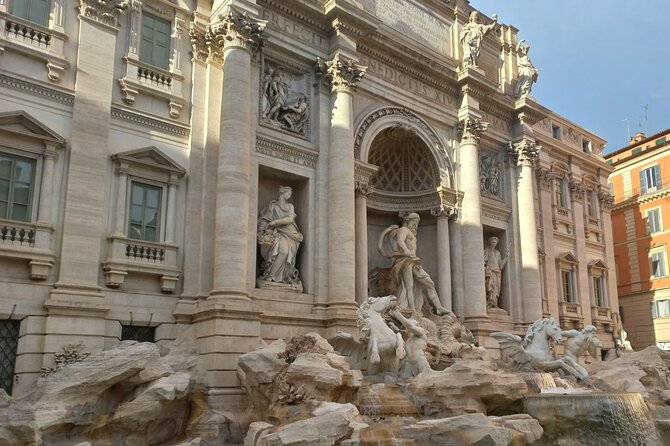
You meet your guide at the central office near V. Monterone, 19, then hop into the electric golf cart. This initial stretch is your warm-up, the moment to settle in, get oriented, and let the guide set the story.
Because you are moving early, you also save time compared with wandering to find the best routes on your own. And because headsets are already active, the narration starts quickly rather than after you arrive at the first sight.
Stop 2: Pantheon quick glimpse, and the key admission detail
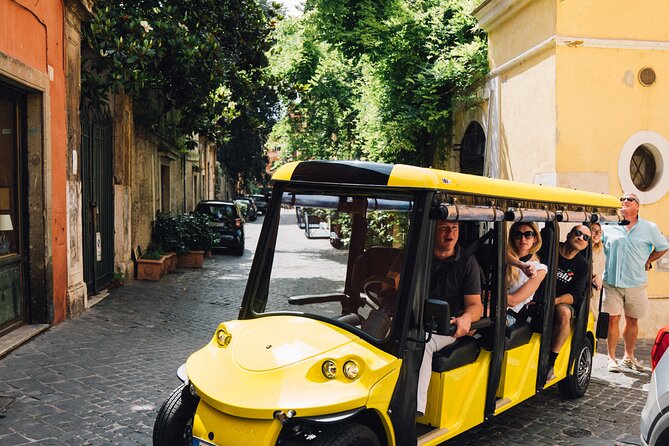
The tour includes a brief stop at the Pantheon, described as one of the best preserved ancient Roman buildings in the world. It is a famous stop for a reason, but the big practical point is admission:
- Pantheon admission is not included.
So you can expect a short view from the outside or a quick moment to decide whether you want to pay separately to enter. If you are the type who hates rushing inside, treat this as a “set up your later visit” stop.
Also, because the stop is brief, focus on the exterior details you can spot quickly. The Pantheon is one of those places where even a short pause helps you understand what makes it so iconic.
Drive through the historic center: Colonna and the story of triumph
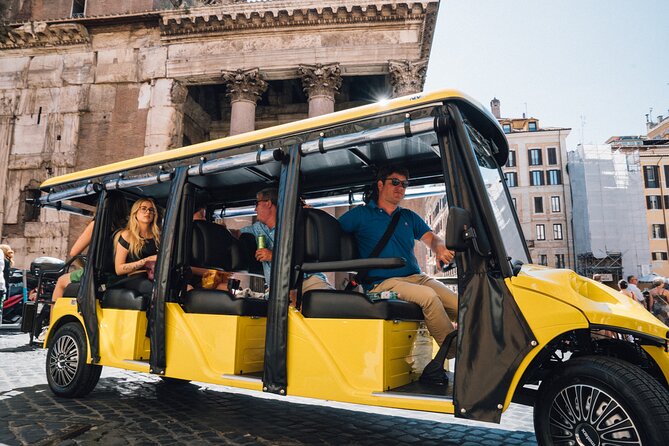
Between stops, the cart drives through parts of the historic center so you can see how the city is stitched together. One highlight here is Piazza Colonna, featuring the Column of Marcus Aurelius.
This column is described as one of only two preserved triumphal columns in Rome and around 1,800 years old. For many people, columns can blend into the background. A good guide turns that into something you notice: the monument becomes a clue about Roman power, propaganda, and how rulers wanted to be remembered.
This is one of the reasons a guided cart route feels more efficient than just arriving at photos. You learn what you are actually looking at before you get the camera out.
Stop 3: Trevi Fountain, coins, and the gelato timing
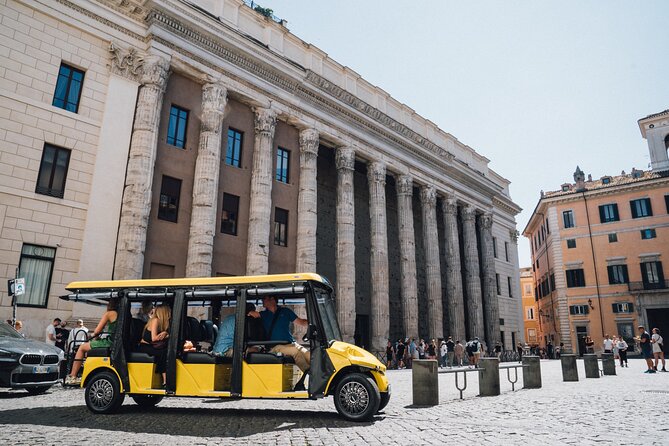
Next up is the Trevi Fountain. You get about 10 minutes, which is plenty for one good walk-in, one good look-around, and a few photos without feeling like you are trapped in a crowd for hours.
The coin tradition is part of the experience, and your guide also gives context about the fountain’s design and its predecessors. You will hear that it is designed by architect Nicolo Salvi and that the name ties back to Aqua Virgo, constructed in 19 BC.
The practical value here is the timing. Trevi is usually crowded, and it can be hard to coordinate everything on your own. With this tour, you have a planned window to enjoy the atmosphere and then keep moving.
And yes, the tour wraps in a sweet note with gelato. You should think of this as a bonus break that keeps the tour energy up without turning it into a long food detour.
Stop 4: Spanish Steps and Piazza di Spagna (quick, but meaningful)
The Spanish Steps and Piazza di Spagna are another classic photo anchor, and you get around 10 minutes here.
The tour frames the steps with their original purpose: the 138 steps were built to connect the Spanish embassy at the bottom to the church of Trinità dei Monti at the top. That connection between politics and religion, made in stone and stairs, is the kind of detail a guide is good at explaining.
A heads-up: with just 10 minutes, you will want to decide fast what you want from this stop. If you want the best view from the top, make that your priority. If you want the steps as a backdrop, arrive near the photo spots quickly and do not let indecision eat your time.
Stop 5: Piazza del Popolo and the northern gateway idea
At Piazza del Popolo, you get about 5 minutes. This might feel short, but it is a smart stop because it is framed as a gateway: a starting point for the Via Flaminia, the road north toward places like modern-day Rimini.
Even if you only catch a quick look, the takeaway is helpful. It reminds you that Rome is not just a pile of monuments. It is also a city shaped by movement, roads, and routes that turned into economic and cultural lifelines.
If you like understanding how Rome connects to the rest of Italy, this kind of stop gives you that bigger picture.
Drive past the Mausoleum of Augustus: Roman power, seen from the road
You also drive past the Mausoleum of Augustus, described as a large tomb built by Emperor Augustus in 28 BC on the Campus Martius. You are not parking here for a long visit, but you are seeing the monument as part of the city’s ongoing landscape.
This is another advantage of cart touring. Some sights are not designed for long, easy walks from every angle. Seeing them from the road, with narration, often gives you enough to recognize the structure later if you choose to visit more deeply on your own.
Stop 6: Piazza Navona, stadium-shaped square, and the Roman clues
Piazza Navona is where the tour slows just a bit in feel, even if it is still a short stop of about 5 minutes.
Your guide explains that Piazza Navona is built on the site of the Stadium of Domitian and follows the stadium’s open-space form. The Roman word agones relates to games, and you get the idea that this plaza’s current shape is tied to what used to happen here.
In other words, you are not just standing in a pretty square. You are standing on a location that has been used for public life for centuries, changing purpose but keeping its role as a gathering space.
If you want a practical tip: look down and picture how a stadium’s shape would guide crowds. It makes the place feel less like scenery and more like a real historical site.
Stop 7: Area Sacra di Largo Argentina, where archaeology matters
At Area Sacra di Largo Argentina, you get another short stop of about 5 minutes. This is one of the most compelling stops because it is described as a major archaeological site that appeared after demolition work revealed remains of four Republican-era temples.
This is the kind of stop that can surprise you. Many Rome highlights are famous because they are still spectacular. Largo Argentina is famous because you can see layers of the past uncovered in the modern city.
If you like history that feels tangible, this is a stop worth paying attention to, even in a quick window.
Stop 8: Piazza del Campidoglio and the Campidoglio staircase moment
Next comes Piazza del Campidoglio, with a brief stop in front of the grand staircase. The tour notes that the square follows Michelangelo’s criteria of uniform design and sits on Capitoline Hill, historically tied to a very ancient village and numerous Roman temples.
This is one of those Rome spots where your brain needs a second to connect the layers. A guide helps, because otherwise you might just see a dramatic staircase and move on. With context, it becomes a reminder that Rome is always rebuilding on top of itself.
Stop 9: Piazza Venezia and the Altar of the Fatherland
At Piazza Venezia, you take in the impressive monument to Victor Emmanuel II, often referred to as the Altar of the Fatherland. Your guide also connects the square name to Palazzo Venezia, a 15th-century palace built by Cardinal Pietro Barbo and later donated to the Republic of Venice in 1560.
This stop can be a turning point. By this point in the tour, you have already seen Roman structures, fountains, and plazas. Piazza Venezia adds the next layer, showing how later eras built big statements too.
That makes the tour feel like more than a “greatest hits reel.” It starts to feel like a timeline.
Monti neighborhood and Via Giulia drive: the in-between Rome you usually miss
Between major stops, the cart drives through Monti, Rome’s first ward, described as a place with cobblestones, antiques, artisans, and a mix of food and bars. You might not have time to explore inside shops, but seeing the neighborhood from the cart gives you a useful sense of where to wander later.
The route also includes a drive along Via Giulia, described as about a kilometer long and connecting Regola and Ponte Rioni. The idea here is that Rome’s “best parts” are not only the obvious monuments. The streets themselves carry design and architectural importance.
This is one of the most practical parts of the day. You come away knowing where you might want to go back on foot when you have more time.
Finishing outside the Colosseum: what to do next
The tour ends outside the Colosseum at Piazza del Colosseo. That is a great place to finish if you want to keep exploring independently after the tour.
Just remember: ending outside does not mean you have already entered. If you plan to tour inside, you will need to match your ticket time and walk from where the tour stops.
One more practical thought: if you are hungry or thinking about your next stop, you will have the energy of someone who just did a highlights overview, not someone who has been walking for hours. That is a subtle quality-of-life win.
Who this tour is best for, and who may want something else
This golf cart tour is a smart match if you:
- Want a first-day Rome overview without spending half the day walking
- Like guided context so landmarks mean more than photos
- Prefer small-group attention rather than a huge bus crowd
- Appreciate the included gelato and bottled water break
You might want to look at a different type of tour if you:
- Want long visits and extended time at each major monument
- Plan to spend a lot of time inside places like the Pantheon during this specific outing
- Get easily frustrated by short stop windows
It is also not ideal if you need very precise timing at a specific monument during the tour, since you should expect stops to run on a tight schedule.
Should you book this Rome city highlights golf cart tour?
If you want an efficient, guided “best of Rome” day without the stress of planning a route on your own, I think this is a strong buy. The headset setup, the small group size, and the mix of monuments plus street driving make the value feel real, especially with gelato and water included.
Book it if you want to leave Rome with a clear mental map and a short list of places you want to revisit. Skip it or consider a longer, ticket-focused option if you prefer deep time at fewer sites.
Either way, this is the kind of tour that can make your next hours in Rome easier, not harder, and that is the real goal of a highlights day.
FAQ
What is the duration of the Rome City Highlights golf cart tour?
It runs for about 2 hours 30 minutes.
How much does the tour cost?
The price is $104.00 per person.
Is the tour offered in English?
Yes. The tour information is provided in English.
Does the tour include entry tickets?
Pantheon admission is not included. Other stops listed are marked as free.
What is included in the price?
You get an electric golf cart, an English-speaking local guide and driver, headsets, snacks including one gelato per person, and bottled water.
How large is the group?
The tour has a maximum of 14 travelers, run with up to 2 vehicles. Seats are 7 per cart.
Where do I meet, and where does the tour end?
You meet at V. Monterone, 19, 00186 Roma RM, Italy. The tour ends outside the Colosseum at Colosseum Piazza del Colosseo, 1, 00184 Roma RM, Italy.
Is hotel pickup included?
No. Hotel pick-up and drop-off are not included.
Can I cancel for a full refund?
Yes, you can cancel for free up to 24 hours in advance for a full refund, based on local time.
Just introduced: the newest Rome write-ups
- Rome Fiumicino Airport Transfer in Luxury Private Transportation★ 4.5 · 339 reviews
- Vatican: Pope Francis Tomb and Papal Basilicas Tour★ 4.7 · 340 reviews
- From Rome: Sorrento, Positano & Amalfi Coast Day Trip★ 4.5 · 340 reviews
- Rome: Guided Colosseum Underground Tour★ 4.8 · 342 reviews
- Colosseum Arena Floor, Roman Forum & Palatine Hill Guided Group Tour★ 5.0 · 343 reviews
- Rome: Small Group Rome’s Dark Side – Ghosts & Legends Tour★ 4.9 · 343 reviews
- Rome: City Highlights Electric Bike Tour★ 4.9 · 343 reviews
City Tours, compared.
City Sightseeing Hop-on Hop-off Bus with Audioguide
Read our review →
City Sightseeing Hop-On Hop-Off Bus with Audio Guide
Read our review →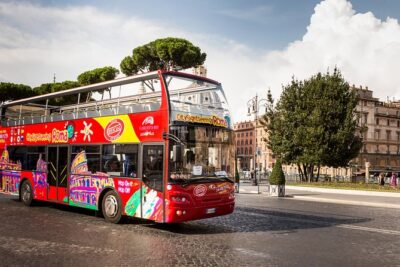
City Sightseeing Rome Hop-On Hop-Off Bus Tour
Read our review →

Fettuccine Pasta Cooking Class in Rome’s City Center
Read our review →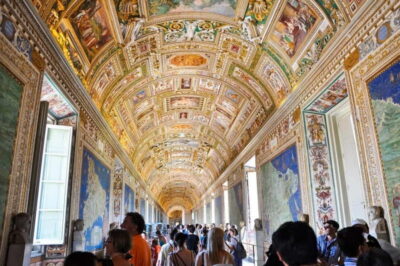
Vatican City: Vatican Museums & Sistine Chapel Entry Ticket
Read our review →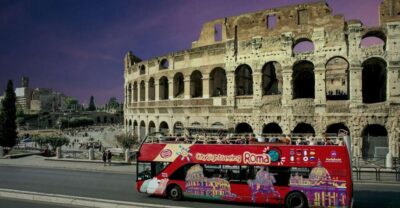

City Sightseeing Florence Hop-On Hop-Off Bus Tour
Read our review →Browse the lists this tour appears in