
Reviewed · SICILY TOURS
Benedictine Monastery of Catania – English Guided Tour
Catania’s monastery turns time into a walk. I love the scale of the late Baroque spaces and the way the tour connects them to what the site used for before it became a university. You also get the lava-built cellar story, not just pretty rooms, and that makes the whole visit feel grounded in place.
I also like how the English guides keep the pace moving and explain the big ideas clearly, with humor from guides like Carmen, Giovanni, and Nicola. One thing to consider: if you are hoping to reach a specific viewing platform, you might find access depends on the particular tour timing.
In This Review
- Key things you will notice right away
- Where the Benedictines Built a Whole City in Catania
- Getting Oriented Without Losing Your Hour
- The Late Baroque Cloisters and Why They Feel So Huge
- Kitchens, Dining Rooms, and the Novices’ Garden: Monastic Life Up Close
- Roman Houses Under a Mezzanine, Then a Library Above It
- The Lava Cellar and the 30-Year Restoration Story
- Price and Value: Why $11 Makes Sense Here
- What the Best Guides Do (So You Actually Enjoy It)
- Who Should Book This Tour
- Should You Book the Benedictine Monastery English Tour?
- FAQ
- How long is the Benedictine Monastery of Catania English guided tour?
- How much does it cost?
- What is included in the tour ticket?
- Where do I meet the guide?
- Is the guide available in English?
- What will I see during the tour?
- Is the tour wheelchair accessible?
- Does the tour skip the ticket line?
- Can I cancel, and what about flexible booking?
Key things you will notice right away
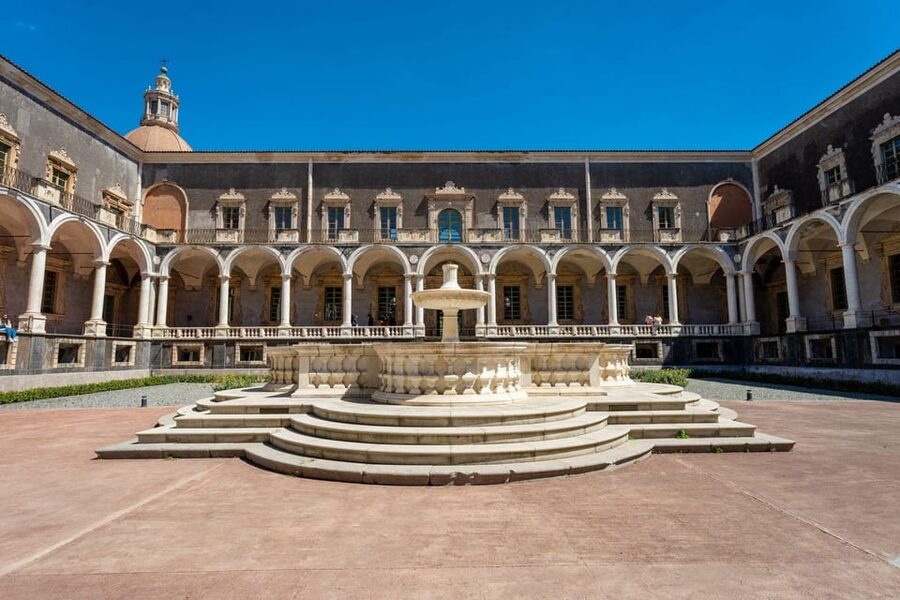
- Two cloisters and a huge, architectural feel for a monastery that’s among Europe’s biggest
- Roman houses under a modern mezzanine, showing how the past sits inside the present
- The University of Catania library connection (Unict), so you are touring an active academic site
- The 16th-century cellar space now used as part of the library experience
- Kitchens, dining areas, and the novices’ garden, so daily monastic life is part of the story
- Guides who stay lively in clear English, often answering questions without rushing you
Where the Benedictines Built a Whole City in Catania
The Benedictine Monastery of San Nicolò l’Arena sits in Catania like a history lesson you can walk through. This isn’t a small chapel where you glance at a statue and move on. It’s a large monastic complex where Roman-era material, centuries of religious life, and modern university use overlap on the same footprint.
The tour is interesting because it does not treat the monastery like a museum display only. You get shown how the space changed over time, and you can see the logic of the layout as you move between areas. That helps if you get lost in big complexes easily, because your guide keeps pointing out what you are looking at and why it matters.
Introductions we still owe you around Catania



Getting Oriented Without Losing Your Hour
You meet at the monastery entrance area on Piazza Dante, after the main gate. The info point is in the courtyard on the right. For a place this big, getting your bearings matters, and the meeting point is designed to get you in quickly.
The big practical win is the live English guide and the fact that the tour includes access to parts that are not normally open. That means you are not stuck outside areas behind barriers, or waiting for an audio app to do the heavy lifting. The duration is 75 minutes, which is long enough to see multiple key zones, but short enough that you can still pair this with other Catania sights the same day.
If English is not your main language, written translations in French or Spanish can be provided. That detail is worth planning around if you want to keep up without turning the visit into a guessing game.
The Late Baroque Cloisters and Why They Feel So Huge
One of the reasons people rave about this tour is visual impact. You step into the monastery’s cloister areas and quickly realize this is built for grandeur, not just function. The architecture is late Baroque in spirit, and it gives you that “how did they build this?” reaction even if you are not an architecture nerd.
You will visit both cloisters. That matters because you start to feel the rhythm of the complex. Cloisters are not just scenic walkways. In a monastery, they are connective tissue, a place where circulation, contemplation, and daily routine meet. Seeing two gives you better context than just one courtyard glance.
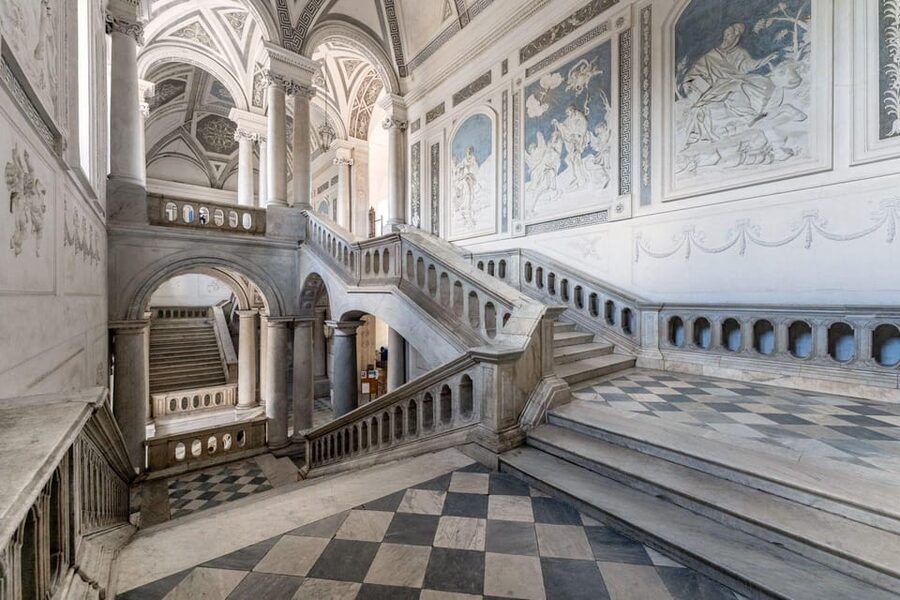
The tour also highlights the work of architect Vaccarini and includes stops such as the monumental staircase. When you see a big staircase in a monastic setting, it helps to understand how movement was organized for status, ceremony, and access to different levels of the complex. It’s one of those details that clicks once your guide points it out.
Kitchens, Dining Rooms, and the Novices’ Garden: Monastic Life Up Close
It is easy to picture monasteries as quiet and distant. This tour nudges you to think about meals, training, and the day-to-day physical reality of living in a complex. You spend time around the famous 18th-century kitchens and related spaces, including areas that connect to dining routines and storage functions.
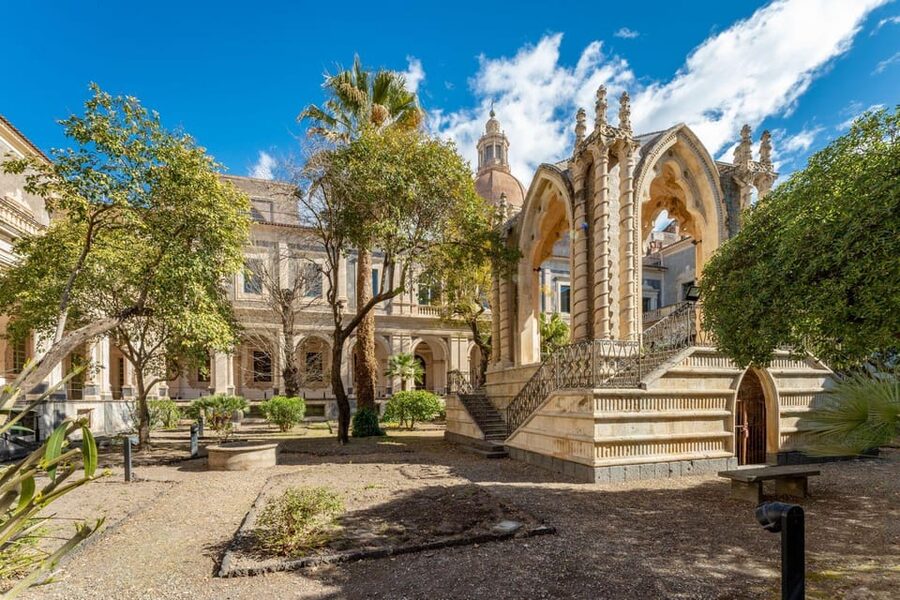
You also get the Garden of the Novices, which helps shift your mental picture from decorative architecture to education and formation. In practical terms, novices and training spaces tell you how the monastery supported new members and how life inside was structured long before “tour route” planning ever existed.
The experience here is not about memorizing facts. It’s about making sense of the layout. Once you connect kitchen areas with dining and garden spaces, the monastery feels more like a working system than a backdrop.
Also on the Catania guest list:
- Catania: Etna Sunset Tour with Pickup and Drop-off
★ 4.8 · 1,348 reviews - Mt. Etna and Taormina village full day tour from Catania
★ 5.0 · 1,155 reviews - From Catania: Mount Etna Sunset Tour with Tasting and Cave
★ 4.7 · 1,119 reviews - Catania: Etna Morning Excursion with Tasting and Pickup
★ 4.8 · 820 reviews
Roman Houses Under a Mezzanine, Then a Library Above It
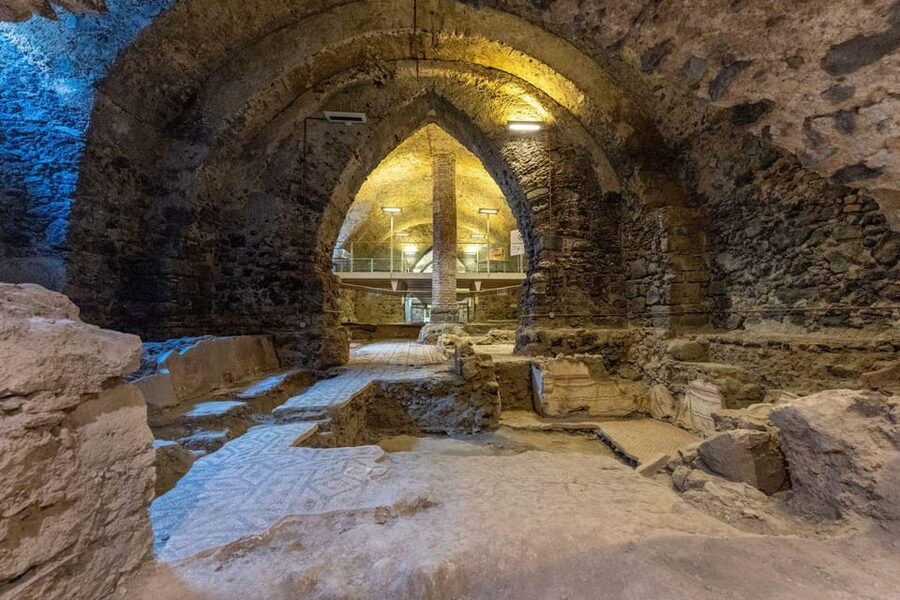
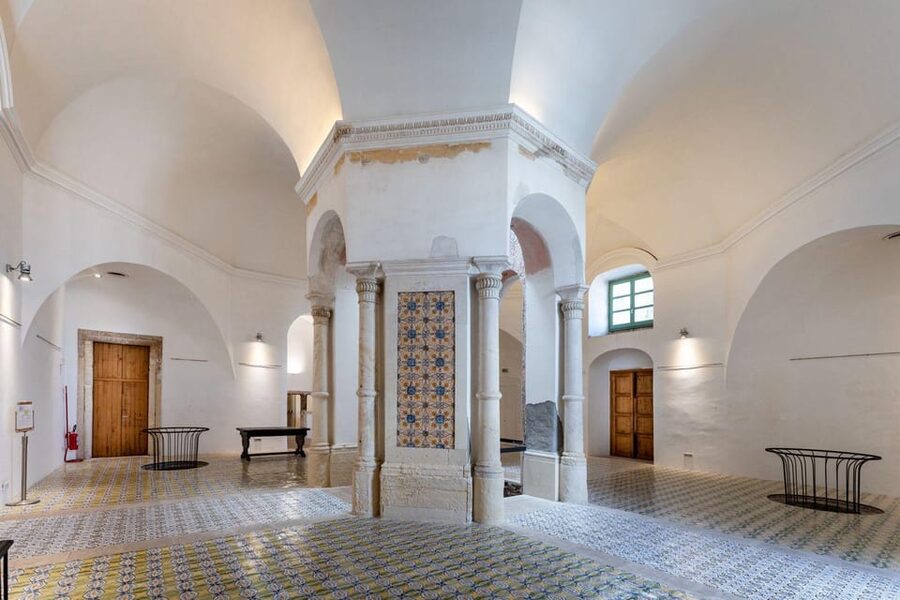
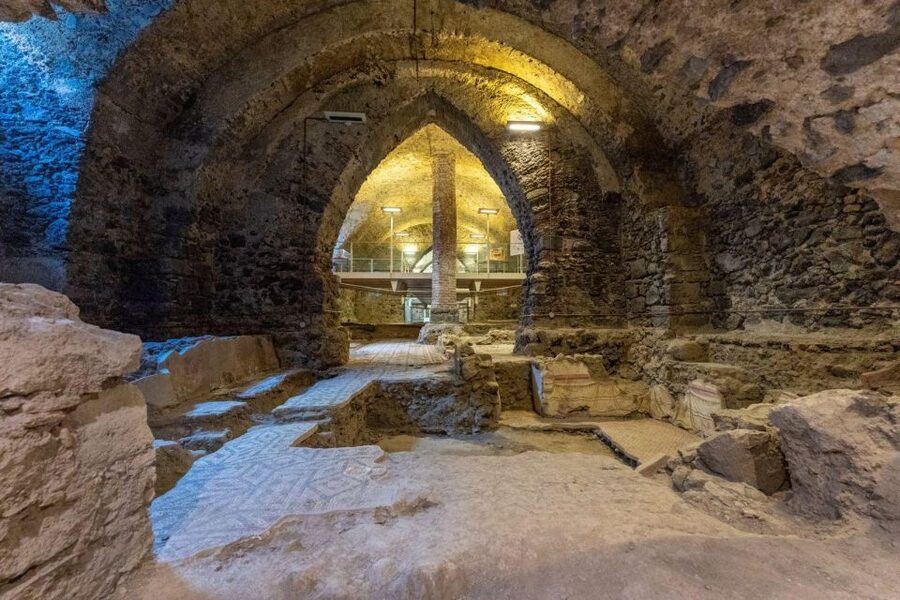
This is one of the most distinctive parts of the visit. You continue to see Roman houses visible right under a modern mezzanine that students use as part of the library. That single visual idea is powerful: you are literally standing in one layer of time while another layer sits below your feet.
In most archaeological sites, you either see ruins or you see a modern building. Here, you see both in the same walking experience. The monastery makes the Roman past part of everyday academic life instead of treating it as something sealed off and untouchable.
The tour also points you to the monastery’s important library spaces, including the section tied to the Department of Humanities at the University of Catania. You are not just visiting “a library.” You are seeing how a site built for religious living got repurposed with academic use while still keeping major historic elements in view.
The Lava Cellar and the 30-Year Restoration Story
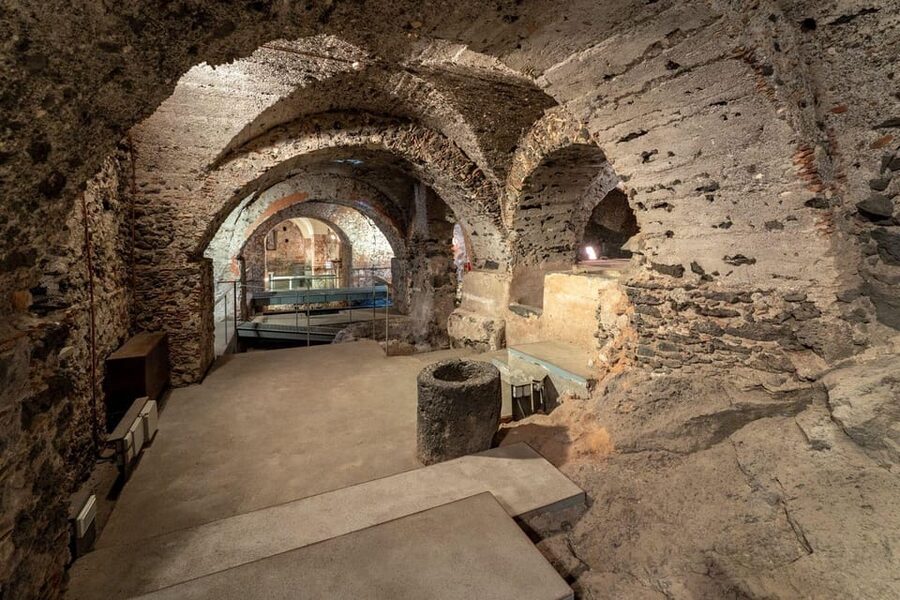
If you only remember one technical detail from this tour, make it this: you get to see a cellar built on the lava. That means the site’s volcanic geography is not a background detail. It’s part of the building logic.
You also visit the 16th-century cellar, now used as part of the library experience. In a monastery, cellars are practical spaces, tied to food storage and preservation. Here, the function is still in the spirit of storage and containment, but the modern use gives the historic space a second life.
Restoration is another big theme. The monastery refurbishment project was part of a longer effort lasting more than 30 years, and the contemporary refurbishment project is associated with architect Giancarlo De Carlo. Why should you care? Because it explains why you can visit areas that many visitors would otherwise never see. Restoration is not just about cleaning stone. It’s about stabilizing, adapting, and negotiating between preservation and modern access.
One more practical benefit: the underground or lower-level areas tend to be a welcome break on a hot Catania day. Reviews note the cooler feeling of the lower spaces, and that lines up with what this site layout suggests.
Price and Value: Why $11 Makes Sense Here
For about $11 per person and 75 minutes, this is strong value in Catania. You are paying for more than entry. You are paying for guided access to areas you might not reach on your own, including key spaces such as the cloisters, kitchen areas, and the library-linked cellar.
The value equation also improves because you get context. Big monasteries are confusing if you are on your own. A short guided loop helps you understand what you are seeing while the spaces are still fresh in your mind. And your guide time is used well, because the tour highlights multiple time periods, not just one era.
If you are building a “Catania basics” day, this tour is an efficient way to understand the city beyond streets and viewpoints. It ties the city’s past to what is happening there now, through the university presence.
What the Best Guides Do (So You Actually Enjoy It)
A lot of the praise centers on how guides run the tour. Names like Carmen, Giovanni, and Nicola show up repeatedly, and the consistent theme is clear spoken English plus a lively style. You will likely find your guide answers questions thoughtfully, and the pace is generally relaxed enough to look up at details and not just shuffle forward.
One more pattern from the experience: humor helps. Monastery tours can turn into a lecture. Here, the best guides keep it human, with stories and explanations that help you remember why rooms exist. If you care about getting meaning out of architecture, that matters as much as the architecture itself.
Who Should Book This Tour
This tour is a good fit if you want:
- A compact way to see major monastery spaces in 75 minutes
- Clear English narration that connects Roman traces, Baroque architecture, and modern university use
- A guided route that includes areas that are not always open
- More than one kind of interest, architecture plus archaeology plus daily-life spaces like kitchens and gardens
It also makes sense if you like practical history. The monastery is not just a pretty ruin. It explains how people lived, trained, stored food, and adapted the space over centuries.
Should You Book the Benedictine Monastery English Tour?
Yes, if you want a high-impact, low-stress introduction to Catania’s cultural heart. At $11 for a guided visit to major areas that are often closed, you get a lot of value per hour. The English guidance, the chance to see Roman houses, and the lava-based cellar make this more than a standard monastery stop.
Consider booking with a backup mindset if you have a very specific wish, like a particular viewing platform, since access can depend on timing.
FAQ
How long is the Benedictine Monastery of Catania English guided tour?
The tour lasts 75 minutes.
How much does it cost?
The price is $11 per person.
What is included in the tour ticket?
It includes access to the monastery (including parts not normally accessible), a live English guide, and baggage storage at the meeting point.
Where do I meet the guide?
As soon as you pass the main gate on Piazza Dante, the info point is in the courtyard on the right.
Is the guide available in English?
Yes, the tour offers a live guided tour in English. Written translations in French or Spanish can be provided if English is not your main language.
What will I see during the tour?
You will see major areas including the cloisters, the kitchen, the novices’ garden, the library areas, the 16th-century cellar, the Roman houses visible under a mezzanine used by students, and other notable monastic spaces.
Is the tour wheelchair accessible?
Yes, the tour is listed as wheelchair accessible.
Does the tour skip the ticket line?
Yes, it includes skip the ticket line.
Can I cancel, and what about flexible booking?
Free cancellation is offered up to 24 hours in advance for a full refund, and there is also a reserve now & pay later option to keep plans flexible.
Just introduced: the newest Catania write-ups
- Catania: Valley of the Temples and Turkish Steps with Snack★ 4.5 · 346 reviews
- The Original Catania Street Food and Market Tour by Streaty★ 5.0 · 345 reviews
- From Catania: Taormina, Savoca, & Castelmola Tour w/ Lunch★ 4.8 · 355 reviews
- ETNA SUNSET: GUIDED TOUR OF ETNA WITH PICKUP FROM CATANIA★ 5.0 · 371 reviews
- Catania: Syracuse, Ortigia, and Noto Tour with Brunch★ 4.6 · 404 reviews
- Catania: Etna Nature Tour with Hiking, Cave Visit, & Tasting★ 4.7 · 502 reviews
- Catania: Underground Catania Tickets and Guided Tour★ 4.6 · 536 reviews
Sicily Tours, compared.

Mount Etna Morning or Sunset Day Trip with Tasting
Read our review →
Mount Etna: Guided Volcano Summit Hiking Tour with Cable Car
Read our review →

From Trapani: Cruise to Favignana and Levanzo with lunch
Read our review →
Sunset Jeep Tour of Mount Etna and Lava Flow Caves
Read our review →
Palermo Original Street Food Walking Tour by Streaty
Read our review →
Mount Etna: Trek to 3000m with cable car and jeep
Read our review →Browse the lists this tour appears in