
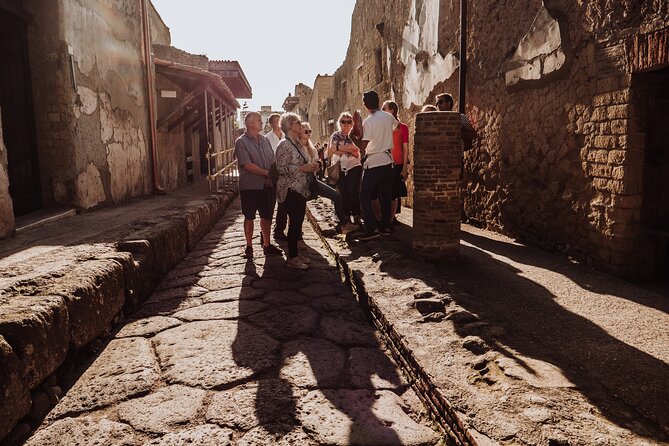
Reviewed · POMPEII & VESUVIUS TOURS
Herculaneum Small Group Tour and Ticket With an Archaeologist
Herculaneum is history you can walk through. This archaeologist-led small group tour takes you on a guided walk through top houses, baths, and monuments, with skip-the-line entry so you are not stuck in queues. When you get a guide like Luciano Leone or Michele, you also get stories that connect building details to how people actually lived.
The one thing to plan for is the pace. It is a walking tour with a lot of time on your feet, so if you need frequent sitting breaks, you might find the rhythm a bit demanding.
In This Review
- Key highlights that make this tour worth your time
- Herculaneum in two hours, what you will actually see
- Price and what you really get for $53.81
- Meeting place at the Ticket Office, plus easy arrival tips
- What the archaeologist guide adds, beyond facts on a sign
- Your stop-by-stop route through Herculaneum highlights
- House of the Deer
- La Terrazza di M. Nonio Balbo
- College of the Augustales
- Casa del Rilievo di Telefo
- Partem Domus lignea, Casa del Tramezzo di Legno
- House of the Skeleton
- Central Thermae
- House of the Black Salon
- Casa Sannitica
- Casa del Bel Cortile
- House of the Grand Portal
- Pacing, comfort, and weather planning
- Who should book this tour
- Quick value check, skip the line, then keep exploring
- Should you book this Herculaneum small-group archaeologist tour?
- FAQ
- How long is the Herculaneum small group tour with an archaeologist?
- Is the tour in English?
- What is the group size limit?
- Where does the tour start?
- Are skip-the-line tickets included?
- What is included in the price?
- Are entrance tickets included, and how much are they if booked separately?
- Can I bring a dog?
- Is there free cancellation?
Key highlights that make this tour worth your time
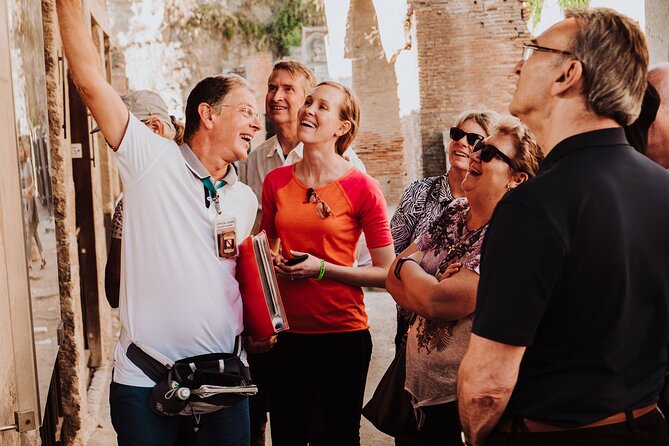
- Skip-the-line tickets help you start fast at the Herculaneum entrance.
- Maximum 20 people keeps the group small enough to actually see what the guide points out.
- Headsets make it easier to follow the narration, even when the group bunches up.
- A working archaeologist style of explaining, not just a script, turns walls and floors into real evidence.
- Wood and carbonised traces at multiple spots make the site feel shockingly immediate.
- Men’s and women’s bathing is built into the tour route, so you see everyday routines, not just big monuments.
Herculaneum in two hours, what you will actually see
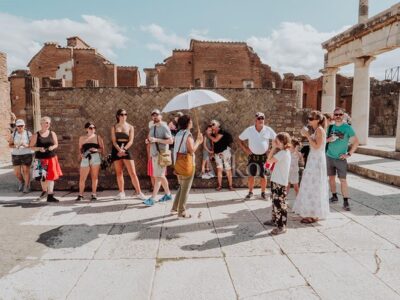
This is a tightly focused way to see Herculaneum highlights without turning your day into a logistics puzzle. The tour runs about 2 hours and moves you through a sequence of stops that cover the range of what makes the site special: wealthy homes, cult or civic spaces, and the public baths.
You start at the Herculaneum Ticket Office, then the route carries you deeper into the archaeological area. Because the plan is pre-set, you do not have to decide on the fly what is worth your limited time. That is a real advantage when you want a meaningful visit but you also want to keep your energy.
More of Pompeii and the volcano that buried it:

Price and what you really get for $53.81
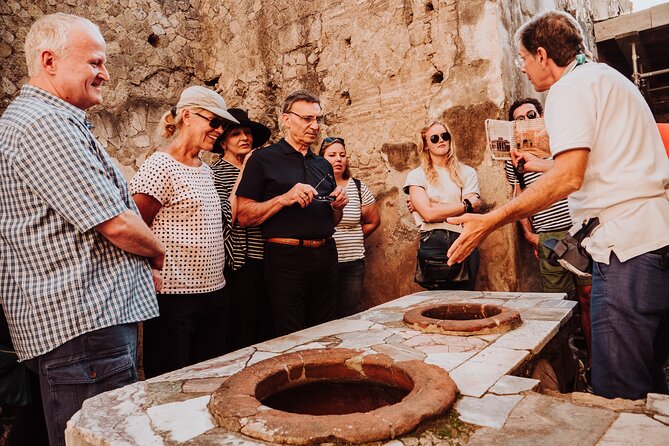
At $53.81 per person, you are not just paying for a guide. Your tour includes the Herculaneum entry tickets plus a licensed guide with archaeological background and headsets.
The entry ticket price for adults is listed at 16 euros, and there is a reduced 2 euros rate for EU citizens ages 18 to 25. Since admission is part of the package, the money you spend is mostly going toward interpretation, pacing, and keeping the whole thing readable with headsets.
In practice, that means you should get more than a quick walk past buildings. You are paying for someone to tell you what to look at, what each place likely meant, and how the site’s surviving features fit together.
Meeting place at the Ticket Office, plus easy arrival tips
The tour meets at the Ticket Office of the Herculaneum ruins. From there you walk into the site with the group.
Getting there is straightforward either by car or train:
- By car: park near via Pignalver (there is close parking, described as not guarded).
- By train: go to Corso Resina 1, then walk about 10 minutes from the Circumvesuviana station.
If you are using public transit, I would give yourself a little cushion. The route is short, but you do not want to arrive rushed, because your tour starts at the ticket office and headsets only work if you get settled early.
What the archaeologist guide adds, beyond facts on a sign
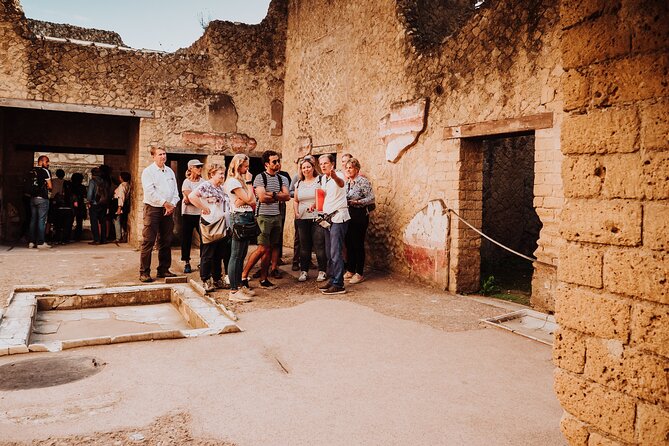
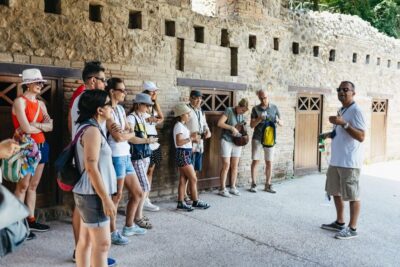
The big value here is the way the guide reads the site. With an archaeologist background, you get explanations that connect architecture, decoration, and small finds to daily life. That is especially helpful in Herculaneum, where the buildings can look similar until someone points out what makes each one distinct.
A standout example from past experiences is how some guides bring extra teaching tools. Luciano Leone, for instance, is noted for using reconstructions and other resource material to help you picture how parts of the buildings would have looked in use. Even if you are not a total history nerd, that kind of visual context makes the site click fast.
Also, the headsets are not an afterthought. With a maximum of 20 people, you still want clear audio when you are walking close to walls, through doorways, or near groups of other visitors. Here, you get that support.
Introductions we still owe you around Naples
- Naples: Naples Underground Entry Ticket and Guided Tour
★ 4.4 · 21,781 reviews - From Naples: Pompeii Ruins & Mount Vesuvius Day Tour
★ 4.3 · 11,459 reviews - From Naples: Sorrento, Positano and Amalfi Full-Day Tour
★ 4.6 · 10,988 reviews - From Naples: Sorrento, Positano & Amalfi Coast – Small Group Tour
★ 5.0 · 8,643 reviews
Your stop-by-stop route through Herculaneum highlights
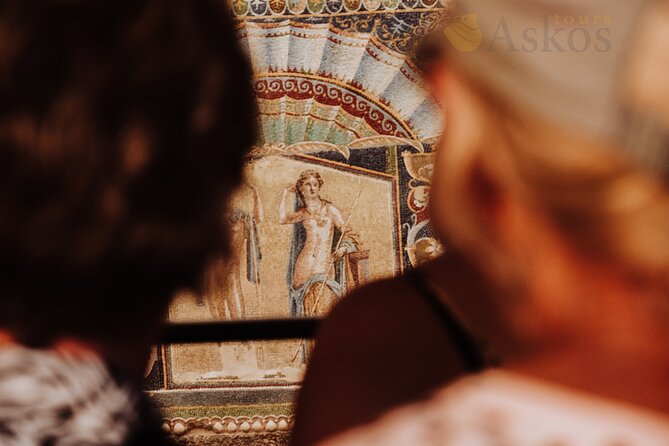
The tour includes 11 focused stops. Many of them are short time blocks, around 10 minutes each, so the guide is doing the heavy lifting for orientation.
House of the Deer
This house gets its name from marble statues of stags or deer found in the peristyle. It is a good first stop because it signals immediately that you are in a wealthy residential world, not just ruins in the abstract.
When you are looking, try to focus on how sculpture, space, and layout all work together in a home like this.
La Terrazza di M. Nonio Balbo
Next you visit La Terrazza di M. Nonio Balbo, tied to a major benefactor, M. Nonius Balbus. On his death, he was honored, and those honors are described in a long inscription on his funeral altar.
This stop is where the tour’s “people mattered” angle becomes clearer. You are not only seeing buildings, you are seeing how status and public recognition were recorded.
College of the Augustales
The College of the Augustales is thought to connect to the cult of Emperor Augustus, and it may have served as a headquarters of the Collegium Augustalium, or possibly even a local civic role.
I like this stop because it shifts you from private life to public or religious organization. You start to understand that neighborhoods in Roman-era towns were not only homes, they were also institutions.
Casa del Rilievo di Telefo
At Casa del Rilievo di Telefo, you look at a standout domestic feature tied to a relief connected to Telefo. The house is suggested as possibly linked to a leading benefactor connected with Marcus Nonius Balbus, and it has a notable detail: it has its own private access to the adjoining Suburban Thermae.
This is one of those “only in the details” stops. Private access to baths suggests comfort and status, and it helps you imagine how different classes used shared spaces.
Partem Domus lignea, Casa del Tramezzo di Legno
Here you see an especially important reminder that not everything survived in stone. This stop is centered on the elegant wooden partition remains.
If you like archaeological “proof moments,” this is it. The tour route is short, but this kind of surviving material detail tends to be the most memorable.
House of the Skeleton
The House of the Skeleton is named after human remains found in a second-floor room in 1831. It is a heavy stop, but it is also important because it makes the disaster human.
When I visit places like this, I try to keep my eye on how rooms are laid out, then let the guide’s context do the emotional work.
Central Thermae
Next comes the Central Thermae, built around the start of the 1st century AD. The big detail here is that, like was common practice, the baths are divided into men’s and women’s areas, each with separate entrances.
This stop is valuable because it turns a “bathhouse equals big room” idea into something concrete. You can actually see that privacy and gendered routine were built into the design.
House of the Black Salon
At the House of the Black Salon, you find a more luxurious mansion. The entrance is described as monumental, and you can still see carbonised remains of doorposts and the lintel.
This is where surviving traces of wood and door structure add drama. You get a sense of how entranceways and thresholds worked, and why they mattered in daily life.
Casa Sannitica
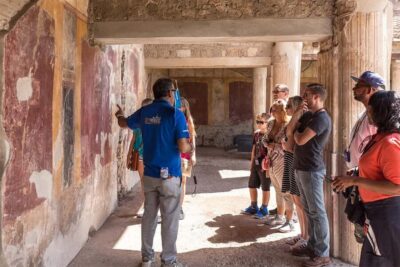
Casa Sannitica is arranged in a style typical of the Samnites. The tour highlights the splendid atrium, a surrounding gallery with Ionic columns, and rooms decorated with frescoes.
This is a great stop if you like decoration and layout. Frescoes and columned galleries help you visualize how social and residential space blended.
Casa del Bel Cortile
This is one of the most original houses on the route: Casa del Bel Cortile has a courtyard with a stairway and a stone balcony instead of an atrium.
If you have been to Roman ruins before, this is an easy way to see that domestic architecture was not copy-paste everywhere. It changes how you imagine movement through the home.
House of the Grand Portal
The tour ends this highlight run at the House of the Grand Portal in the central archaeological area. You get a domus with various environments, including collonnati and frescos, plus visible charred remains of wooden elements.
This is a strong closing stop because it brings together multiple categories: size, ornament, and the evidence of what once existed.
Pacing, comfort, and weather planning
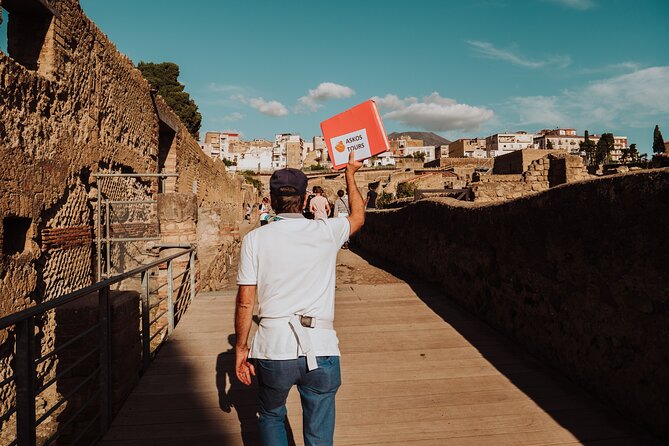
This tour operates in all weather conditions, so bring the right clothing. There is a common pattern in the experience: you do a lot of standing and walking, with limited chance to sit.
Also, the stops are short. That is part of why this tour works well in two hours, but it means you should come ready to walk, look, and listen without expecting long rests.
Quick practical tip: if rain is possible, protect your camera and keep your shoes grippy. Uneven ground plus wet stone is not the place to test your newest sneakers.
Who should book this tour
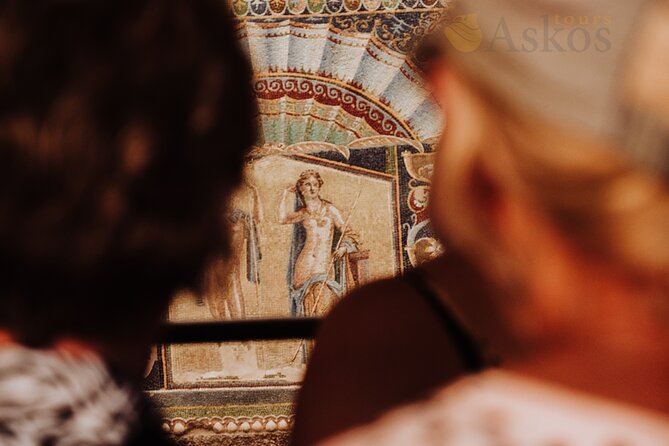
I think this is ideal if:
- you want an organized plan and do not want to guess which houses to prioritize
- you care about how people lived, not just big-name monuments
- you prefer a smaller group atmosphere, capped at 20 people
- you want context from a guide with archaeological background
It also works well for families, including teens, and for people who appreciate steady explanation rather than a fast museum sprint. If you have hearing needs, the use of headsets is a practical advantage.
Quick value check, skip the line, then keep exploring
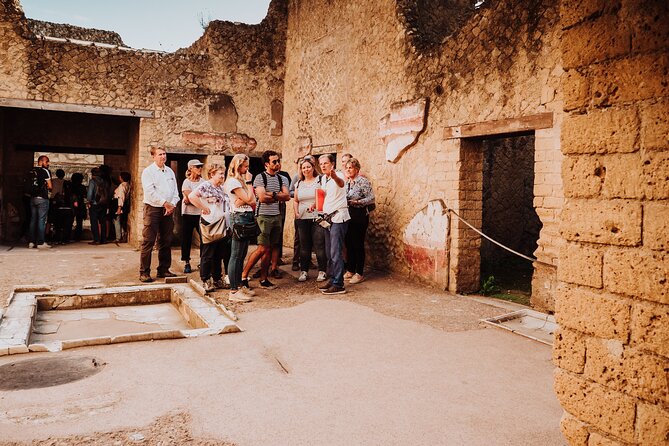
Because the tickets are included, you can think of the tour as your guided backbone and then use your time after the walking portion to see more at your own pace, if you want. The guided part helps you understand what you are looking at, so later exploration becomes easier.
Should you book this Herculaneum small-group archaeologist tour?
Yes, if you want the most efficient route through Herculaneum with real interpretation. The combo of archaeologist guide, headsets, skip-the-line entry, and a small group size makes this a strong value for a two-hour visit.
I would only hesitate if you cannot manage standing and walking for the full duration. If that is you, it may be worth choosing a slower format, or going in knowing you will need breaks.
FAQ
How long is the Herculaneum small group tour with an archaeologist?
It lasts about 2 hours.
Is the tour in English?
Yes. The tour is offered in English.
What is the group size limit?
The tour has a maximum of 20 travelers per guide.
Where does the tour start?
The meeting point is the Ticket Office of the Herculaneum ruins.
Are skip-the-line tickets included?
Yes. The tour includes skip-the-line tickets, so you should not wait in long queues.
What is included in the price?
Included items are guidance and assistance, entrance fee to Herculaneum, a licensed archaeologist-background guide, small group format, and headsets.
Are entrance tickets included, and how much are they if booked separately?
The tour includes the entry tickets. The listed entry ticket prices are 16 euros for adults and 2 euros for EU citizens ages 18 to 25.
Can I bring a dog?
Dogs are allowed in the Herculaneum Archaeological Park, but they must be on a leash or muzzle, and you must have bags for droppings. Access rules inside certain areas also apply, including limits in the Antiquarium premises, Boat Pavilion, and domus with mosaic floors.
Is there free cancellation?
Yes, you can cancel for a full refund up to 24 hours in advance. If you cancel less than 24 hours before, the amount is not refunded.
Just introduced: the newest Naples write-ups
- Capri Boat Tour from Naples – Small Group, Swim & Relax★ 5.0 · 341 reviews
- Pompeii Guided Tour from Naples with Skip-the-Line Entry★ 5.0 · 343 reviews
- Procida Island Tour by Boat 2h 15m with Swimming and Underwater Photos★ 5.0 · 344 reviews
- From Naples: Caserta Palace Ticket and Train with Audioguide★ 4.3 · 348 reviews
- Naples Shore Excursion: Private Tour to Sorrento, Positano, and Amalfi★ 4.5 · 352 reviews
- From Naples: Capri Boat Day Trip with Drinks★ 4.7 · 354 reviews
- From Naples: Sorrento, Positano and Amalfi Tour★ 4.6 · 361 reviews
Pompeii & Vesuvius Tours, compared.
Entry Ticket and Guided Tour with an Archaeologist
Read our review →

Pompeii Small Group Tour with an Archaeologist
Read our review →
Pompeii, Amalfi Coast and Positano Day Trip from Rome
Read our review →Browse the lists this tour appears in