
Reviewed · POMPEII & VESUVIUS TOURS
Pompeii: Group Tour with an Archeologist Guide
Pompeii can swallow a whole day. This 2-hour guided loop gives you the big story fast, with skip-the-line entry and a pro guide who translates the ruins into real Roman life. I especially like the whisper headsets for hearing clearly in a larger group, and the focus on the most important western highlights. The main drawback is simple: you will not see everything Pompeii offers in only two hours, so go in ready to prioritize.
The tour centers on walking through the ruined city buried by Vesuvius in 79 AD, with frequent stops at the places that help the timeline click. If you want the most famous stops without getting stuck behind slow-moving lines, this format is a smart fit. Just bring comfortable shoes, and expect it to feel like Pompeii, not a museum lobby.
In This Review
- Key things I’d watch for before you go
- A smart way to cover Pompeii in just two hours
- Meeting at Tempio Travel and getting into Porta Marina
- The western Pompeii loop: Marina Gate, Forum, Basilica, and more
- Marina Gate to the public heartbeat of the city
- Forum and Basilica: where civic life happened
- Baths: Pompeii’s social engine
- Lupanar brothel: uncomfortable, but historically revealing
- Main street and theaters: movement and entertainment
- Frescoes, houses, and the details that bring Pompeii to life
- Plaster casts: a hard moment that clarifies everything
- Garden of the Fugitives: what the site teaches about last moments
- House of the Tragic Poet and House of the Golden Cupid
- How the archaeologist guide changes the experience
- Whisper headsets: why they matter in practice
- Group tour reality: pace, heat, and comfort tips
- Value check: what you get for around $50.11
- After the tour: ideas in modern Pompeii (and a church stop)
- Who this Pompeii tour is best for
- Should you book this Pompeii group tour?
- FAQ
- How long is the Pompeii group tour?
- Where does the tour start and end?
- What is included in the tour price?
- Which languages are offered?
- What should I bring?
- Is luggage allowed?
- Is the site free on the first Sunday of the month?
Key things I’d watch for before you go
- Skip-the-line entry so you spend your time walking, not queuing.
- Whisper headsets that make listening easier in a big group.
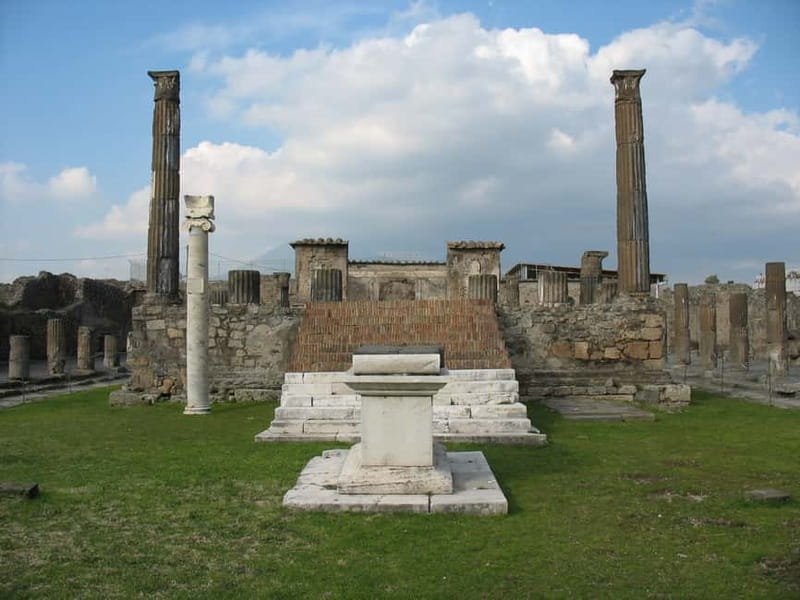
- Western Pompeii highlights like the Forum, Basilica, baths, and the Lupanar brothel.
- Plaster casts that turn tragedy into something you can picture.
- Named houses including the House of the Tragic Poet and the House of the Golden Cupid.
- A smart end-of-tour nudge toward the modern city, including a nearby church recommendation.
A smart way to cover Pompeii in just two hours
Pompeii is one of those places that looks straightforward from a distance and then, up close, becomes huge. Streets, storefronts, baths, temples, homes, and public buildings all overlap in your brain unless someone helps you build a path.
That is where this tour earns its keep. You get a guided walk designed to hit the places that answer the big questions: What did people do here? Where did they gather? How did daily life work? And, most famously, how does a volcanic disaster become visible centuries later?
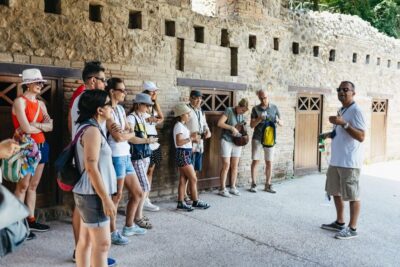
I like that the tour keeps you on a single “story track.” You are not wandering. You are moving through a curated slice of western Pompeii, and your guide connects the dots as you go. It is also a good way to beat decision fatigue. When you arrive on-site and see long lines and map chaos, having a plan already made is a big win.
More of Pompeii and the volcano that buried it:


Meeting at Tempio Travel and getting into Porta Marina
You meet at the Tempio Travel office, on the 1st floor of the Circumvesuviana train station. One traveler note that helped me imagine the start: the meeting office has a red logo, and you take the stairs up to the second floor to check in. That detail matters because station buildings can confuse you when you are on a tight schedule.
From there, the tour moves toward the entrance area for the guided route. You should also expect the usual Pompeii on-site flow: processing through security and then into the archaeological area. The skip-the-line entrance tickets help, but you are still entering a working site with controlled access.
Practical tip from the vibe of the tour: travel light. Luggage or large bags are not allowed, and the tour is built for walking. If you are coming from a station with a backpack, keep it compact and easy to manage.
The western Pompeii loop: Marina Gate, Forum, Basilica, and more
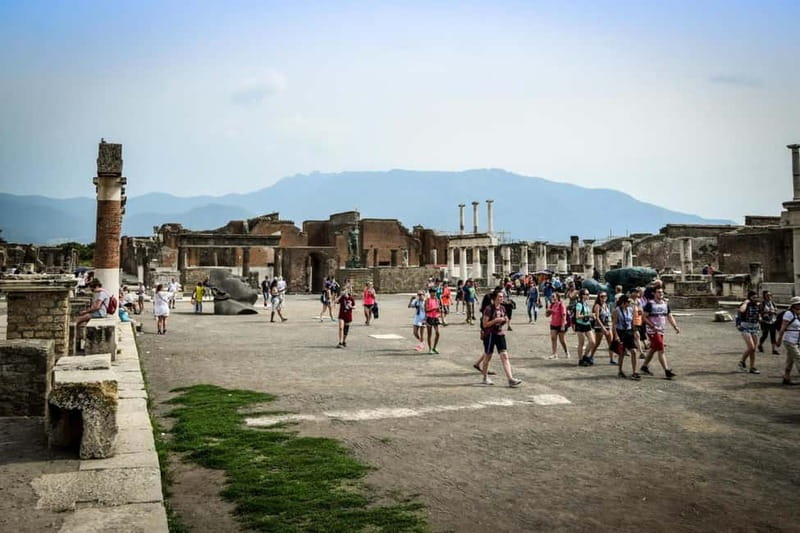
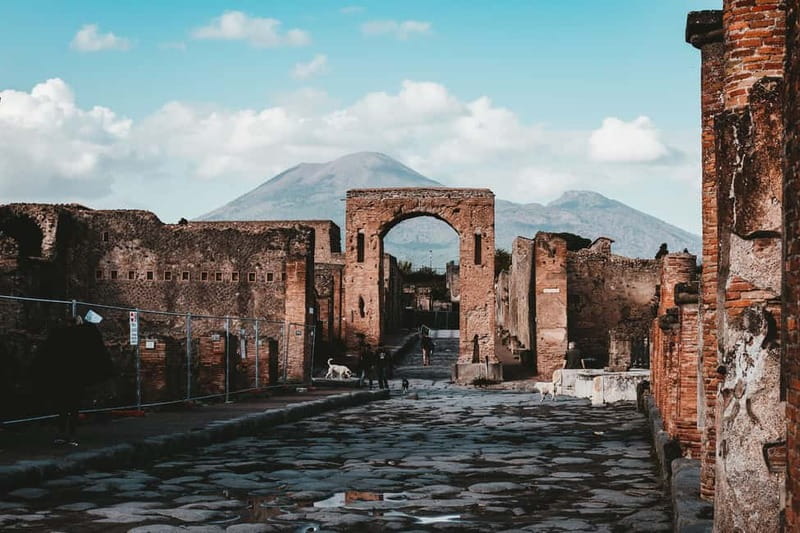
The walk starts near Porta Marina (Marina Gate), which is a strong entry point for understanding how Pompeii connected to the outside world. From there, you transition into the public core of the city, where people organized life around commerce, religion, and politics.
Here are the stops that matter most in this western route, and what you should pay attention to at each one:
Marina Gate to the public heartbeat of the city
The Marina Gate area is a good warm-up. It gives you orientation quickly, so the ruins feel less like random walls and more like a city plan. Even if you only know Pompeii from photos, you start seeing how movement worked: where you would enter, where you would funnel toward the center, and how people would transition from “arrival” to “daily business.”
Introductions we still owe you around Naples
- Naples: Naples Underground Entry Ticket and Guided Tour
★ 4.4 · 21,781 reviews - From Naples: Pompeii Ruins & Mount Vesuvius Day Tour
★ 4.3 · 11,459 reviews - From Naples: Sorrento, Positano and Amalfi Full-Day Tour
★ 4.6 · 10,988 reviews - From Naples: Sorrento, Positano & Amalfi Coast – Small Group Tour
★ 5.0 · 8,643 reviews
Forum and Basilica: where civic life happened
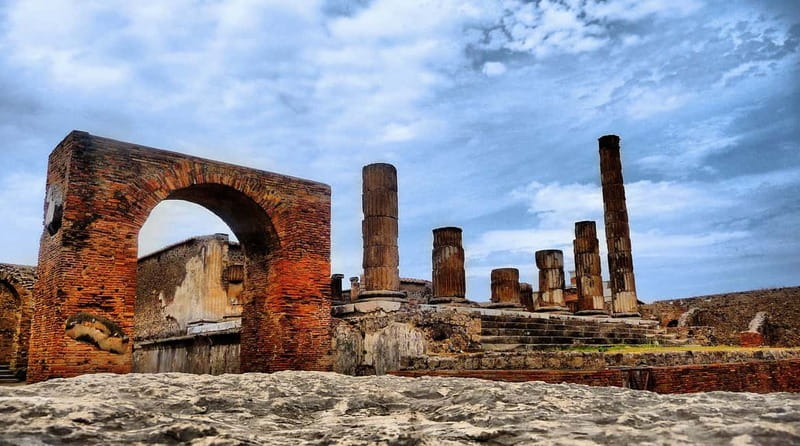
The Forum is Pompeii’s central stage for public life. If you want to understand the Roman “why” behind everything, this is one of your best bets. The Basilica nearby helps you picture the meeting and business spaces where people conducted transactions, discussed issues, and gathered.
If you tend to get lost in ruins, the Forum and Basilica combo helps you anchor your mental map. It is the difference between seeing stones and understanding purpose.
Baths: Pompeii’s social engine
The public baths are on the route, and they are more important than they sound. Roman baths were not just hygiene. They were meeting points, gossip hubs, and places to spend time. Walking past them with a guide helps you see how even everyday routines had a built-in social rhythm.
Lupanar brothel: uncomfortable, but historically revealing
You also visit the Lupanar, the brothel area. This stop can feel jarring if you are expecting only grand temples and tidy streets. That is exactly why it is valuable. Pompeii preserves ordinary life, and the Lupanar is a direct window into the reality of the city.
Your guide’s framing is what turns this from a shock stop into a historical one. You will get context for what you are seeing and how it fit into the broader town.
Main street and theaters: movement and entertainment
The main street and the theaters round out the loop by showing how Pompeii handled travel and leisure. The street routes help you understand that the city was designed for people to move. The theaters, meanwhile, remind you that culture was part of everyday life, not only for visitors or elites.
If your schedule is tight, this is the kind of balanced mix that makes you feel like you saw a functioning city, not a list of buildings.
Frescoes, houses, and the details that bring Pompeii to life
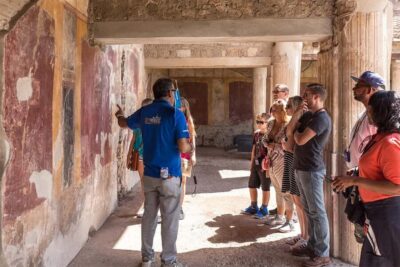
One of the tour highlights is time spent on the visuals that make Pompeii feel real, not distant. Frescoes show up in the conversation because Pompeii is famous for wall art that survived, in some form, long enough to be studied and displayed.
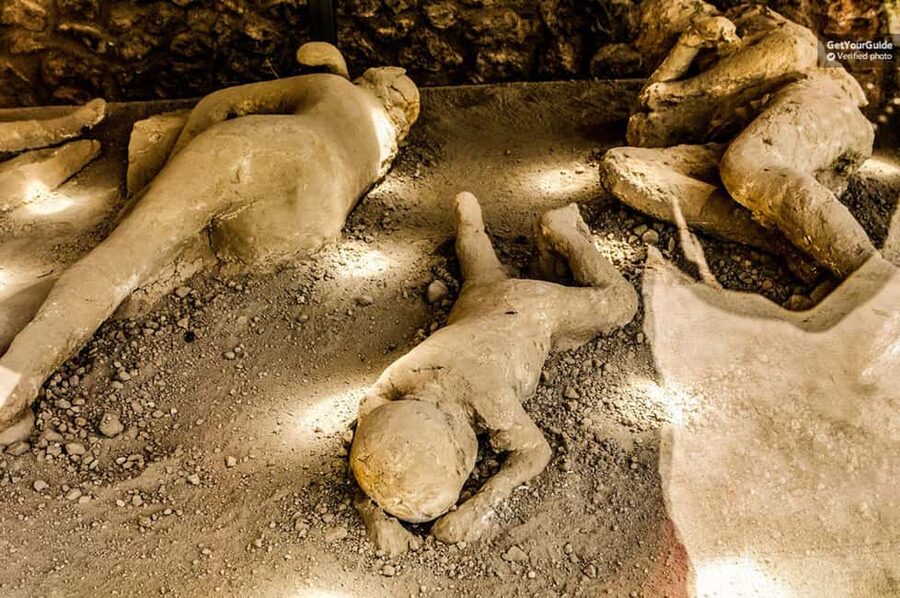
You will also have a chance to see the plaster casts of Pompeii’s tragic citizens. That part is not light reading. But it is also not abstract. It gives the disaster a human scale, which is why it sticks with people after the walk ends.
Plaster casts: a hard moment that clarifies everything
Plaster casts are sometimes treated like a “museum add-on.” Here they feel more like a turning point. The earlier you go through the city’s normal life, the heavier the casts become. That sequencing matters because it forces you to understand that this was a place full of routines before it became a catastrophe.
If you want a guide to help you connect cause and effect, this is where it shows.
Garden of the Fugitives: what the site teaches about last moments

The Garden of the Fugitives is one of the stops that helps you understand the story beyond the famous headline. It is a place where you can feel the finality of 79 AD without needing complex explanations.
What makes it worth your time on a guided route is that you are not just standing and looking. You are seeing how the site communicates events in a way words alone cannot. The tour format gives you just enough structure to understand why this area matters, and you are not left guessing.
House of the Tragic Poet and House of the Golden Cupid
After the public spaces, the tour shifts to named houses. This is where Pompeii starts to feel intimate. Public buildings show how a city operated. Homes show how people actually lived.
You will see highlights including the House of the Tragic Poet and the House of the Golden Cupid. Named houses are especially helpful on a short tour because they give you something memorable to attach to what you are walking through. Without that, homes can blur together into “old rooms.”
With guidance, you are likely to notice features you might otherwise miss: layout cues, artistic references linked to the home’s identity, and the small elements that help you picture a daily routine.
How the archaeologist guide changes the experience
Your experience lives and dies by the guide. The good news here is that the guides behind this tour style get high praise for keeping the walk lively and readable.
In the feedback I saw, names like Alfonso, Ernaldo, Eraldo, Giuseppe, Lena, Laura, and Antonio show up repeatedly. The consistent theme is not just facts. It is how those facts are delivered. Multiple guides were praised for answering questions directly and keeping the pacing smooth so nobody falls behind.
That matters because Pompeii punishes distraction. If you are staring at a wall and you do not know what you are looking at, the ruins can feel like scenery. A strong guide helps you look with purpose.
Whisper headsets: why they matter in practice
One of the most practical inclusions is the whisper headset system for larger groups. Pompeii is noisy in its own way. Wind, echoing stone spaces, and the simple challenge of following a guide walking ahead all add up. With headsets, you can keep your attention on the site while still catching the explanation.
You end up with a tour that feels like a conversation, not a group field trip where you spend half your time trying to hear.
Group tour reality: pace, heat, and comfort tips

Even with headsets, a group tour has its tradeoffs. The loop is efficient, which means the pace can feel brisk at points. You might also feel that it is a pretty sizeable group, since the headset system is designed for that.
Heat is another factor that can surprise you. One traveler wrote that it was very hot even in the afternoon, and they bought a paper umbrella outside for about 10 euros to keep sun off. That is the kind of real-world tip that matters on-site. Bring sun protection planning, and wear shoes you can stand in for a couple of hours on uneven ground.
This is also not the best choice if you need mobility accommodations. The tour is not suitable for people with mobility impairments, so keep that in mind before you commit.
Value check: what you get for around $50.11
At about $50.11 per person for a roughly two-hour visit, this tour is priced like a “best use of limited time” product. If you only have a morning or afternoon in Pompeii, the value is strong because you are not spending half your time arranging entry, picking an itinerary, or trying to figure out what matters.
You also get:
- Skip-the-line entrance tickets, which directly saves time
- Professional live guide
- Whisper headsets for larger groups
- Free parking if open and available
- A route focused on the western highlights
It does not include food or drinks, and it does not include hotel pickup or drop-off. That is normal for Pompeii day activities. The takeaway is that you should treat this as an experience ticket for orientation and key sights, then plan your own meal time in the modern city after.
If you are the type who likes to wander slowly and linger in side corners, you might feel the time is tight. But if you want the big picture quickly, the price starts to make sense.
After the tour: ideas in modern Pompeii (and a church stop)
When the walking ends, your guide will suggest how to spend the rest of the day in modern Pompeii. That end-of-tour support is more useful than it sounds. You get local guidance on what to do next instead of staring at maps.
One specific direction included in the tour info is the Sanctuary Dedicated to Our Lady of the Holy Rosary, which is just a few steps from the archaeological site. If you want a change of pace after ruins, that nearby stop can be a nice reset.
Who this Pompeii tour is best for
This tour is a strong match if you:
- Want the major highlights without building a whole itinerary yourself
- Have limited time, like a short day trip
- Prefer learning with a guide rather than walking in silence
- Appreciate hearing about daily life details, including the more uncomfortable parts
It may be less ideal if you:
- Need mobility-friendly routing
- Want to spend lots of time at one location for photos and slow reading
- Are hoping to cover the entire site in one go
Should you book this Pompeii group tour?
Yes, if you want an efficient, guide-led overview that helps Pompeii make sense. The combination of skip-the-line access, whisper headsets, and a route focused on western Pompeii is exactly what many people need when time is short. And the guide quality, with names like Alfonso, Giuseppe, Lena, and others showing up for their pacing and clear explanations, is a real reason to feel confident booking this format.
If you have the freedom to spend a full day and you love reading every sign slowly, you might prefer a self-guided route with a longer visit. But if you want the headlines plus the human details, in a managed two-hour walk, this is a practical way to do Pompeii.
FAQ
How long is the Pompeii group tour?
The tour lasts 2 hours.
Where does the tour start and end?
It starts at the Tempio Travel office in the Circumvesuviana train station area (1st floor). The tour ends back at the meeting point.
What is included in the tour price?
Included are a 2-hour guided tour, skip-the-line entrance tickets, whisper headsets for large groups, and free parking if open and available.
Which languages are offered?
The live tour guide offers English and Italian.
What should I bring?
Bring a passport or ID card and comfortable shoes.
Is luggage allowed?
Luggage or large bags are not allowed.
Is the site free on the first Sunday of the month?
Entrance is free on the first Sunday of each month, but tickets cannot be reserved ahead of time, so entry is not guaranteed.
Just introduced: the newest Naples write-ups
- Capri Boat Tour from Naples – Small Group, Swim & Relax★ 5.0 · 341 reviews
- Pompeii Guided Tour from Naples with Skip-the-Line Entry★ 5.0 · 343 reviews
- Procida Island Tour by Boat 2h 15m with Swimming and Underwater Photos★ 5.0 · 344 reviews
- From Naples: Caserta Palace Ticket and Train with Audioguide★ 4.3 · 348 reviews
- Naples Shore Excursion: Private Tour to Sorrento, Positano, and Amalfi★ 4.5 · 352 reviews
- From Naples: Capri Boat Day Trip with Drinks★ 4.7 · 354 reviews
- From Naples: Sorrento, Positano and Amalfi Tour★ 4.6 · 361 reviews
Pompeii & Vesuvius Tours, compared.
Entry Ticket and Guided Tour with an Archaeologist
Read our review →

Pompeii Small Group Tour with an Archaeologist
Read our review →
Pompeii, Amalfi Coast and Positano Day Trip from Rome
Read our review →Browse the lists this tour appears in