
Reviewed · UNDERGROUND & CATACOMBS TOURS
Underground Catania
Catania has a second city underground. I loved the Roman thermal rooms tucked beneath the Duomo area and the underground Amenano river flowing through a cave. One possible drawback: it is marketed as private, but it runs as a small group experience capped at 8, and the pace can feel a bit slow if you like to move fast.
This tour is built for people who want story plus place, not just standing in front of a wall. With English-speaking guides such as Oreste, Maria, and Mathilde mentioned in past tours, you get careful explanations about how earthquakes and Etna-related eruptions shaped the city’s layers. Since most stops are underground, it is also a smart way to stay comfortable when Catania is hot, and guides tend to stay flexible if weather turns.
You meet at Piazza del Duomo, 7, then work your way to several underground sites and end around Piazza Stesicoro. Expect about 2 to 3 hours, with a set rhythm that keeps changing from baths to basilica to lava cave to a church in rock.
In This Review
- Key highlights worth caring about
- Why Catania goes underground beneath the Duomo
- Terme Achilliane: Roman thermal rooms under Piazza Duomo
- Basilica Cattedrale di Sant’Agata: faith, rebuilding, and power in one spot
- A Putia dell’Ostello and the Amenano underground river
- Chiesa di San Gaetano alle Grotte: lava caves turned into sacred space
- How the tour timing works, and why pacing matters
- Price and value: what $96.79 buys you
- What you’ll get from the guide, beyond facts
- Who should book Underground Catania, and who might not
- Should you book this Underground Catania tour?
- FAQ
- How long is the Underground Catania tour?
- How much does it cost per person?
- Where do I meet the tour?
- What is the end point of the tour?
- Is the tour offered in English?
- Are admission tickets included?
- How large is the group?
- Can I cancel for a full refund?
- Is there a mobile ticket?
Key highlights worth caring about
- Small-group cap of 8 makes it easier to hear your guide and ask questions
- Archaeologist-led storytelling connects each site to Sicily’s earthquake and eruption history
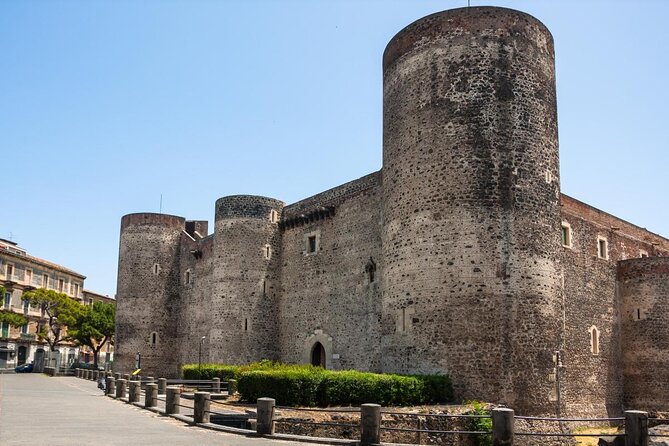
- Roman baths under the Duomo area at Terme Achilliane, dated to the 3rd to 4th century AD
- Amenano underground river at A Putia dell’Ostello, including a cave section with water still flowing
- A lava flow cave reused over centuries at Chiesa di San Gaetano alle Grotte, from Greek times to Romans
- High satisfaction score (4.9 with 97% saying they’d recommend it)
Why Catania goes underground beneath the Duomo
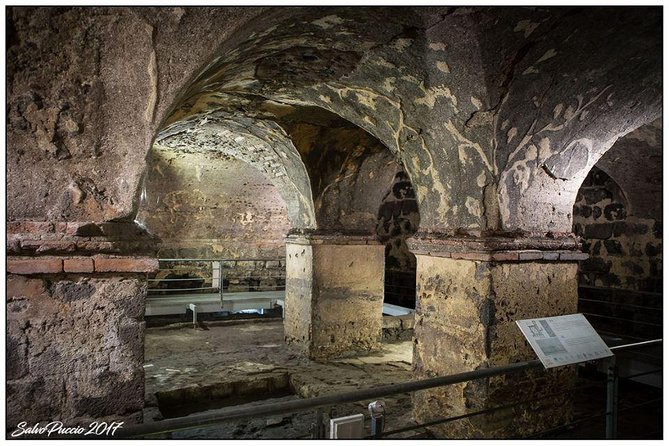
Catania is a city built on layers, literally. Volcanic activity from nearby Etna, plus earthquakes and repeated rebuilding over centuries, pushed parts of daily life down into the ground. That is what makes this kind of tour so different from a typical walking loop. You are not only seeing old things, you are seeing how the city’s survival plan worked.
The biggest payoff for me is that you start in the city’s loud, recognizable center, then gradually realize how much history sits below your feet. The first stop anchors you with Roman engineering, the middle stops shift toward religious and medieval stories, and the final stop turns the geology itself into a timeline. By the end, you’ll look at the streets above with a new kind of attention.
Further under Rome’s streets:


Terme Achilliane: Roman thermal rooms under Piazza Duomo
You begin with Terme Achilliane, a vast thermal complex dating to the 3rd to 4th century AD. The tour explanation here is key: this was not a small bathhouse. It covered a wider area that once extended toward what is now Piazza Duomo.
What you actually see is the part that remains accessible today, located just below the cathedral area. That matters because underground ruins can be hard to read from a tourist viewpoint. Having a guide frame what remains, what the rooms originally were like, and how Roman cities used thermal spaces makes the whole structure feel legible.
Practical tip: expect your first underground stop to set the tone. You will likely spend around 20 minutes here, so use that time to slow down and really listen. Roman baths were social and practical, not just luxury. If you enjoy urban history, this stop gives you the foundation for everything else you’ll see.
Admission at this stop is included, which also helps with value. If you are trying to pack history into a short trip, this is the kind of early start that pays off.
Basilica Cattedrale di Sant’Agata: faith, rebuilding, and power in one spot
Next comes Basilica Cattedrale di Sant’Agata, the city’s center in both a spiritual and civic sense. This is where you shift from underground engineering to the story of how Catania keeps rebuilding its identity.
The basilica is described as sacred and also profane between Liotru and Sant’Agata, with Norman-era structure and later Baroque splendor. In plain terms, this building became a living record of destruction and reconstruction across the centuries. You’ll hear how the Norman period’s original ecclesia munita, a fortified church concept, evolved into the cathedral you see today.
Why this matters for an underground tour: St. Agatha is not just a side note. She is tied to Catania’s self-image. When you later visit a church associated with the first deposition tradition in rock, the earlier cathedral stop helps the connections land. You start to see why these underground spaces were worth creating and preserving.
This stop is about 20 minutes, and there is no admission ticket cost noted here. It is a good breather from purely underground spaces while still keeping the tour’s theme intact.
A Putia dell’Ostello and the Amenano underground river
Then you get to one of the tour’s most memorable “wait, what am I looking at” moments: A Putia dell’Ostello. The concept is fascinating even before you step into the cave. This is tied to the Amenano, a mysterious underground river that once fed the Lake of Nicito.
Over time, eruptions, earthquakes, and wars changed not just roads and building locations, but also the city’s natural layout. That is the point of this stop. You are seeing how a water system can disappear from the surface yet still keep shaping what happens underground.
What makes it special is that you visit a suggestive sliding cave where a branch of the river still flows. You are not just looking at a dry tunnel. The presence of flowing water helps you understand how people would have thought about the space and why water-related passages mattered for survival and planning.
This stop is shorter, about 10 minutes, with admission included. That short duration is a plus if you like variety and quick hit surprises. Just be ready for a fast transition in mood, from grand cathedral history to something more intimate and mysterious.
If you are the type who always wonders where the water goes in old cities, this is one of the stops that answers the question in a very Catania way.
Introductions we still owe you around Sicily
- Catania: Mount Etna Morning or Sunset Day Trip with Tasting
★ 4.8 · 4,028 reviews - Mount Etna: Guided Volcano Summit Hiking Tour with Cable Car
★ 4.7 · 3,784 reviews - Palermo: NO Mafia Walking Tour
★ 4.8 · 2,431 reviews - Palermo: Hop-on Hop-off Bus Tour 24-hour Ticket
★ 3.9 · 2,410 reviews
Chiesa di San Gaetano alle Grotte: lava caves turned into sacred space
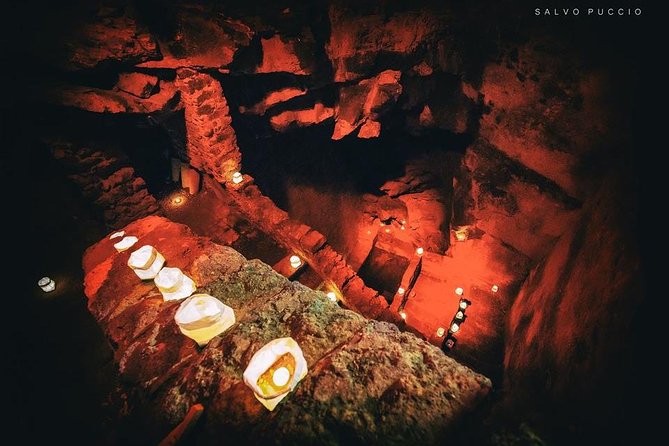
The final substantive stop is Chiesa di San Gaetano alle Grotte, often described as one of the most beautiful places in Catania. It is also a geology lesson.
This church is inside an ancient lava flow cave. The space was reused over multiple eras: first as a cistern in Greek times, then as a catacomb tomb space under the Romans. That layered reuse is the theme you’ve been building since the first stop. Catania does not just preserve history. It reuses it.
There is also strong local tradition tied to Saint Agatha. According to tradition, it was the site of the first deposition of Saint Agatha, and a small church was built as early as 262. Today the crypt preserves remains of ancient frescoes and decorations carved directly into living rock.
In other words, you’re not seeing history behind glass. You’re seeing history embedded in the stone itself. For many people, this is the emotional peak of the tour.
This stop runs about 20 minutes, and admission is included. If you are sensitive to damp air, wear what you’d normally use for a cool basement. Underground spaces can feel cooler than the street, even on warm days.
How the tour timing works, and why pacing matters
The whole experience runs about 2 to 3 hours. With four stops, that’s a compact schedule, and it helps you fit this into a day without giving up too much time to logistics.
The flow is part of the value:
- you start with Roman thermal engineering
- connect the city center story via the cathedral
- shift to water and underground movement at A Putia dell’Ostello
- end with a lava cave turned sacred and burial space
Pacing can be a make-or-break detail. Some groups have noted the walking pace can feel slow, while other groups praised the guides for adjusting timing when needed. My practical take is this: if you like a fast pace, you may need to mentally prepare that this is more talk-heavy than sprint-heavy. If you love history explanations and time for questions, the format is a great fit.
Also, because the tour is in English, it is well suited if you want a real narrative you can follow step-by-step. If you read fast and like short summaries, you might find you want just a little more time at each stop. That is not a bad thing with archaeology, but it is something to consider.
Group size stays small, with a maximum of 8 travelers. That setup usually helps with audio, comfort, and the ability to ask follow-ups. It can also mean you wait a few moments between stops while everyone gets oriented.
Price and value: what $96.79 buys you
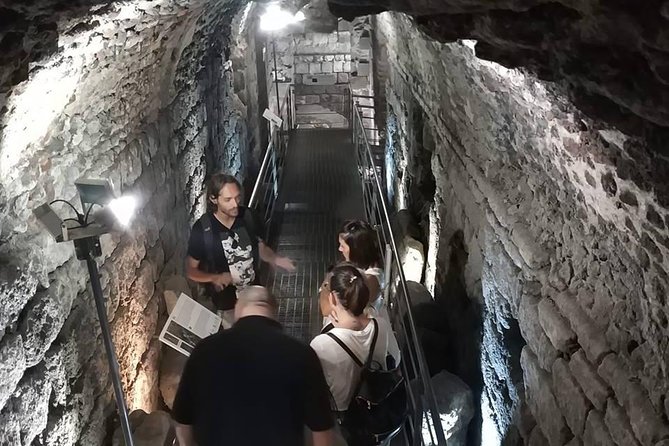
At $96.79 per person for a 2 to 3 hour tour, this is not the cheapest way to “see Catania.” But it is aiming at a specific kind of value: access plus interpretation.
Here is why the price can make sense:
- Multiple underground sites are included rather than one single attraction
- Admission is included at major stops (Terme Achilliane, A Putia dell’Ostello, and Chiesa di San Gaetano alle Grotte)
- The guide is framed as an archaeology expert, and you get context connecting the city’s geology to its human history
- It is capped at 8 travelers, so you get a more personal experience than mass tours
A separate question is what you mean by private. The experience is described as private exclusively for your group, yet it still has a maximum number of travelers. So check the exact booking wording you see. If you expect a one-on-one tour every time, you might feel surprised. If you are happy with a small-group format and excellent explanations, this price is much easier to justify.
Value also increases if you are tight on time. Catania has a lot above ground. This tour gives you a whole second city concept in one session. If you are trying to understand how the city works, not just what landmarks look like, that is where the cost starts to feel reasonable.
What you’ll get from the guide, beyond facts
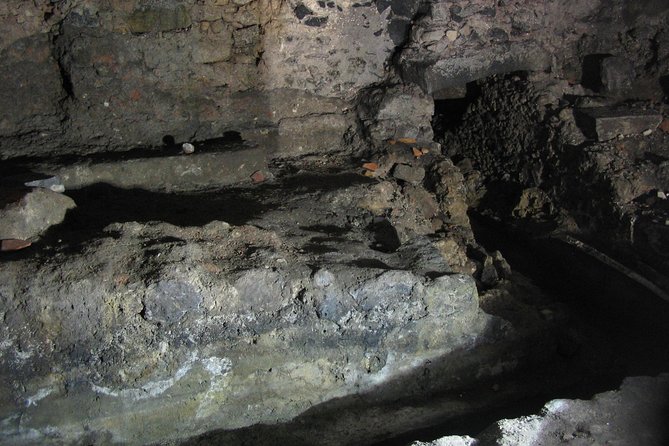
The underground spaces themselves are impressive, but the guide makes them click.
In the notes people shared, guides like Oreste, Maria, and Mathilde stood out for being specialists and for explaining stories in ways that helped the places make sense. That is exactly what you want from an archaeology-focused tour. Otherwise, lava caves and catacomb spaces can blur together fast.
You can also tell this tour leans into cause and effect:
- how volcanic activity and earthquakes changed what could remain visible above ground
- how water systems like the Amenano were redirected or cut off
- how people reused spaces over time, rather than starting from scratch
If you are also curious about Mt. Etna but you do not want to plan a full volcano day, this tour can scratch a similar itch. You’ll get the Etna influence explained through Catania’s underground reality.
And if you like questions, this tour seems to allow them. People noted patience when they wanted to look longer at details.
Who should book Underground Catania, and who might not
This tour fits best if you:
- want a different angle on Catania beyond churches and streets
- enjoy history that links geology, disasters, and rebuilding
- like guided explanations that connect each stop to the bigger story
- want a compact 2 to 3 hour activity that stays engaging
It may be less ideal if you:
- want a true fast-paced walking tour with minimal talk
- need a large crowd environment for comfort and energy, since the group is capped at 8
- are strict about the difference between private and small-group, so read the wording carefully
If your main goal is only surface-level sightseeing, you might decide to spend your time above ground. But if you want to understand why Catania looks the way it does, then going underground is the shortcut.
Should you book this Underground Catania tour?
If you like authentic-feeling access and you enjoy being taught, I’d book it. The combination of Roman thermal spaces under the Duomo area, a living-water cave connection to the Amenano river, and a lava-cave church with frescoes carved into rock is not something you can replicate on your own as easily. The overall satisfaction rate is also very strong, and most people describe it as memorable and uniquely Catania.
Just go in with the right expectations:
- it is a small group experience capped at 8
- it is discussion-heavy, not a quick selfie circuit
- most stops are underground, so dress for a cooler, more enclosed setting
If that sounds like your kind of tour, Underground Catania is a smart use of a few hours in Sicily.
FAQ
How long is the Underground Catania tour?
It runs about 2 to 3 hours.
How much does it cost per person?
The price is $96.79 per person.
Where do I meet the tour?
You start at Piazza del Duomo, 7, 95131 Catania CT, Italy.
What is the end point of the tour?
The tour ends around Piazza Stesicoro, 95100 Catania CT, Italy.
Is the tour offered in English?
Yes, it is offered in English.
Are admission tickets included?
Admission tickets are included for Terme Achilliane and A Putia dell’Ostello, and for Chiesa di San Gaetano alle Grotte. The Basilica Cattedrale di Sant’Agata stop is free.
How large is the group?
The tour has a maximum of 8 travelers.
Can I cancel for a full refund?
Yes. You can cancel up to 24 hours in advance for a full refund.
Is there a mobile ticket?
Yes, the tour uses a mobile ticket.
Just introduced: the newest Sicily write-ups
- Etna Tour – HalfDay Small Group & licensed Tour Guide★ 5.0 · 185 reviews
- Etna Special Dawn Excursion★ 5.0 · 185 reviews
- Naxos: Taormina Boat Tour with Snorkeling and Prosecco★ 4.9 · 185 reviews
- Sicilian Cooking Class in Taormina★ 5.0 · 186 reviews
- Guided tour of the salt pans of Trapani and the Salt Museum★ 5.0 · 188 reviews
- Private tour of Etna and Winery Visit with Food and Wine Tasting from Taormina★ 5.0 · 188 reviews
- five sense outdoor experience★ 5.0 · 189 reviews
Underground & Catacombs Tours, compared.
Naples Underground Entry Ticket and Guided Tour
Read our review →
Colosseum: Underground and Ancient Rome Tour
Read our review →
Catacombs of San Gennaro Entry Ticket & Guided Tour
Read our review →
Crypts and Catacombs Underground Tour with Transfers
Read our review →
Expert Guided Tour of Colosseum Arena OR Underground, and Forum
Read our review →
The Original Roman Crypts and Catacombs Tour with Transfers
Read our review →
Colosseum Underground Small Group Guided Tour
Read our review →Browse the lists this tour appears in