
Reviewed · POMPEII & VESUVIUS TOURS
Pompeii and Herculaneum Small Group Tour with an Archaeologist
Pompeii plus Herculaneum in one guided sweep is a big win. I like that you get archaeologist-led context instead of wandering with a phone map, and I like that tickets and headsets are handled so you spend more time seeing and less time managing logistics. The main trade-off is time: Pompeii is huge, so the schedule moves at a brisk pace.
What makes this day feel efficient is the built-in connection between sites. You start with guided highlights in Pompeii, then move to Herculaneum with either a Circumvesuviana train (if you begin in Pompeii) or a modern minibus (if you begin in Naples, Rome, or Sorrento). If you want to linger in one spot for an hour, you might feel slightly rushed.
In This Review
- Key highlights at a glance
- Why This Pompeii and Herculaneum Tour Works on One Day
- Archaeologist Guide in Plain English: What You’ll Actually Learn
- Meeting Points and How Transport Changes by Start City
- Pompeii Highlights: Forum, Baths, Theaters, and Homes in Two Hours
- Pompeii stop-by-stop: what each place is for
- Herculaneum After Pompeii: Why This City Feels Different
- Herculaneum stop-by-stop: the “feel” you came for
- Pace, Headsets, and the One Thing to Plan Around
- Price and Value: What $77.09 Gets You
- Who This Tour Suits Best (and Who Should Rethink It)
- Should You Book This Tour?
- FAQ
- Where do I meet for the Pompeii, Naples, Rome, and Sorrento options?
- Is the train between Pompeii and Herculaneum included?
- How long is the Pompeii and Herculaneum guided time?
- Are admission tickets included?
- Do I have to buy lunch during the tour?
- What size is the group?
- Are headsets provided?
- How does the tour end based on where I start?
- Is this tour suitable for visually impaired guests?
Key highlights at a glance
- Skip-the-ticket-line access so your day starts faster
- Two guided blocks that turn ruins into daily life stories
- Circumvesuviana transfer included when you start in Pompeii
- Max 20 people plus headsets for easier listening
- Entrance fees for both sites included, which matters for value
- Herculaneum runs as the perfect follow-up, with different preservation and vibe
Why This Pompeii and Herculaneum Tour Works on One Day
You are trying to do two of the world’s most important Roman ruin sites in limited time. The trick is not trying to see everything. This tour focuses on the places that help you understand how the cities worked, what people valued, and why the eruption left such a strange record.
For me, the biggest advantage is the “why am I looking at this?” layer. When your guide connects buildings like baths, theaters, and villas to everyday routines, you stop treating the stones like a museum display. You start picturing a neighbor walking out for a drink, a merchant setting up under a portico, or someone heading to the forum.
One more practical plus: you get headsets. Pompeii and Herculaneum are often noisy and crowded, so it helps when you can hear your guide without craning your neck.
More of Pompeii and the volcano that buried it:

Archaeologist Guide in Plain English: What You’ll Actually Learn
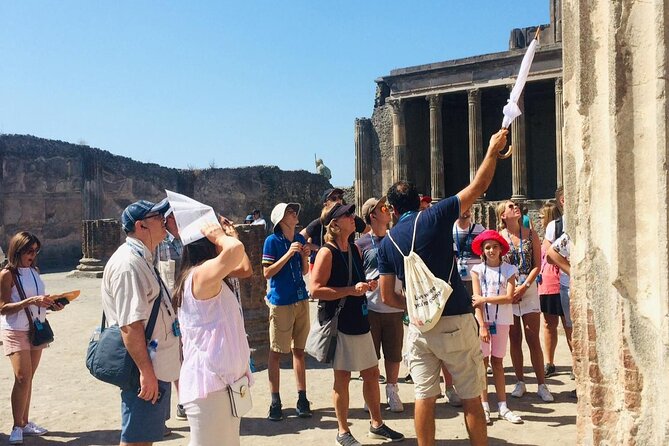
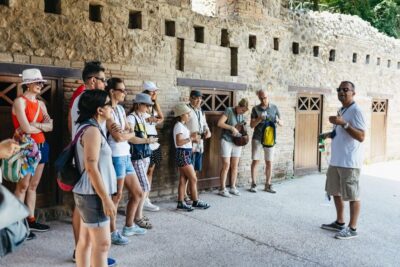
This is a small-group tour led by an archaeologist guide, and the effect is real. People like Michele, Diego, Tomas, Antonio, Amadeo, and Paulo show up in past groups, and the common theme is clear explanations that fit into the walk.
You’ll learn how the cities functioned, not just what the buildings were. In Pompeii, that means understanding the Forum area as a civic and commercial hub, and using places like the baths and theaters to grasp how social life played out in public spaces.
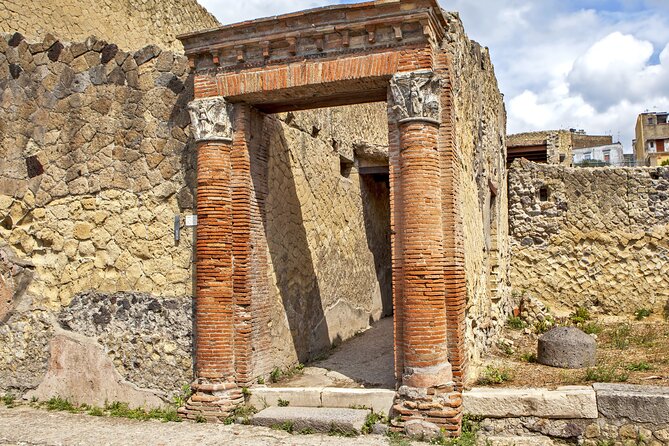
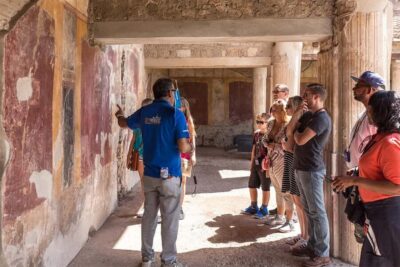
In Herculaneum, the guide’s job is to help you notice details that look subtle at first. The preservation here is famous, and when someone points out things like how private houses were arranged, or how benefactors left their mark through inscriptions, the whole site starts to feel personal instead of distant.
Meeting Points and How Transport Changes by Start City
This tour is built around four start options, and the logistics shift with each one. You meet your archaeologist guide at a set location based on where you begin:
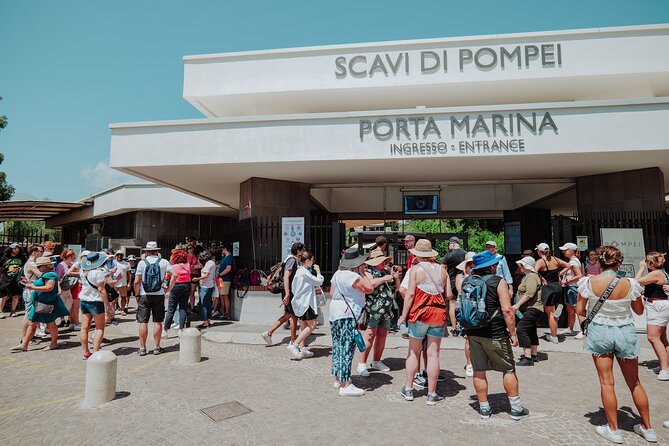
- Pompeii option: meet at Porta Marina Superiore, then you use the included train link to reach Herculaneum
- Naples and Rome options: meet at Starhotels Terminus for full-day transport by modern minibus between sites
- Sorrento option: meet at Piazza Angelina Lauro, also using modern minibus transport
How you travel between sites is the biggest difference. If you start in Pompeii, you take the included Circumvesuviana train for about 30 minutes, plus a short walk to the ruins entrance area. If you start in Naples, Rome, or Sorrento, you go by minibus with the guide, which is simpler and usually less time spent figuring things out.
At the end of the day, you also finish differently. Naples and Sorrento starts typically include return to your pickup area. Rome travelers are dropped at Naples station. If you start from Pompeii, you end inside the Herculaneum ruins area after the visit, so you’ll need your next plan for getting onward from there.
Pompeii Highlights: Forum, Baths, Theaters, and Homes in Two Hours
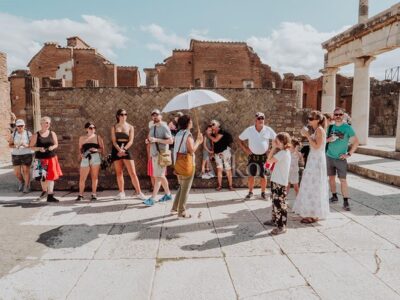
Pompeii feels like a city laid out in layers. The challenge is that it’s enormous. This tour handles that by concentrating on the most instructive pieces first, then moving briskly through key neighborhoods and public buildings.
You get about two hours of guided walking in Pompeii, hitting major anchors like:
- the Forum area (civic life and the main square)
- the Stabian Baths (one of the city’s oldest thermal complexes)
- the House of the Faun (big villa energy, with impressive scale)
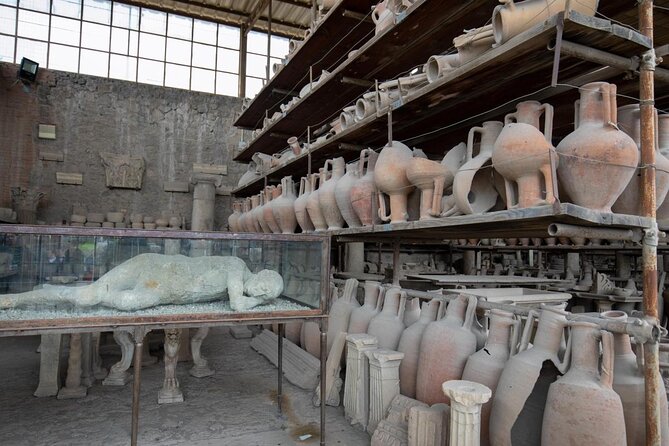
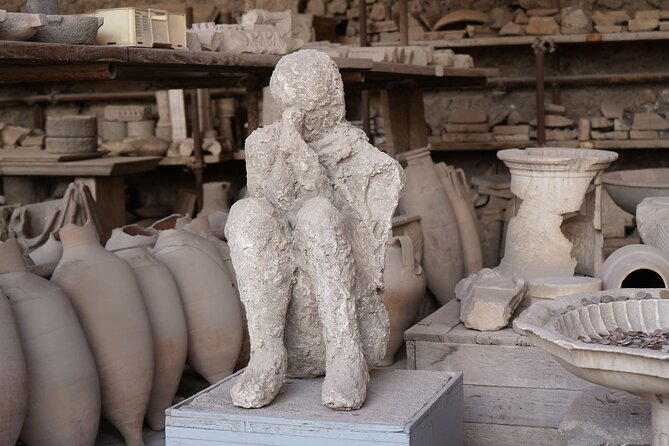
- plaster casts, which make the disaster feel shockingly human
Expect quick stops and short segments that still give you enough context to understand what you are looking at. This is not the kind of pace where you can wander off to follow a side street for 45 minutes and still catch the group.
Introductions we still owe you around Pompeii
- Pompeii Ticket + Tour with Optional Tasting Experience at Pompeii
★ 5.0 · 663 reviews - Pompeii private tour with an Official Guide
★ 5.0 · 631 reviews - Pompeii Private Tour with an Archaeologist and Skip The Line – 3 hours
★ 5.0 · 564 reviews - Pompeii Skip-the-line Tour with Archaeologist Guide
★ 5.0 · 559 reviews
Pompeii stop-by-stop: what each place is for
Here’s what the tour does with your time in Pompeii, and why it matters.
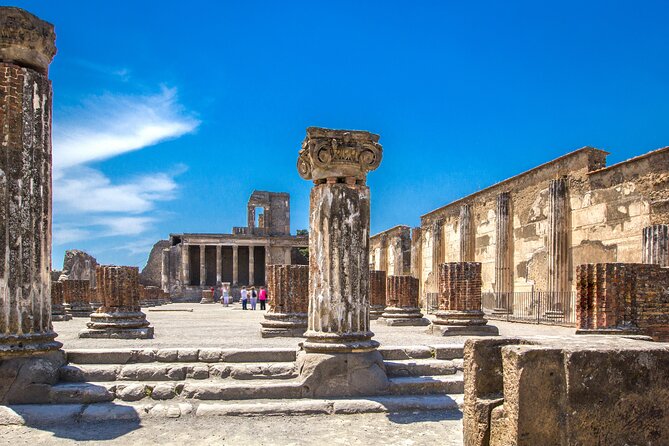
Basilica (open portico by the main activity zone)
Think of it as a covered space where people gathered for commerce and daily business. It’s a great start because it sets the tone for how Pompeii functioned before you even get to the big “signature” structures.
Forum square (Foro de Pompeya)
This is the city’s main square. Even a brief look helps you understand where civic life happened, where people would have seen announcements, and where public events would have pulled attention.
Main street walk
A quick walk through the principal street gives you a feel for the urban layout. You start noticing rhythms like shops facing the street, entrances, and the way spaces funnel movement.
House of Menander
This is a top-tier mansion, with architecture and decoration that show how wealth expressed itself. The value here is learning what rich Roman domestic space looked like when viewed through decoration, not just size.
Granaries of the Forum
Look for the details tied to storage and public infrastructure. You also get a sense of how the disaster record includes casts related to victims and even animals, which makes the ruins feel less like abstraction.
Stabian Baths (Terme Stabiane)
The baths cover a huge area, and they are among Pompeii’s earliest thermal complexes. This stop is useful because it shows how “health and recreation” were built into the city’s routine.
Lupanar (the famous brothel)
This is one of Pompeii’s most talked-about sites. In a good guided format, it’s not only shock value. It’s a chance to talk about how entertainment and services were organized and advertised in the city.
House of the Faun
A large and impressive residence, chosen for its scale and importance. It’s the kind of stop that helps you see Pompeii as a place where people lived in a mix of private luxury and public interaction.
Odeon (Teatro Piccolo)
This small theater adds context for the performing arts side of city life. Even if you only get a short look, it helps you map leisure spaces beyond the big amphitheater world.
Teatro Grande (main theater)
This is Pompeii’s big theater moment. It’s a clean way to connect architecture to the social calendar, since theaters were major public gathering points.
One warning to plan for: Pompeii’s sheer size is real. Even if you hit many highlights, it will still feel like you covered the essentials, not every corner.
Herculaneum After Pompeii: Why This City Feels Different
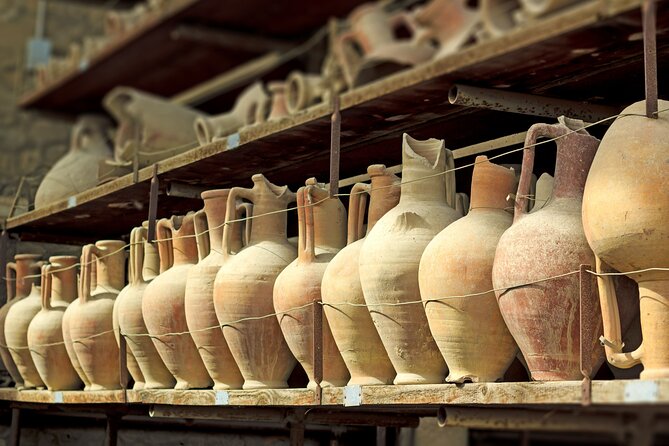
After Pompeii, Herculaneum hits with a different emotional tone and a different type of preservation. You do get another two hours of guided time in Herculaneum, plus entrance access handled for you.
One smart design choice: you arrive and the guide leads you to the Ticket Office area right away. If you are starting from Naples, Sorrento, or Rome, the drop-off is near the entrance. If you start from Pompeii, it’s a short walk from Ercolano Scavi station.
Then you work through a string of houses, public spaces, and bath areas. Herculaneum can feel more intimate than Pompeii, which is useful if you want a second site that still feels like you’re learning something new.
Herculaneum stop-by-stop: the “feel” you came for
House of the Deer
Named for marble stag or deer statues in the peristyle. It’s a quick way to show how decorative motifs served as status signals.
La Terrazza di M. Nonio Balbo
This stop ties architecture to a major benefactor. When you connect buildings to inscriptions and patronage, you see how elite support shaped the city.
College of the Augustales
A building tied to worship connected to Emperor Augustus, and likely to local organization. It helps you understand how religion and civic structure overlapped.
Casa del Rilievo di Telefo
A house with private access to the nearby Suburban Thermae. That detail matters because it shows how some homes were set up to plug into the city’s bathing life with extra convenience.
Partem Domus lignea (wooden partition area)
This is a key “wow” stop. The importance is the preserved wooden element, which makes the everyday details feel more immediate than stone-only ruins.
House of the Skeleton
Named after human remains found during discovery. It’s sobering, and it also keeps the eruption from becoming just a scenic backdrop.
Central Thermae
Built around the early 1st century AD, with separate spaces for men and women. If you pay attention here, you’ll get a clearer picture of how routine and gendered public spaces were handled.
House of the Black Salon
A more luxurious mansion, with a monumental entrance where carbonized door elements remain. Even a short look communicates the wealth level.
Casa Sannitica
Designed in a style associated with the Samnites, with a standout atrium and fresco-decorated rooms. This is a nice contrast if you noticed different influences in Pompeii.
Casa del Bel Cortile
Original plan with a courtyard and a stairway plus a stone balcony. It’s an example of how not every Roman home followed the same template.
House of the Grand Portal
A central domus with multiple environments. The tour also points you toward the charred remains of wooden elements, which makes Herculaneum feel tactile in a way you don’t get from stone ruins alone.
Pace, Headsets, and the One Thing to Plan Around
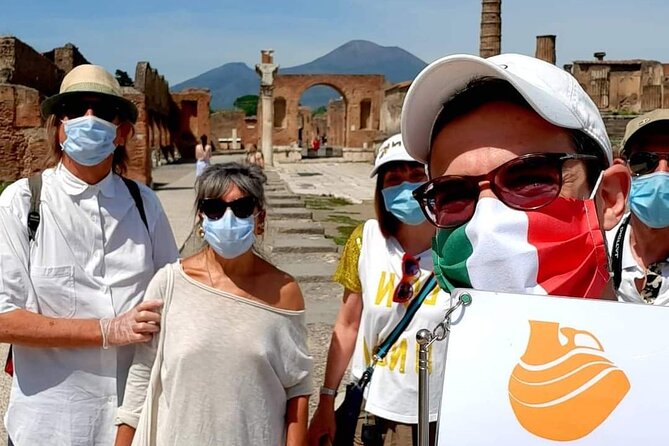
This tour is designed to hit two major sites on the same day. That means you should expect a fast-moving but structured rhythm, with many stops kept intentionally short.
In practice, that works well if your goal is to see the biggest markers, learn what they meant, and get a mental map for a future return. It’s less ideal if your dream day is to slow down, sit, and study every wall painting for 30 minutes.
A couple of real-world factors can affect how it feels. Headsets help with listening, but if you have trouble hearing your guide at any point, don’t just “tough it out.” Find a spot where the guide’s voice carries, and keep your questions brief so the guide can answer as you move.
Lunch is also the main “soft spot” in the schedule. Meals are not included, and there’s a quick lunch break between the two sites. The tour may route you through a nearby mall area, which can feel like a mood mismatch for some people. If you care about atmosphere, plan ahead by packing snacks or choosing a quick meal near the area rather than settling for whatever is closest.
Price and Value: What $77.09 Gets You
At about $77.09 per person, the value is strongest if you compare what you would otherwise pay and plan separately.
You are getting:
- guided time in both Pompeii and Herculaneum
- entrance tickets included for each site
- headsets for better audio
- built-in transport between sites (minibus from Naples, Rome, and Sorrento, or train from Pompeii)
- access support that helps you avoid wasting time at ticket points
If you look at ticket costs alone, Herculaneum’s adult entry is listed at 16 euros, and Pompeii’s adult entry is 20 euros. Even without exact currency math, you can see why the “just pay for admission” comparison swings in favor of booking with a package that also includes guiding and transportation.
The other value angle is time. Pompeii and Herculaneum are not the places you want to spend half your day sorting out where to stand, which line to join, and how to connect between sites. This tour does that work for you.
Who This Tour Suits Best (and Who Should Rethink It)
This tour suits you if you want a guided day with a strong learning focus, and you’re okay with a tight pace. It’s ideal for first-timers who want to understand Roman daily life through the biggest, most instructive stops in both cities.
It’s also a good fit if you are traveling from Naples, Rome, or Sorrento and you’d rather not juggle trains, transfers, and ticket timing on your own. The meeting points are fixed, the transport is included, and the guide keeps the flow moving.
You might rethink it if:
- you want long free time in Pompeii (the site is huge)
- you get uncomfortable with lots of short walking segments
- you are very sensitive to interruptions around lunch
And one important note: it is not recommended for visually impaired guests unless accompanied by a dedicated personal assistant.
Should You Book This Tour?
Yes, I think you should book it if your priority is clarity and highlights over wandering. The combination of archaeologist-led explanations, included tickets, and easy transfers between Pompeii and Herculaneum makes it a smart choice for a one-day window.
Book it with extra confidence if you like your sightseeing organized: you’ll hit the Forum area, major baths, standout houses, and the theater spaces in Pompeii, then switch to Herculaneum’s more intimate preservation and domestic details.
If you want a slower day in Pompeii, treat this tour as your “map and context” day, then plan a return on your own for deeper time. This tour gives you the foundations. Then you can choose what you want to revisit.
FAQ
Where do I meet for the Pompeii, Naples, Rome, and Sorrento options?
If you start in Pompeii, you meet at Porta Marina Superiore. For Naples and Rome starts, you meet at Starhotels Terminus. For Sorrento starts, you meet at Piazza Angelina Lauro.
Is the train between Pompeii and Herculaneum included?
Yes. If you choose the option that starts in Pompeii, you receive a Circumvesuviana one-way train ticket to reach Herculaneum with your tour guide.
How long is the Pompeii and Herculaneum guided time?
You spend about two hours guided in Pompeii and about two hours guided in Herculaneum.
Are admission tickets included?
Yes. Entrance tickets for both Pompeii and Herculaneum are included, and the tour includes Pompeii express entry tickets.
Do I have to buy lunch during the tour?
Meals and drinks are not included. There is a short lunch break available (own expense) between Pompeii and Herculaneum.
What size is the group?
This tour has a maximum of 20 travelers.
Are headsets provided?
Yes. Headsets are included for all participants.
How does the tour end based on where I start?
If you start in Naples or Sorrento, you return by included transport. If you start in Rome, you are dropped off at Naples station. If you start in Pompeii, the tour concludes directly in the Herculaneum ruins area.
Is this tour suitable for visually impaired guests?
It is not recommended for visually impaired guests unless accompanied by a dedicated personal assistant.
Just introduced: the newest Pompeii write-ups
- PompeiI Exclusive Tour with your Archaeologist in a Small Group★ 4.5 · 363 reviews
- Complete Pompeii Skip the Line Tour with Archaeologist Guide★ 4.5 · 379 reviews
- Pompeii 2h Small-Group Tour with Expert Archaeologist★ 5.0 · 385 reviews
- Pompeii Private Tour with an Archaeologist and Skip The Line★ 5.0 · 391 reviews
- Pompeii Guided Tour & Horse Riding on Vesuvius with Lunch★ 5.0 · 419 reviews
- Visit in Pompeii – Pompeii Private Tour with Ada★ 5.0 · 436 reviews
- Sharing Tour of Pompeii★ 5.0 · 487 reviews
Pompeii & Vesuvius Tours, compared.
Entry Ticket and Guided Tour with an Archaeologist
Read our review →
Pompeii Small Group Tour with an Archaeologist
Read our review →
Pompeii, Amalfi Coast and Positano Day Trip from Rome
Read our review →Browse the lists this tour appears in