
Reviewed · POMPEII & VESUVIUS TOURS
Pompeii Skip-the-line Tour with Archaeologist Guide
Two hours in Pompeii, and time vanishes. This is a guided way into the ruins, designed so you do not just look, you understand what you are seeing, including how Pompeii was preserved after the AD 79 eruption. You also get help pacing a huge site without wasting your energy getting lost.
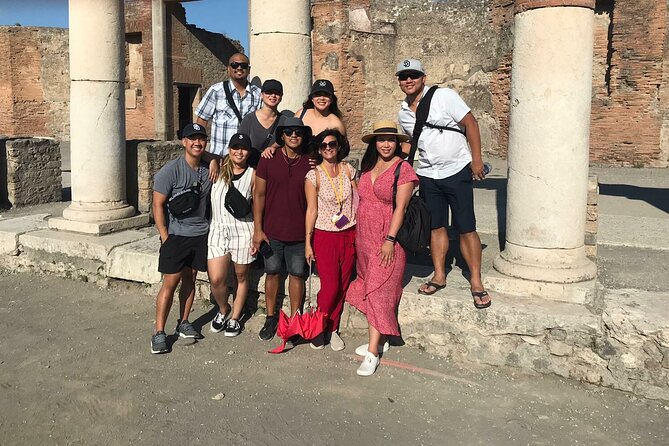
I especially like the small group size (up to 16), which keeps things conversational instead of lecture-mode. And I like that the guides named in the experience, such as Lello, Italo, Leonardo, and Cela, tend to connect the buildings to daily life, not just dates on a wall. For many people, the best part is that you notice details you would likely miss on your own.
One consideration is that this is not a casual stroll. You walk on original streets, including lava rock, for about 2 hours, and you meet your guide at a fixed location rather than getting hotel pickup.
In This Review
- Key things to know before you go
- Where to meet and how to reach Pompeii (Naples, Sorrento, and the final walk)
- The archaeologist-style guide experience, and what you gain fast
- Walking Pompeii’s original streets: lava rock, wheel ruts, and pace
- Pompeii’s forum and civic life: where religion and politics overlap
- Theater and thermal bathhouse: performance and everyday social life
- Small shops and big stories: businesses, gladiators, and the Lupanare
- AD 79 and Vesuvius: why the ruins feel so exact
- Price and value: is $71.35 for 2 hours worth it?
- What to pack and how to handle the walking on ancient surfaces
- Who should book this Pompeii skip-the-line guided tour?
- Should you book? My quick decision guide
- FAQ
- How long is the Pompeii Skip-the-line Tour with Archaeologist Guide?
- Is admission to the Pompeii ruins included?
- Is this tour a standalone ticket to the ruins?
- Where do I meet the guide?
- Do I need hotel pickup or drop-off?
- What language is the tour offered in?
- What group size should I expect?
- What should I wear or bring?
- What happens if I am late or miss the tour?
- Can I cancel for free?
Key things to know before you go
- Skip-the-line style entry with admission included, so you enter with your guide rather than wandering on your own.
- Max 16 people, which usually means better questions and less crowd pressure.
- An expert guide, and in practice you might get archaeologist-style storytelling from guides like Lello or Italo.
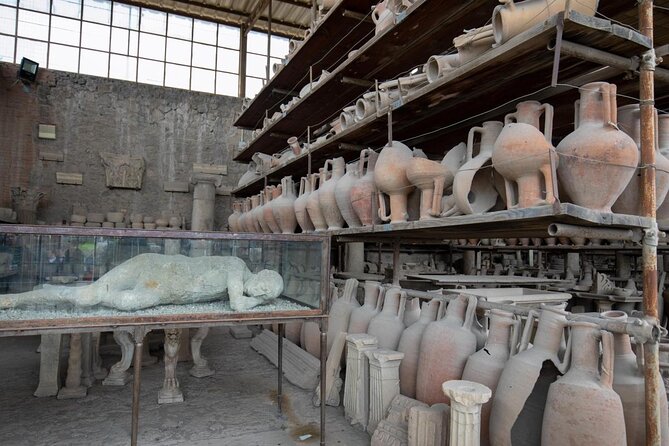
- A focused 2-hour route, hitting the forum, theater, baths, and the Lupanare brothel.
- You really walk on ancient surfaces, including lava rock, so good shoes matter.
- Ear sets are mentioned in feedback, helping you hear clearly during the walk.
Where to meet and how to reach Pompeii (Naples, Sorrento, and the final walk)
You start at Hotel Vittoria, Piazza Esedra, 80045 Pompei NA. The tour ends back at the same meeting point. That simple start and finish is helpful, because you can plan the rest of your day without chasing a different drop-off.
Getting there on your own is part of the deal, but it is straightforward. If you are coming from Naples or Sorrento, you can take the Circumvesuviana train to Pompei Scavi. From the station, it is typically an easy transfer on foot to the entrance area where your guide meets you.
This matters because Pompeii has its own rhythms. If you are relying on a pickup, you will waste time at the wrong moment. With this tour, you do the transit, then show up, get the guide, and start walking. Just build extra buffer time so you do not risk missing the meeting point, since late or missed starts come with no refunds.
Also, plan for the weather. This experience requires good conditions. If the tour gets canceled due to poor weather, you are offered another date or a full refund, so you do not need to stress too hard, but you should keep flexibility.
More of Pompeii and the volcano that buried it:


The archaeologist-style guide experience, and what you gain fast
The core value here is that the ruins come with context. Pompeii is huge, and without a guide you can easily end up looking at pretty walls while missing what made these spaces important to real people. With a local guide and admission tickets included, you are paying for interpretation and time-saving navigation.
A major plus is that guides linked to this experience, including Lello, Italo, Leonardo, and Cela, have a track record of turning architecture into stories. In feedback, guides are described as working on the site through years of excavation, and you can feel the difference when someone points out small clues like wear patterns, street layout logic, and how different buildings fit together.
The best guides also adjust to your group. You might notice that the tour stays interactive, with time for questions and explanations that match what you are physically standing in front of. That is the secret sauce for a place like Pompeii. It is not just facts, it is learning how to read the site in real time.
One practical detail to check mentally: this is not a standalone ruin ticket you use by yourself. Your confirmation is tied to the guided entry and your presence with the guide.
Walking Pompeii’s original streets: lava rock, wheel ruts, and pace
The tour is about 2 hours of walking, and you should expect the ground to be real ancient ground. You are told to wear comfortable shoes, and you will walk on lava rock. That is not a small note, it changes how your feet feel by the end.
You also walk along old cobblestones and can look for ruts left by wagon wheels. That detail is worth your attention because it gives you a physical sense of movement, trade, and the daily traffic of a working Roman town. When you can imagine carts rolling over the same streets centuries ago, Pompeii starts to feel less like a museum set and more like a city frozen mid-day.
Pacing is another quiet benefit. The experience focuses on highlights rather than forcing you to cover the entire park. Pompeii is too large for a “see everything” approach in two hours. A guided highlight route helps you spend your energy where the meaning is strongest.
For comfort, bring a hat for summer sun, and assume you will be outside for most of the tour. If you are visiting in hotter months, hydration becomes your responsibility, since food is not included.
Pompeii’s forum and civic life: where religion and politics overlap
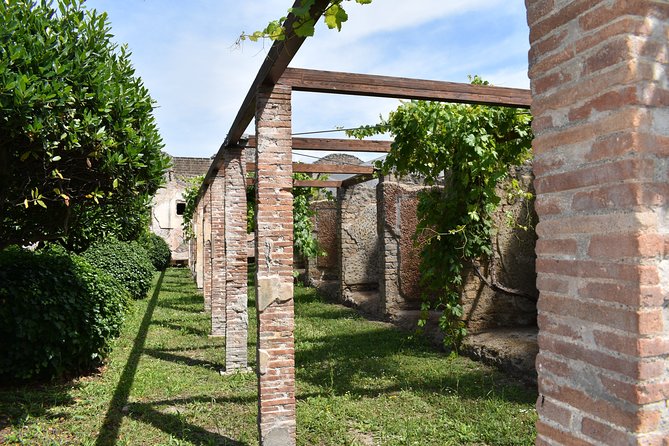
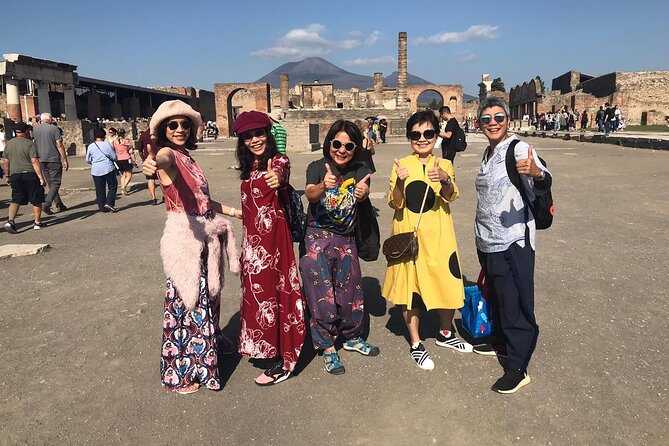
One of the biggest stops is the forum, the heart of Roman public life. This is where temples and civic buildings sit close together, showing how religion, politics, and public decisions blended into one physical center of town.
A good guide makes the forum click fast. You get explanations that help you see which structures were for worship, which spaces were for civic activity, and how people would have organized public moments. Without that framing, it is easy to treat the forum like a dramatic open area. With a guide, you understand it as a system.
Another value here is comparison. Your guide is likely to connect the spaces to how people behaved in real life, not just what the buildings look like today. That approach is what helps the forum go from impressive to understandable.
Drawback note: the forum can feel crowded or visually intense at certain times, even with a smaller group. The solution is to stay close to the guide, keep your ears on, and do not drift off to “get the perfect photo.” You will get plenty of photos later, and you will miss fewer key points if you follow the route tightly during the busiest moments.
Introductions we still owe you around Pompeii
- Skip the Line Guided Tour of Pompeii led by an Archaeologist
★ 5.0 · 703 reviews - Pompeii Ticket + Tour with Optional Tasting Experience at Pompeii
★ 5.0 · 663 reviews - Pompeii private tour with an Official Guide
★ 5.0 · 631 reviews - Pompeii Private Tour with an Archaeologist and Skip The Line – 3 hours
★ 5.0 · 564 reviews
Theater and thermal bathhouse: performance and everyday social life
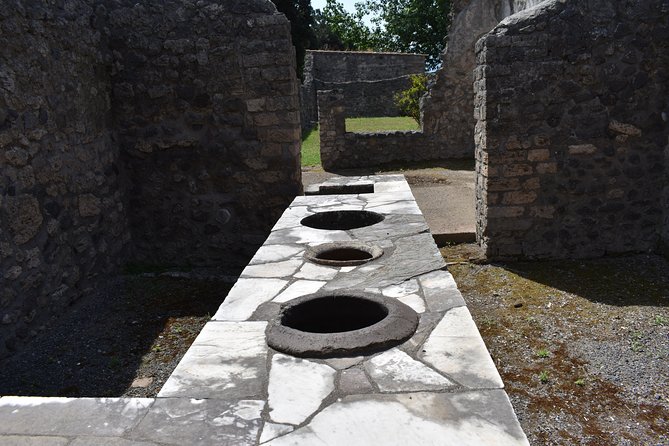
Pompeii’s theater gives you a glimpse into entertainment. Roman performances included both tragedy and comedy, and standing in the space makes those genres feel less abstract. A guided tour helps you locate where performers would have been and how an audience would have experienced the show.
Then you get into the routine side of Pompeii with the thermal bathhouse. Baths were not only for cleanliness. People went regularly to bathe, exercise, and, yes, gossip. This stop is one of the best reminders that Pompeii was a functioning community, not just a tragic eruption snapshot.
If you like historical “how did they live” details, this part is your payoff. You walk past the structures and learn what likely happened in and around them, including how these spaces became daily meeting points.
One practical point: bathhouse areas can be uneven, and some sections look similar from a distance. That is when your guide’s orientation matters. If you drift, you may lose the thread of what each room or corner is supposed to tell you.
Small shops and big stories: businesses, gladiators, and the Lupanare
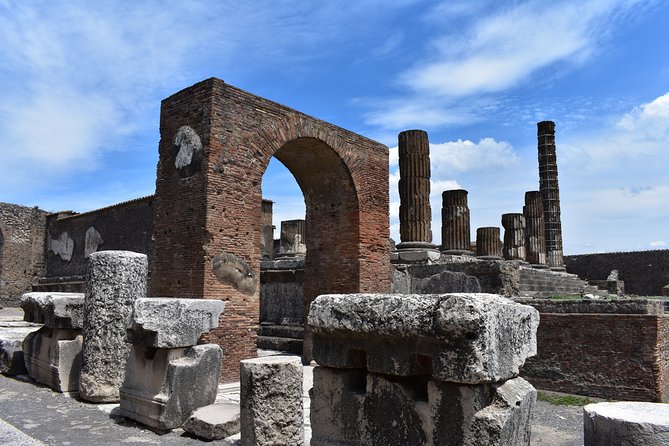
Pompeii is packed with the kind of hints that make your imagination start working. Your route includes peeks into remains of local businesses, like restaurants, bars, and shops that sold everyday goods such as food and clothing. These details matter because they show a city economy, not just monumental architecture.
You also visit areas tied to gladiators, including barracks where gladiators trained and lived. This is fascinating because it adds contrast. Pompeii was full of ordinary routines, and it also had structured roles for spectacle, discipline, and training.
Then comes the Lupanare, Pompeii’s brothel, described as one of the site’s most popular attractions. This stop can be tricky emotionally because it is explicit, but a good guide keeps it grounded in context: how the building worked, what made the space function, and what Pompeii’s urban culture looked like from multiple angles.
If you have any sensitivities about content, this is the part where you decide how you want to handle it. You do not need to linger. You can listen for the historical interpretation and then move on with the group.
AD 79 and Vesuvius: why the ruins feel so exact
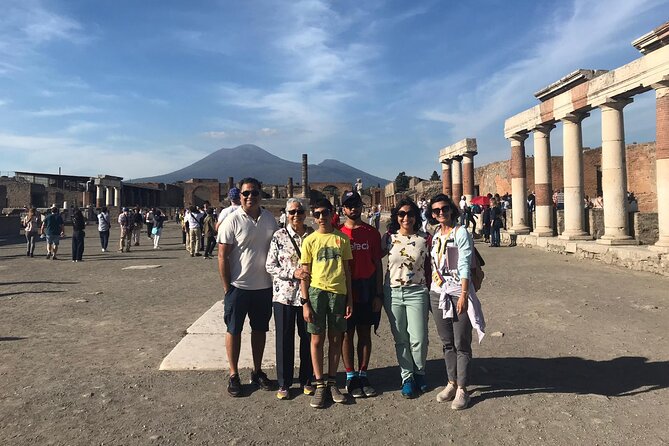
The eruption of Mt. Vesuvius in AD 79 is the big story behind Pompeii’s survival. The tour teaches this not as a distant myth, but as the event that sealed a city in place. When you hear the timing and the impact as you walk through spaces, the ruins start to feel specific, almost like the city paused mid-action.
In feedback about guides connected with this experience, you may hear how archaeologists use evidence to infer details, including how they know the date and timing of the eruption. Even if you do not get that exact explanation in every group, you can still expect a guided storyline that links what you see to what happened when the volcano erupted.
This is why the guide matters so much. Pompeii without context can feel like thousands of walls. With context, each room becomes a question: what happened here, what did people do next, and why does this spot look the way it does?
Price and value: is $71.35 for 2 hours worth it?
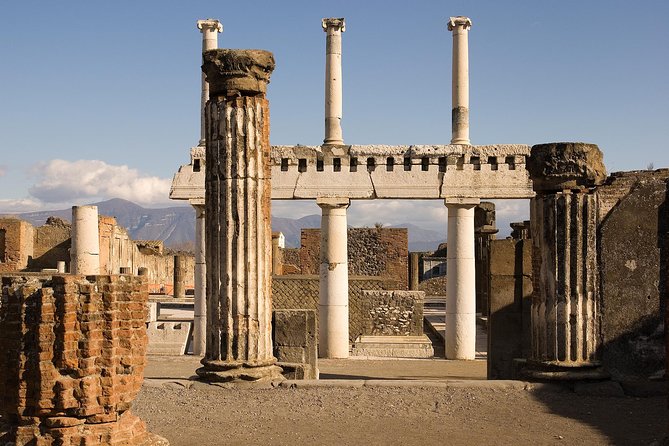
At $71.35 per person for about 2 hours, you are paying for three things at once: your guide, admission tickets, and the time you save by entering as part of a guided experience. For Pompeii, that bundle tends to be worth it because the site is too large to “figure out” quickly, and interpretation is what turns ruins into understanding.
The small group size up to 16 adds value too. A large-group tour can force you into a passive role. Here, you are more likely to get your questions answered and to stay oriented as you walk through dense sections.
Also consider the walking time. Two hours is not much, but it is a realistic slice of Pompeii highlights. If you have a limited schedule, buying a guided highlight route can be the smarter value than spending those hours wandering alone and then feeling like you missed the point.
One caution on expectations: this experience is a guided confirmation, not a ticket that turns you into an independent ruin explorer during the same window. If you want full freedom to roam without following a guide, you might prefer a different style of visit. But if you want the site to make sense fast, this one hits.
What to pack and how to handle the walking on ancient surfaces
This tour is built around feet. You will be told to wear comfortable shoes because you walk on original streets, and you are explicitly warned about summer sun with a suggestion to pack a hat. That is the practical side, but it also affects your enjoyment.
My advice is simple:
- Wear shoes you trust on uneven stone.
- Bring a hat and sun protection if you are going in daytime heat.
- Carry water, since food is not included.
If you are sensitive to crowds, the smaller group helps. Still, you will be in a major attraction zone, so move with your group and do not pause for long photo stops at tight corners. You will get better photos when you are not sprinting to catch up while the guide is explaining something important.
If you use a service animal, it is allowed. The experience is also listed as close to public transportation and generally possible for most travelers, which helps you plan without overthinking mobility constraints.
Who should book this Pompeii skip-the-line guided tour?
I think this tour is a strong fit if:
- You have only a couple hours and want the biggest Pompeii highlights connected together.
- You like stories that explain daily Roman life, not just big tragic history.
- You want a smaller group experience where questions are welcome.
- You enjoy archaeology-level detail, including street wear like wagon-wheel ruts.
You might want to skip or reconsider if:
- You hate walking on ancient stone surfaces, including lava rock.
- You want to roam freely with no guide time.
- Your schedule is tight enough that meeting time stress could make you late.
For families, this can work well when kids can handle steady walking and curiosity. The guides behind this experience have a reputation for answering questions, and that can turn Pompeii into a “we figured it out” adventure rather than a “we stood and waited” day.
Should you book? My quick decision guide
Book this Pompeii tour if you want your time to count. For two hours, you get a guided hit list that includes the forum, theater, thermal bathhouse, gladiator areas, and the Lupanare brothel, plus the AD 79 Vesuvius story tying it all together.
Skip it if your main goal is pure wandering and you prefer self-paced exploration without structured stops. Pompeii is too big to cover fully in one quick visit, and this tour is honest about being a guided overview, not a complete park marathon.
If you decide to go, pick a time when you are comfortable walking outdoors for the full duration, and bring solid shoes. Then show up early enough to feel relaxed when you meet your guide near the entrance.
FAQ
How long is the Pompeii Skip-the-line Tour with Archaeologist Guide?
It lasts about 2 hours. The tour notes that the 5 pm tour also lasts 2 hours.
Is admission to the Pompeii ruins included?
Yes. Admission tickets are included as part of the experience.
Is this tour a standalone ticket to the ruins?
No. This is a guided tour confirmation. It is not a ticket you can use by yourself to enter the ruins without the guide.
Where do I meet the guide?
The meeting point is Hotel Vittoria, Piazza Esedra, 80045 Pompei NA, Italy. The tour ends back at the same meeting point.
Do I need hotel pickup or drop-off?
No. Hotel/port pickup and drop-off are not included.
What language is the tour offered in?
The tour is offered in English.
What group size should I expect?
The experience has a maximum of 16 travelers.
What should I wear or bring?
Wear comfortable shoes because you will walk on the original ancient streets, including lava rock. A hat is recommended for summer sun.
What happens if I am late or miss the tour?
If you are late or miss the tour, there will be no refunds.
Can I cancel for free?
Free cancellation is available. You can cancel up to 24 hours in advance for a full refund, and cancellations within 24 hours are not refunded.
Just introduced: the newest Pompeii write-ups
- PompeiI Exclusive Tour with your Archaeologist in a Small Group★ 4.5 · 363 reviews
- Complete Pompeii Skip the Line Tour with Archaeologist Guide★ 4.5 · 379 reviews
- Pompeii 2h Small-Group Tour with Expert Archaeologist★ 5.0 · 385 reviews
- Pompeii Private Tour with an Archaeologist and Skip The Line★ 5.0 · 391 reviews
- Pompeii Guided Tour & Horse Riding on Vesuvius with Lunch★ 5.0 · 419 reviews
- Visit in Pompeii – Pompeii Private Tour with Ada★ 5.0 · 436 reviews
- Sharing Tour of Pompeii★ 5.0 · 487 reviews
Pompeii & Vesuvius Tours, compared.
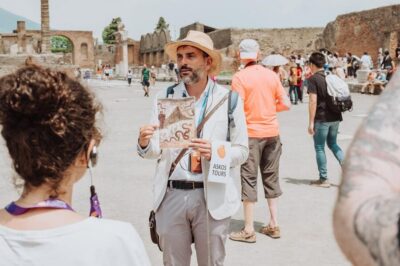
Entry Ticket and Guided Tour with an Archaeologist
Read our review →
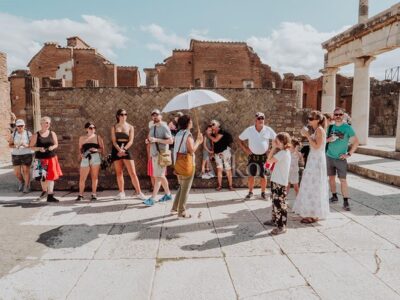

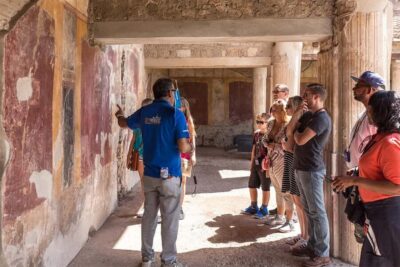

Pompeii Small Group Tour with an Archaeologist
Read our review →
Pompeii, Amalfi Coast and Positano Day Trip from Rome
Read our review →Browse the lists this tour appears in