

Reviewed · POMPEII & VESUVIUS TOURS
Pompeii: Skip-the-Line Entry & Audioguide
Pompeii hits you like a time machine. With skip-the-line entry, you start exploring quickly instead of losing your morning to queues, and the audioguide lets you move room to room without rushing. I also like that you get a paper city map to help you build a mental picture fast.
I’m drawn to how practical this setup is for Pompeii’s big layout. You focus first on the central forum, then you can follow the city flow through aqueduct and fountain areas, Roman homes, and major public spaces at your own speed.
One drawback to plan around: some operators ask for a passport deposit to collect the audio equipment, and that can feel uncomfortable if you do not like leaving documents behind.
In This Review
- Key Things to Know Before You Go
- Pompeii Skip-the-Line With an Audioguide, the Fast Way to Make It Make Sense
- Price and Value: What $53 Buys at Pompeii
- Finding the Meeting Point Near Chalet Donna Lucia
- What Your Self-Guided Route Actually Covers
- The Central Forum, Where Pompeii’s Public Life Came Together
- Streets, Aqueduct Remains, and Fountains That Explain Daily Comfort
- Public Baths, Private Homes, and Businesses
- Amphitheater and Theater, Built for Spectators
- Frescoes and Color, When the Past Still Looks Alive
- How the Audioguide Helps You Read Pompeii
- Skip-the-Line Entry: Worth It, or Just Marketing?
- Rules, Limits, and What You Must Bring
- Practical Tips So 2 Hours Feels Like More
- Who This Experience Fits Best
- Should You Book This Pompeii Skip-the-Line Entry With Audioguide?
- FAQ
- How long does the Pompeii skip-the-line and audioguide experience take?
- Where do I meet for this Pompeii activity?
- What’s included with the ticket?
- Is Villa dei Misteri included?
- Do I need to bring ID?
- Are there restrictions on what I can bring?
Key Things to Know Before You Go
- Skip-the-line entry helps you start sooner, though you should still expect crowds inside
- Audioguide in many languages (including English) means you control the pace and repeat what matters
- Forum first orientation makes the rest of Pompeii easier to understand as you walk
- Real daily-life stops like baths, fountains, aqueduct remnants, homes, and businesses keep it grounded
- Major venues like the amphitheater and theater add scale to the ruins
- Villa dei Misteri is excluded, so plan your expectations around the main park route
Pompeii Skip-the-Line With an Audioguide, the Fast Way to Make It Make Sense
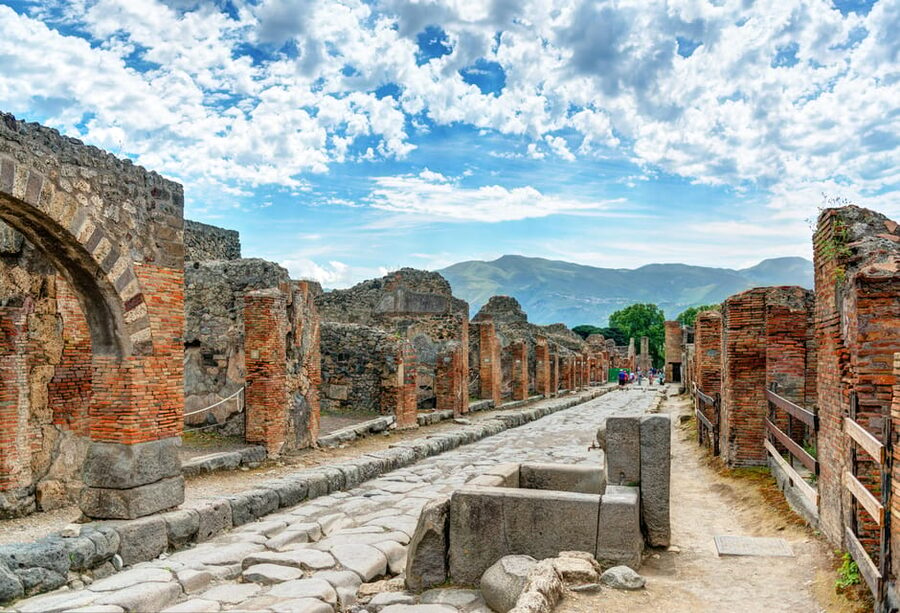
Pompeii is not small. Even when you are only seeing the main highlights, you’re covering long streets, wide plazas, and buildings that feel spread out by design. The best part of this experience is that it is built for “walk and listen,” not “walk and guess.”
With skip-the-line entry, you reduce the most annoying friction in your day. Once you’re inside, the audioguide gives you a guided structure, so you spend your energy looking at the ruins instead of trying to decode them alone.
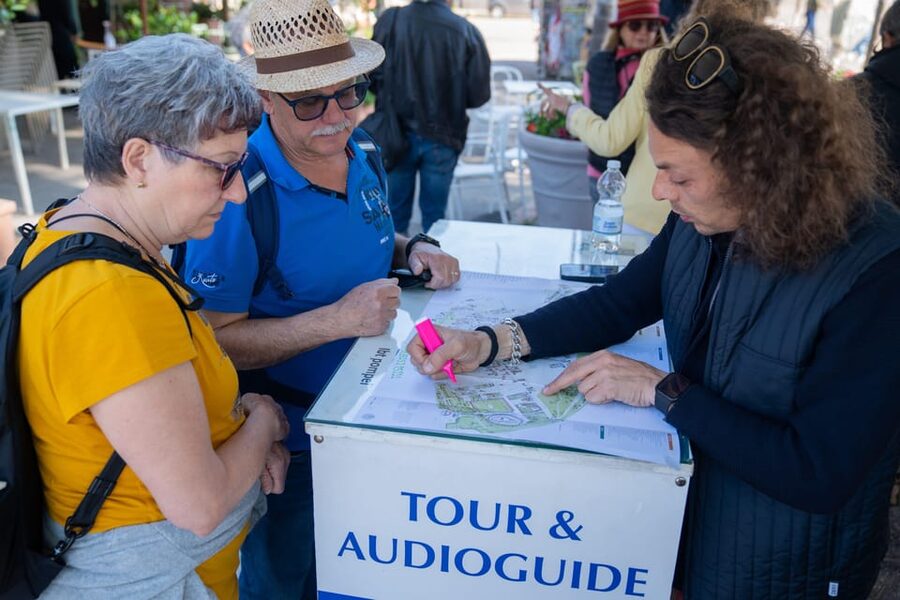
You also get a paper map, which sounds basic until you’re standing at a junction and trying to figure out where the forum sits relative to the baths or amphitheater. That quick visual helps you stay calm and keep moving.
More of Pompeii and the volcano that buried it:



Price and Value: What $53 Buys at Pompeii
At around $53 per person, this option is aiming at the sweet spot: you’re paying for the convenience layer (skip-the-line) plus interpretation (audioguide and map), not for an all-day sit-down tour. For many first-timers, that is exactly what you want at Pompeii, because the park rewards attention and pacing.
That said, the reviews you’ll find online include a strong reminder to double-check what’s included before you buy. Some people feel they paid far more than the going rate on-site, especially when they expected the audioguide to be included in a lower-cost ticket. So when you compare options, compare apples to apples: ticket, audioguide, and any extras.
Also note what is not included. Villa dei Misteri entrance is excluded, and drink and food are not part of the package. If you want that villa, you may need a separate ticket, and you should plan on buying water and snacks outside the inclusions.
Finding the Meeting Point Near Chalet Donna Lucia
To start smoothly, you need to find the IBT Center/Touristation next to Chalet Donna Lucia. This is the kind of detail that matters in Pompeii because the city can be confusing on foot, and you do not want to arrive late after you’ve already reserved a timed or organized entry.
Bring your ID. The info here is clear that ID is required for all participants, and it’s also listed that you should bring your passport or ID card. Many visitors forget this step in the “just show your email” era, but Pompeii logistics can be strict about document checks.
If you are doing this during a busy season, give yourself buffer time. One common frustration with organized tours is not the ruin itself, but standing around wondering where the group starts. You can avoid that by getting there early, not right on time.
What Your Self-Guided Route Actually Covers
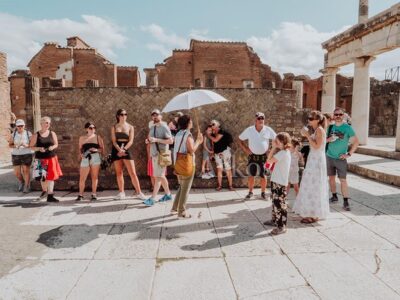
You’re exploring the Pompeii Archaeological Park, a city destroyed by the eruption of Vesuvius in 79 AD. The best way to enjoy it is to treat the ruins like a set of neighborhoods. The audioguide and map are designed to keep you oriented so the site feels like a place, not just scattered stone.
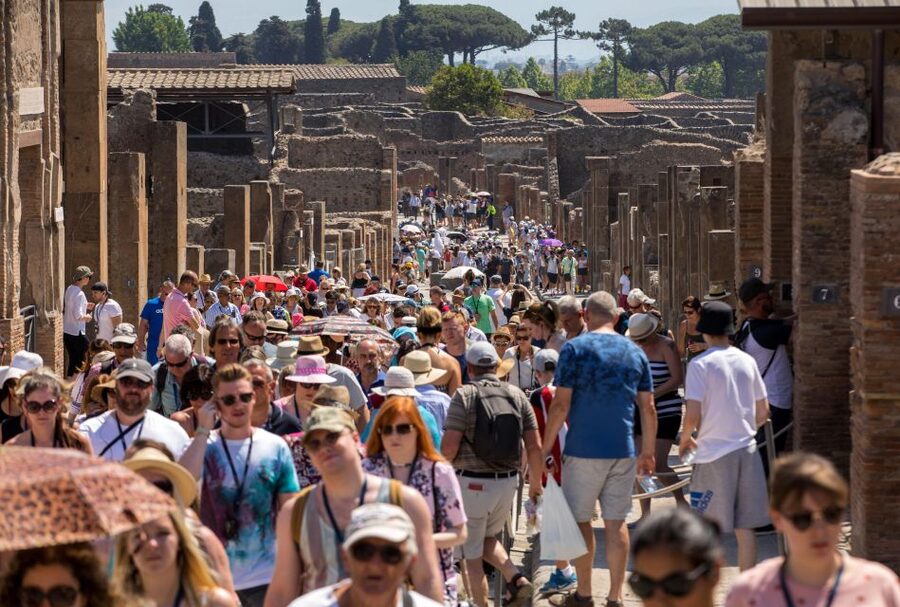
Your route has a clear rhythm: start with the central forum, then continue through surrounding streets and key public and private spaces. Expect a lot of walking, uneven ground in places, and frequent stops where you will want to slow down because the buildings still show recognizable doorways, columns, and room layouts.
Introductions we still owe you around Pompei Campania
- Naples: Pompeii and Mt. Vesuvius with Lunch and Wine Tasting
★ 4.5 · 2,454 reviews - Pompeii: Skip-the-line-Ticket and Guided Tour
★ 4.6 · 1,152 reviews - Pompeii: Small-Group Tour of Pompeii and Herculaneum
★ 4.8 · 867 reviews - Pompeii: Guided Tour with Skip-the-Line Entry
★ 4.9 · 812 reviews
The Central Forum, Where Pompeii’s Public Life Came Together
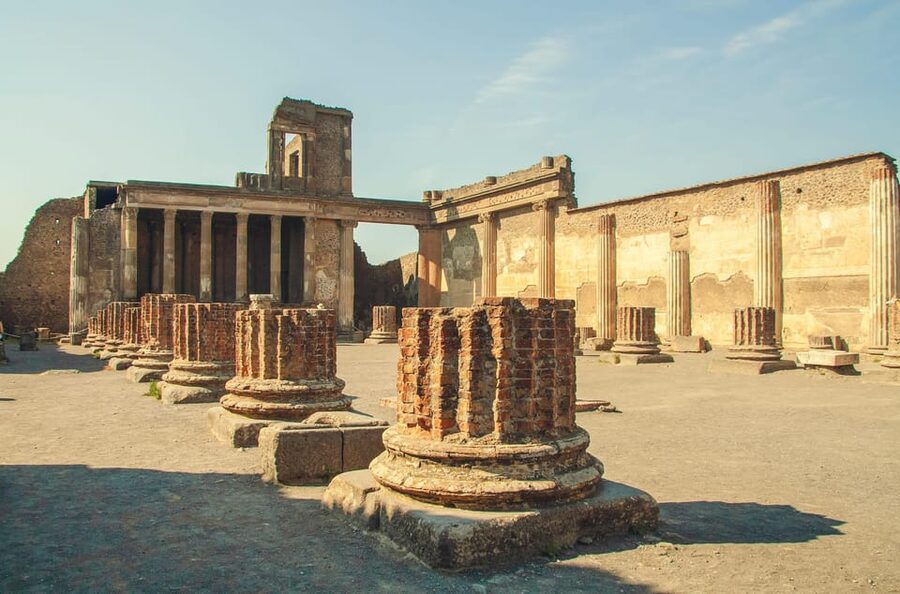
The experience begins with the central forum, the hub you would have crossed on regular business and public moments. This is where your imagination has the easiest job, because the setting already communicates power and routine, even in ruins.
Look at how the forum’s open space contrasts with the surrounding structures. Then, keep an eye on Mount Vesuvius in the background. That view is not just scenery. It’s a constant reminder of the disaster that froze daily life in place.
Streets, Aqueduct Remains, and Fountains That Explain Daily Comfort
Next you wander through the streets and see remains of aqueducts and fountains. This is one of the most helpful ways to understand Pompeii. Water systems tell you what kind of city it was, and how daily life worked at a practical level.
Fountains are also where you might notice how public space and maintenance show up in the design. Even when parts are broken, you still get a sense of where people would have gathered, filled containers, or moved water to neighborhoods.
Public Baths, Private Homes, and Businesses
Pompeii’s ruins are famous for homes with room layouts that still feel legible. In your walk, you should expect to pass public baths, private houses, and business areas, plus statues and other recognizable features.
This is where the audioguide earns its keep. The difference between “pretty ruins” and “I understand what I’m seeing” is often one explanation about function. Baths, for example, help you picture routines of hygiene and social time. Houses and shops help you see how wealth and trade lived side by side.
Amphitheater and Theater, Built for Spectators
You should also make time for the amphitheater and the dramatic theater. These are the moments when Pompeii feels big, because crowds are part of the original story, not an invention of modern imagination.
When you stand in these spaces, think about sound and movement. Even without the original roar, the shape of the venue helps you understand why performances mattered so much.
Frescoes and Color, When the Past Still Looks Alive
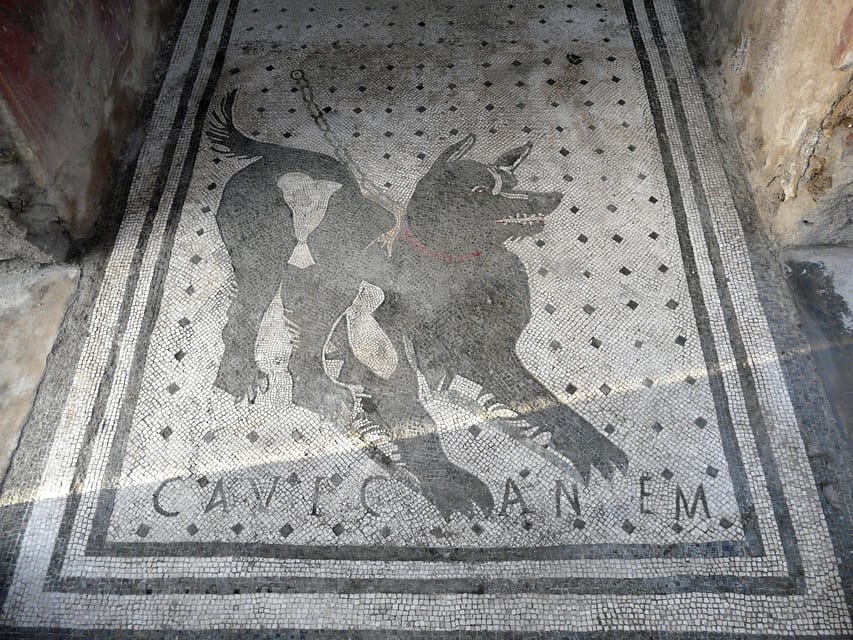
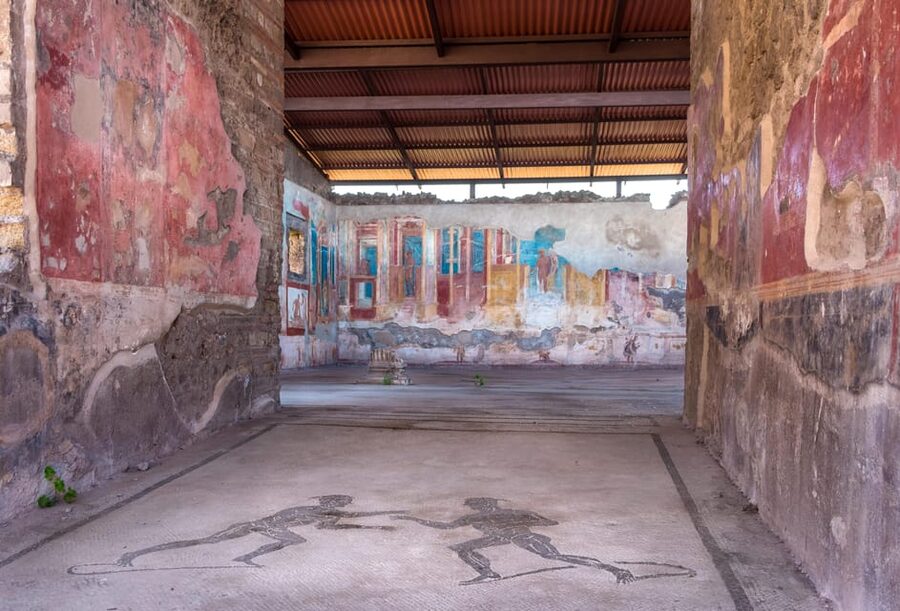
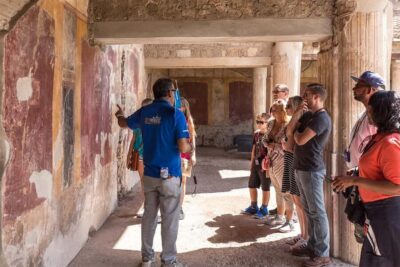
One of the more striking details you’ll encounter is the presence of colorful frescoes in houses and businesses, along with remains that show decorative choices. These fragments make it clear that Pompeii was not all plain stone.
Your best move here is to slow down. Frescoes can be tempting to photograph and move on from, but it’s worth letting the audioguide guide your eyes, so you’re not just capturing images, but also noticing what’s left and why.
How the Audioguide Helps You Read Pompeii
The audioguide is included, and it comes in a long list of languages: Italian, English, French, Spanish, German, Portuguese, Chinese, and Japanese. If you want to understand Pompeii without hiring a full guided tour, this feature is the backbone of the experience.
The way I recommend using an audioguide here is simple: do not let it run nonstop. Use it like a smart friend who explains what you are about to see. When you reach a major stop, press play and listen. When you turn a corner, pause and visually confirm what you just learned.
If you choose the guided tour option, you may get an introductory talk before going self-guided. One review specifically noted that an introduction from Daniel was good. That kind of setup can make your first 30 to 40 minutes feel less chaotic.
Skip-the-Line Entry: Worth It, or Just Marketing?
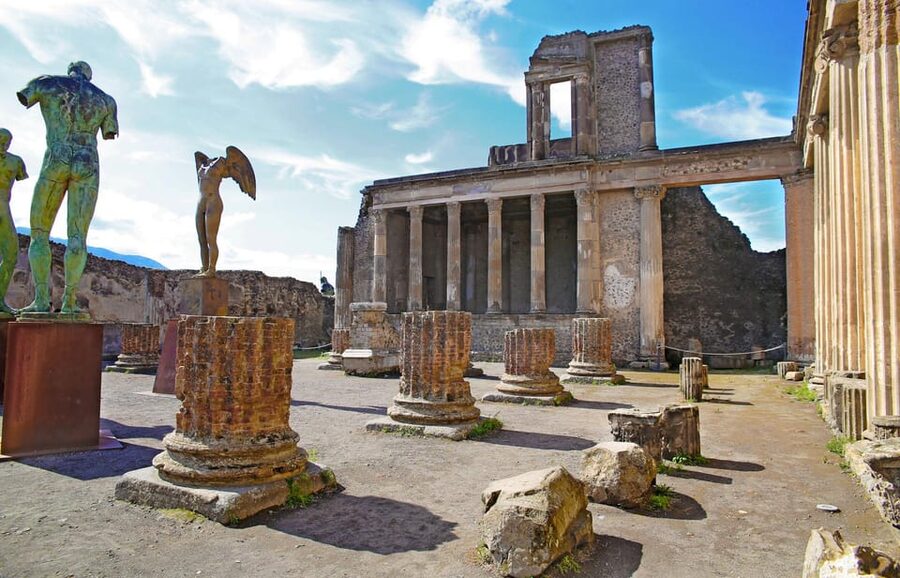
The biggest promise is that you avoid long queues and begin exploring right away. In a site as popular as Pompeii, skipping the worst line can save time and reduce stress.
Still, it’s smart to have expectations. Some visitors have found that the practical difference between “skip-the-line” and buying a ticket on the spot can be smaller than advertised, especially when lines are not wildly different at the moment you arrive. That does not mean the experience fails, it just means your timing matters.
If you care most about minimizing waiting, aim for an earlier start time if your schedule allows. If your goal is to maximize sightseeing, arriving earlier also helps you see more with less crowd pressure inside the park.
Rules, Limits, and What You Must Bring
This is a well-run archaeological site, and a few rules shape your day.
You should bring passport or an ID card, and you should be ready for document checks because ID is required for all participants. You should not bring pets, and no smoking is allowed. Large bags and luggage are not permitted, and alcohol and drugs are also not allowed.
There is a helpful note for small-dog owners: small dogs are permitted inside the archaeological area, but they must be kept on a leash and carried when inside buildings. If you’re traveling with a pet, plan your bag-free day so you can comply without stress.
Also, keep in mind that the package does not include food or drinks. Pompeii can wear you out fast with sun and walking. Plan to buy water and a snack rather than relying on tour stops.
Practical Tips So 2 Hours Feels Like More
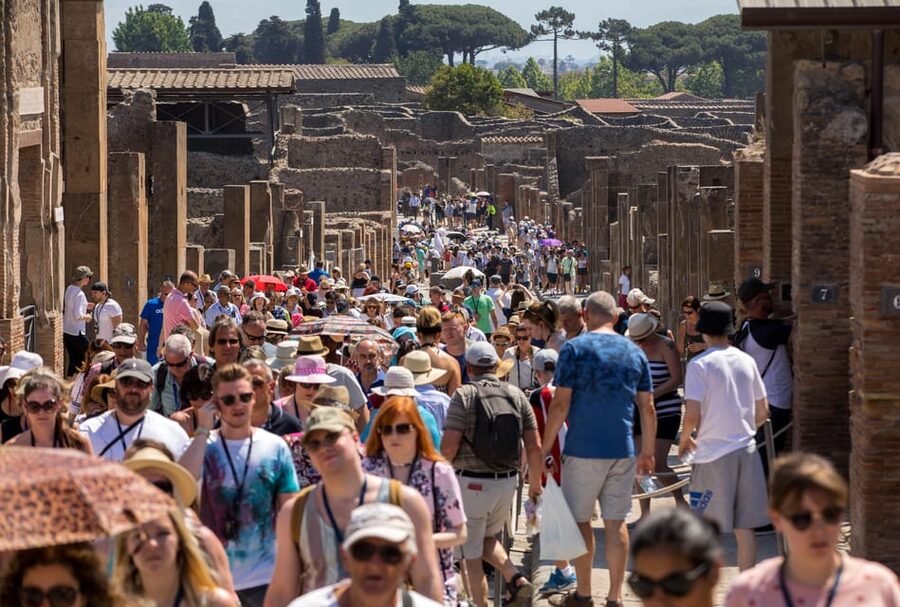
The experience lists duration from 2 hours up to 1 day, depending on available starting times. Even if you choose the shorter window, you can get a satisfying overview if you walk with a plan.
Here’s how I’d do it:
- Start at the forum and let the audioguide orient you.
- Pick two “big” venues, either amphitheater or theater, plus one neighborhood section of homes or businesses.
- Save extra time for fresco areas, because that’s often where comprehension clicks.
Wear supportive shoes. Pompeii has uneven surfaces, and you’ll be standing still to look at details as often as you’re walking. Bring sunglasses and sun protection too, because a lot of the most interesting sights are outdoors.
If you are using a phone for maps or photos, bring a charged battery. Even with a paper map, your phone helps for quick orientation when you pause for longer looks.
Who This Experience Fits Best
This is a strong fit if you want independent exploration with built-in explanation. You get skip-the-line convenience, but you’re not trapped in a group pace.
It also works well if you:
- Prefer to stop and reread explanations when something sparks curiosity
- Want a smooth first visit without booking a full private guide
- Travel in a multi-language group and still want the same audioguide structure
If you want a deep historical lecture, constant Q and A, or a dedicated focus on a specific site like Villa dei Misteri, you may need additional options beyond this package.
Should You Book This Pompeii Skip-the-Line Entry With Audioguide?
I’d book this if your priorities are simple and practical: get in quickly, understand what you’re seeing, and walk at your own speed. The combination of skip-the-line entry, audioguide, and a paper map is a good value mix for Pompeii’s layout.
Before you purchase, do two quick checks. First, confirm that audioguide access is truly included in your selected option, since online comparisons can be messy. Second, arrive early enough to handle the IBT Center/Touristation meeting point confidently, because confusion costs more time than any line.
If you hate the idea of leaving your passport behind, consider that some setups have required a deposit for audio equipment, and plan accordingly. If that would make you uncomfortable, look for an alternative that does not involve document holds.
In most cases, though, this is the kind of Pompeii entry that keeps the day fun and readable, so the ruins feel like a city you can actually picture.
FAQ
How long does the Pompeii skip-the-line and audioguide experience take?
It’s listed as 2 hours to 1 day, depending on the starting time availability. You can expect a walk that lets you explore at your own pace within that window.
Where do I meet for this Pompeii activity?
The meeting point is the IBT Center/Touristation next to Chalet Donna Lucia.
What’s included with the ticket?
Included items are skip-the-line entry to Pompeii Archaeological Park, an audioguide, and a paper city map. A guided tour is included only if that option is selected.
Is Villa dei Misteri included?
No. Entrance to Villa dei Misteri is not included.
Do I need to bring ID?
Yes. Passport or ID card is required, and ID is required for all participants.
Are there restrictions on what I can bring?
Yes. You should not bring luggage or large bags, and pets are not allowed (small dogs are allowed with a leash and carried when inside buildings). Smoking and alcohol and drugs are also not allowed.
Just introduced: the newest Pompei Campania write-ups
- Pompeii: Day Tour of Pompeii and Vesuvius with Bus Transfer★ 4.2 · 250 reviews
- From Naples/Salerno: Pompeii, Sorrento, and Positano Tour★ 4.5 · 250 reviews
- Discover Pompeii: French Walking Tour of the Buried City★ 4.8 · 253 reviews
- Pompeii: Tour with Archaeologist Guide & Skip-the-Line Entry★ 4.5 · 478 reviews
- Pompeii: Afternoon to Sunset Guided Tour with Ticket★ 4.9 · 484 reviews
- Pompeii 3hours Villa of Mysteries tour with an Archaeologist★ 4.8 · 486 reviews
- From Pompeii: Bus Transfer to Vesuvius with Park Entry Fee★ 4.2 · 700 reviews
Pompeii & Vesuvius Tours, compared.

Entry Ticket and Guided Tour with an Archaeologist
Read our review →


Pompeii Small Group Tour with an Archaeologist
Read our review →
Pompeii, Amalfi Coast and Positano Day Trip from Rome
Read our review →Browse the lists this tour appears in